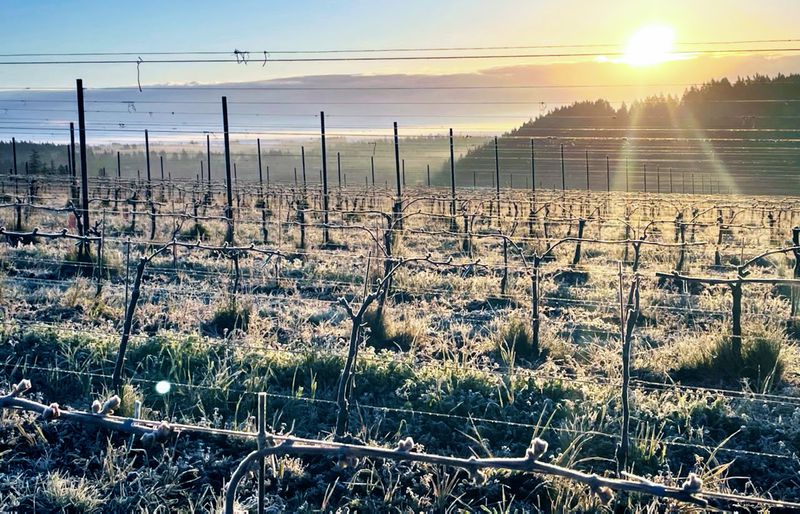
Frost can be beautiful and exhilarating. It can also be destructive when it arrives in a vineyard at the wrong time of year. After heavy frosts recently hit agricultural areas up and down the West Coast, the Willamette Valley wine industry waits to learn how much wine they will be making this fall.
Last week, a story published by The Oregonian/OregonLive broke the news that early breaking grapevine buds in numerous Willamette Valley vineyards were damaged by a sustained spring frost. Dai Crisp, the co-owner of Lumos Wine Co. in Philomath, described the period from late Thursday, April 14, into the following day’s pre-dawn hours as “particularly wicked.” Stirling Fox, a veteran vineyard manager and winery owner, predicted the frost damage threatened to cut the Willamette Valley’s annual grape crop in half.
Adam Campbell of Elk Cove Vineyards was one of the first in the industry to publicly challenge the accuracy of such dire predictions. “People need to know that some vineyards were hit by frost while others weren’t touched at all. If you look at the whole Willamette Valley, it’s not as dramatic as all the phone calls I’ve been getting asking if we’re making wine this year,” Campbell said.
Campbell estimates frost damage will lower his overall crop yields by 5-10%. When asked what he thought the Willamette Valley as a whole faces, Campbell said that while it is too early to tell, he is more comfortable with a crop loss estimate of 20-25%.
Jessica Cortell offers a different perspective. Cortell is the founder of Vitis Terra Vineyard Services, an Amity-based company that manages 700 acres of local vineyards. “Overall, it doesn’t look good out there,” Cortell said.
After her most recent survey, Cortell said that she saw the least damage in the Eola Hills and significant damage in parts of the Chehalem Mountains American Viticultural Area. Based on her observations, Cortell said, “I think that Stirling’s 50% number will be pretty close to what actually happens.”
J. Christopher’s Appassionata estate vineyard is one location in the Chehalem Mountains that suffered significant damage. Winemaker Timothy Malone described it as “catastrophic,” reporting that he believes the Appassionata vines lost 100% of their primary and 50% of their secondary buds.
Secondary buds are the grapevine’s emergency backup plan, but they are less fruitful than primary buds. Researchers at Cornell University in Ithaca, New York, suggest “a common rule of thumb is that secondary buds will produce about 30% of the crop that primaries are capable of producing.”
The Willamette Valley Wineries Association (WVWA) is eager to focus consumer attention on the quantity issue, arguing fruit quality will not be impacted by the recent frost. “Yes, quantity will be affected. At this stage, however, it’s hard to determine the exact extent of how the frost affected the region. We want to make sure people do not dismiss this vintage as lost both from a qualitative and a quantitative standpoint,” Morgen McLaughlin, WVWA executive director, said in an email.
In a set of frost talking points sent on April 19, the WVWA advised its members that “At this moment, we as a region are at a critical juncture. Overly broad statements from individual wineries can add to the confusion. Regardless of their intention, these comments may have lasting negative impacts on our region’s 2022 vintage and tourism. Messaging matters more than ever.”
Kim Bellingar of Bellingar Estates in Newberg is a WVWA executive board member who also sits on the organization’s board of directors. Bellingar said the organization’s message reflects previous experiences with weather- and wildfire-impacted vintages. “We have had moments in our history where discussions of the quality of the vintage, often before wines are in the bottle, completely changed the way people think about the Willamette Valley. Nothing has happened so far that indicates frost will impact the fruit’s quality and the wines made,” Bellingar said.
The frosting of the valley raises important questions about climate change, the challenges involved with managing secondary crops and the impact lower yields will have on everything from vineyard labor to the state of Oregon’s economy.
In the meantime, Jim Prosser, the owner of J.K. Carriere Wines in Newberg, offers his perspective. “Before each vintage, we have our Pollyanna glasses on, thinking this will be the best vintage ever. Do we have a smudge on our glasses right now? Yes, but you wipe it off and keep going. We take it as it comes. That’s what farmers do,” Prosser said.
Source - https://www.oregonlive.com