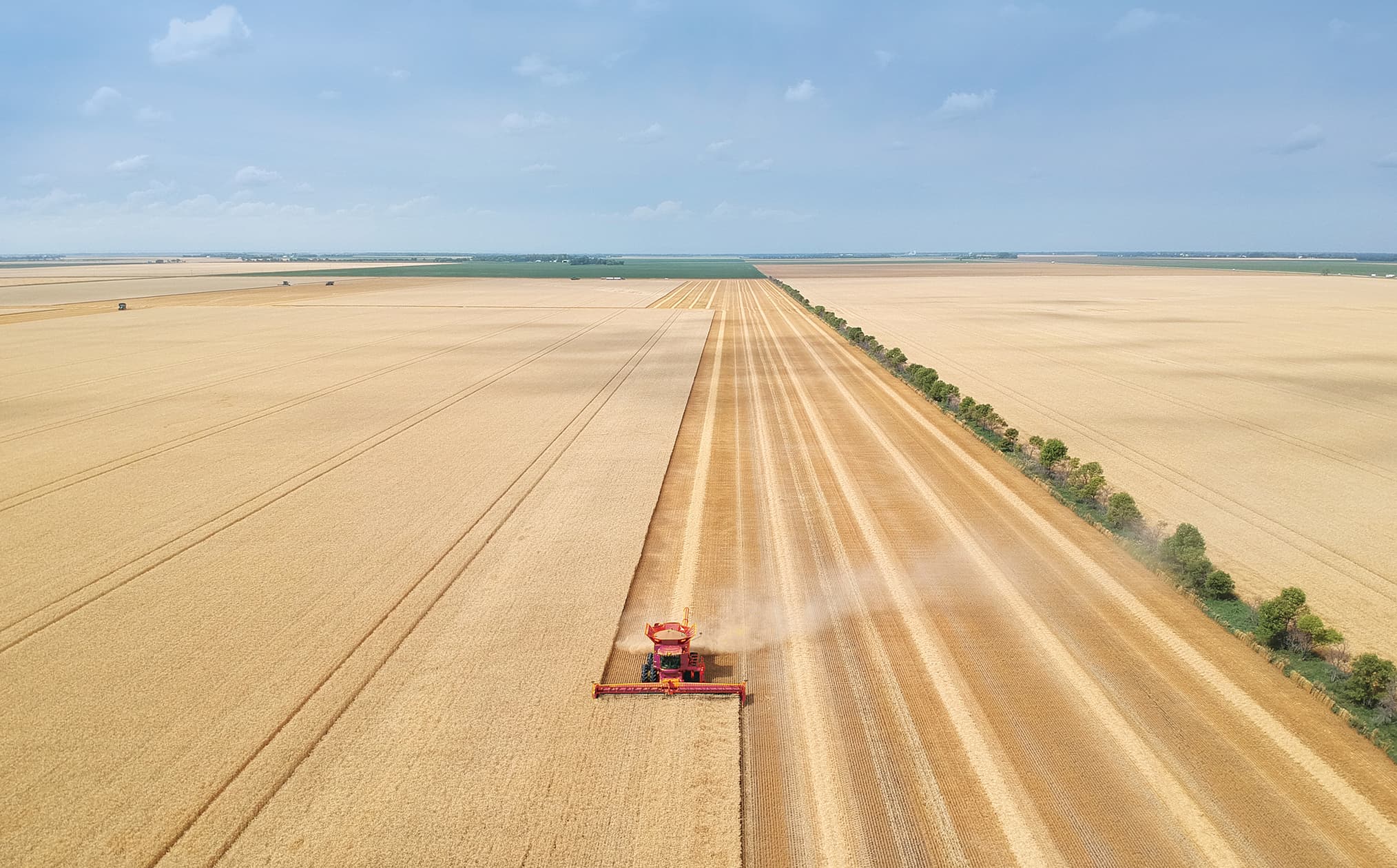
An invasion. A war. A pandemic. A financial crisis. All have conspired to put unprecedented stress on global food systems. Ukraine and Russia produce a combined total of 14% of the world’s wheat and 30% of the world’s wheat exports, as well as 60% of the world’s sunflower oil. These supplies are under threat, with Russia suspending food and fertilizer exports, and Ukraine’s farmers under extreme stress, fighting an invading army while tending to this year’s crop.
And Russia is not alone in limiting its exports. According to Rob Vos at the International Food Policy Research Institute, based in Washington DC, by 12 April, a total of 16 countries had banned or restricted food exports. This marked reduction in supply is fuelling inflation. Taken together, the impacts could be catastrophic for some of the world’s poorest and most vulnerable people. At least 26 countries, including Somalia, Senegal and Egypt, rely on one or both of Russia and Ukraine for between 50% and 100% of their wheat. If the war continues, many countries already saddled with pandemic debt could be forced to borrow more to subsidize staple foods, creating more hardship.
Clearly, action must be taken now. Priorities must include preventing and rolling back export bans, and funding the World Food Programme’s emergency-relief efforts. The agency said last month that, because of inflation, it needs to find an extra US$60 million to $75 million a month.
Schools of thought
The diagnosis might be clear, but there’s less consensus on what needs to be done in the medium-to-long term to increase nations’ resilience to the hunger that follows pandemics, wars and extreme weather. Food-systems science is complex, with many perspectives, and there are gaps in the research. There is also no intergovernmental mechanism through which governments, having been informed by research advice, are bound to act on food systems.
According to one school of thought, every policy lever must be applied to reduce countries’ dependence on food imports — even if that means choosing options that might not be the most environmentally sound. It could mean, for example, felling forests so that more cereal and oil crops can be grown closer to home markets.
A second school of thought argues that the crisis presents a chance to speed up moves towards a more environmentally conscious future. Intensive agriculture is the leading cause of biodiversity loss and, globally, farming contributes 30% of all greenhouse-gas emissions. At least four policies could minimize these impacts, while at the same time securing food supplies, say proponents.
First, around one-third of global croplands produce animal feed, according to the World Resources Institute, an environmental think tank based in Washington DC. Humans could meet their energy needs using a lot less land if they ate fewer animal products. Second, one-third of all food produced globally never reaches the plate — it is lost in the production chain or wasted once it reaches households. Improvements in harvesting and storage methods could potentially reduce losses, as might efforts to nudge consumers to make more responsible choices.
Third, most land under cultivation is occupied by a small number of food crops, such as wheat, rice, maize (corn), soya and potatoes. This contributes to biodiversity loss. Diversifying agriculture to include more legumes, nuts and vegetables would benefit both the planet and people, because these crops provide important nutrients.
Finally, croplands that are currently being used to grow biofuels could be converted back to growing food crops. In the United States, some 40% of maize is used to make ethanol. Research shows that biofuels grown on croplands are not as useful in climate mitigation as once thought1.
The research challenge
Each of these measures will have associated costs, and the trade-offs must be assessed, which is why research is crucial. Some areas of this research are patchy. An analysis of published agricultural science (a project called Ceres2030) found that less than 5% was relevant to the needs of smallholder farmers. Moreover, the major funders of agricultural research overwhelmingly finance research into the staple cereal crops. Esther Turnhout, chair of science, technology and society at the University of Twente in the Netherlands, says: “Something is going wrong here in how we understand food systems, and part of the problem lies in how we do research into food systems.”
At a key United Nations summit last year, delegates discussed the idea of establishing a body akin to the Intergovernmental Panel on Climate Change (IPCC) for food systems. It would respond to questions from policymakers and produce advice based on a synthesis of the available evidence. Its reports would also remind funders of gaps in the science that need addressing.
But the idea has its detractors, who rightly point out that the food-systems field does not lack high-level panels of scientists producing research evidence. At least 11 such panels3 have a remit that covers this; these include the high-level panel of experts of the Committee on World Food Security, which provides ongoing science advice to the UN system.
What food systems lacks is an intergovernmental mechanism by which policymakers are given independent assessments of the literature and commit to acting on these findings, in the way that the IPCC’s reports inform the work of governments meeting at UN climate conventions.
The feasibility of the IPCC-style panel for food systems is being researched by an expert group reporting to the European Commission in Brussels. Its recommendations, due to be published this summer, are expected to confirm that existing organizations are not delivering what is needed. But the solution, says one group member, environmental scientist Jacqueline McGlade, is not necessarily a new IPCC-style body. Instead, the group is expected to recommend a greater effort to gather knowledge and evidence from under-represented groups. In addition, a UN ‘clearing house’ could extract what governments need from existing science-advice panels and embed these recommendations in global commitments such as those on climate change, biodiversity and the UN Sustainable Development Goals.
Whether the expert group persuades enough people and organizations to come together to improve the breadth and clout of food-systems science advice remains to be seen. But the analysis and soul-searching along the way will be productive. The latest crisis should be seen as the moment when the world came together to renovate the food system and the research agenda behind it. As Sheryl Hendriks, a food-policy researcher at the University of Pretoria, says: “The geopolitics are more clear than we’ve ever, ever imagined.”
Source - https://www.nature.com