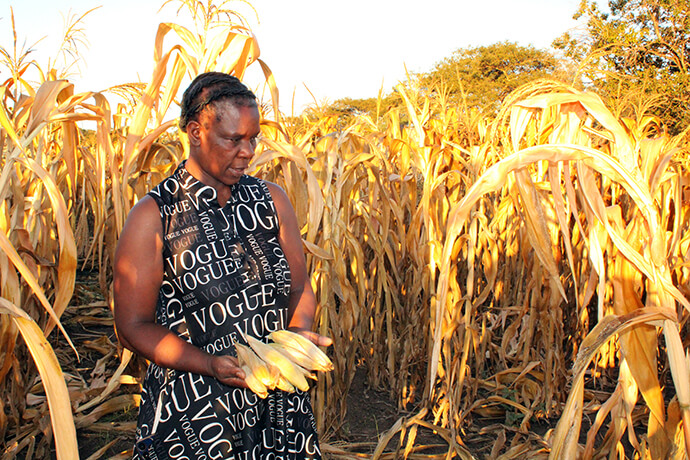
El Niño-induced drought has left millions facing hunger and starvation in Zimbabwe.
In April, the President of the Republic of Zimbabwe, Emmerson Mnangagwa, declared the drought a national disaster and revealed that the country needs about $2 billion to avert starvation.
The United Methodist Church’s efforts to boost food security in the region also suffered a huge blow with church mission farms seeing major crop losses.
The United Methodist Board of Global Ministries, through the Yambasu Agriculture Initiative, supports maize production at four United Methodist mission farms: 62 acres at Nyadire, 25 at Mutambara, 69 at Old Mutare and 12 at Hanwa.
The Rev. Lancelot Mukundu, Nyadire mission station chair, said the church’s efforts to transform the farms into green belts were shattered by El Niño-induced drought. El Niño is a climate pattern that refers to the warming of waters in the Pacific Ocean, which affects regional and global weather.
“It was heartrending to see the crops being water-stressed daily until they were a write-off,” he said. “All efforts and resources were lost. There is no harvest, not even a kilogram of maize grain can be salvaged.”
Mukundu said Nyadire should not be suffering from the effects of droughts because it has water rights for the Nyadire and Nyaitenga rivers, which are a stone’s throw away from the mission.
“If they were to harness the use of these vast waters by any means, they could become the breadbasket of the area,” he said. “The available water has the potential to support surrounding areas rather than relying on dry-land, rain-fed agriculture.
“If those 25 hectares (62 acres) were under irrigation,” Mukundu noted, “we could have managed to harvest enough to feed the seven units at Nyadire Mission, our sister schools and the community and, with time, we could be self-sustaining.”
Roland Fernandes, chief executive of Global Ministries and the founder of the Yambasu Agriculture Initiative, said “the devastating effects of this drought underscore the urgent need for sustainable agricultural solutions that can withstand climate shocks.
“Investing in resilient irrigation systems and climate-smart farming practices will enhance both food security and livelihoods,” he said.
Last year, Mukundu said, Nyadire Mission achieved a bumper harvest and even sold part of it to its sister boarding schools: Dendera, Nyamuzuwe, Murehwa and Nyadire Teachers College.
“But now these will outsource the maize grain, and the learners will bear the cost. Without irrigation, we are going to have a chronic challenge in our harvests,” he said.
Esnath Arichara, Nyadire farm manager, agreed that irrigation is key to the farm’s success.
“My heart breaks thinking that we could have avoided all these losses,” she said, calling this season’s maize crop a total loss.
“The perennial Nyadire River is less than 500 meters away, and if we had irrigation systems to provide supplementary irrigation to bridge the gap, a bumper harvest would be certain.”
Judith Matema, a teacher and hostel warden at Nyadire Central Primary School, practices backyard farming. “In good years,” she said, “I can harvest 200 kilograms (441 pounds) of maize grain, which will be more than enough for my family.
“However, this year, I will not harvest even 20 kilograms,” she said, noting that even if she does harvest that much, the quality of the mealie meal will not be good to prepare sadza, a thick porridge that is a staple in the region.
“I had also planted finger millet to mitigate the effects of climate change, but still the crop was affected. … I do not expect any harvest,” she said.
The Rev. Future Sibanda, Hanwa mission station chair, said farm workers planted five hectares (12 acres) of maize, but due to the drought, they anticipate harvesting just 10%.
Still, Sibanda said he is grateful to the Zimbabwe Volunteers in Mission for giving Hanwa $50,000 to establish a two-hectare greenhouse that will generate income year-round.
The effects of drought did not spare Old Mutare Mission.
The Rev. Tedious Mwadiwa, station chair, said the farm planted 28 hectares (69 acres) of maize, but the yield will be well below what was anticipated.
“If we had irrigation, we could have cushioned the worst effects of drought and achieved a bumper harvest.”
At Mutambara Mission, farmers continued to count their blessings as the mission’s 25-acre plot became a good example of the impact of an irrigation system.
Barnabas Gwatura, mission station chair, said he was impressed with this year’s crop.
“My crop did not suffer from water stress because we managed to bridge water unavailability with irrigation. My vision is to add value to our farm produce by selling the processed products. I envisaged having a factory here at Mutambara and selling packaged mealie meal. This will help us to be self-sustaining because partners’ funds do not live forever.”
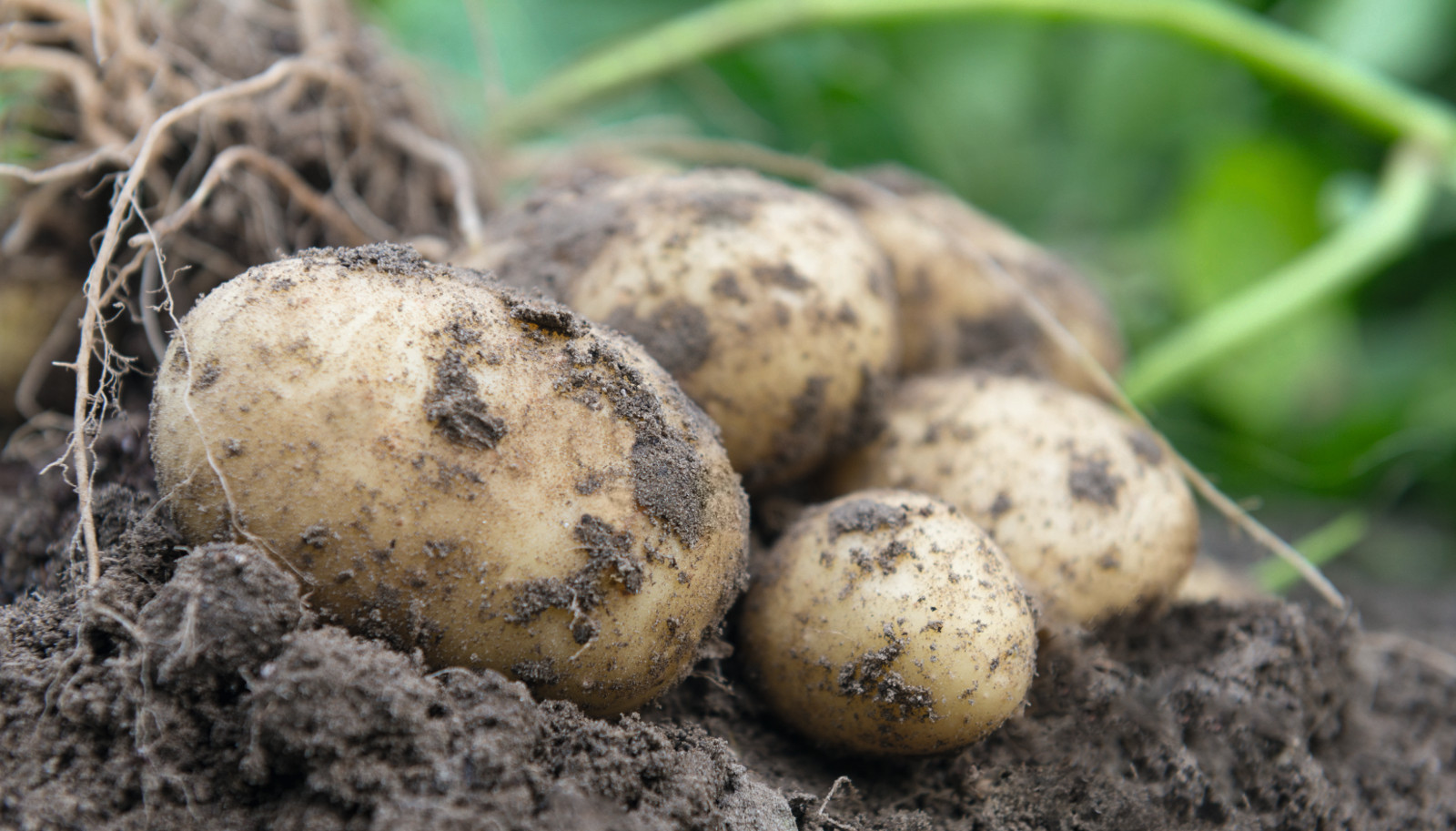
He said the mission also planted 250 kilograms (551 pounds) of green beans and one hectare (two acres) of potatoes.
“We always plant crops year-round, and this has helped us to boast church coffers,” he added.
“My wish is to expand the irrigation systems and drill boreholes so that we can irrigate a bigger area and become an example within the community.”
Mushaishi Madzakate, a farmworker at Mutambara Mission, said an irrigation system is the best solution to address the effects of El Niño.
“We get water from the perennial Umvumvumvu River through gravity to irrigate our crops. There is little cost in accessing this water.
“I am very happy with our harvest because we never labor in vain.”
Annie Sibanda, a former employee of Mutambara Mission, was counting her losses after El Niño destroyed her backyard crops.
“I am a vegetable vendor and a backyard crop farmer,” she explained, “but this year, the weather has been very harsh and destroyed every crop. In good years, I never buy a mealie meal, but this year we have already started buying.”
Famine also has a negative effect on church activities, said the Rev. Marian Sigauke, Chimanimani Chipinge District superintendent.
“The shortage of food has affected church activities drastically. Most people are focusing on having food on the table and are hopeless. Ninety percent of my circuits are rural, meaning they support the church through farm produce. If there is drought, their commitment is divided between the stomach and the church.
“It will be very difficult to preach about the goodness of the Lord to someone who is starving. They would ask where God is when they are starving. How are they going to survive to the next harvest?” she said.
Morgan Jeranyama, Yambasu Agriculture Initiative national project consultant in Zimbabwe, said the effects and impact of El Niño-induced droughts have been huge.
“It has forced us to rethink and refocus on how best to proceed. In the 2023-24 season, we had rain-fed maize crops, but the results were poor.
“If I am to rate the four farms — Mutambara, Old Mutare, Hanwa and Nyadire — Mutambara had a good crop because of irrigation, followed by Old Mutare. Old Mutare received more rains as compared to Hanwa and Nyadire. The last two were most hard hit, and the crops are a total write-off.”
Despite the losses, he said, there are bright spots, adding that he is thankful for the support by Zimbabwe Volunteer in Mission at Hanwa for supporting the construction of a greenhouse. “This will help learners to acquire knowledge and skills. Job creation will be an added advantage for the community.”
Jeranyama said there also is an effort at Nyadire to partner with financial institutions and secure center pivots for irrigation. “We aim to clear 100 hectares (247 acres), and this will help to sustain the project and a significant area will be put under irrigation,” he said.
“It is my hope that, with these efforts, our farms will become the breadbaskets in their areas and be self-sustaining in the near future.”
Source - https://www.umnews.org