NEWS
845
of 1225
News
09.09.2016

USA - Changes and Challenges Loom for 2018 Farm Bill

Agriculture organizations across the country are already turning their attention to the development of the 2018 farm bill. The American Farm Bureau Federation is putting together some early policy ideas in anticipation of testimony before the House and Senate Ag Committees as early as next spring. Mary Kay Thatcher, senior director of congressional relations with AFBF, said some changes need to be made in the 2018 farm bill compared to the 2014 bill. “Well, certainly we’ve heard from our cotton producers and our dairy folks, that they don’t think the new programs that were put into effect are working for them. Fairly low participation in both programs and most folks feeling again like they just don’t provide an adequate safety net.” The biggest challenge in writing a new farm bill is not enough money. “I think one of the biggest issues we’re going to face in the next farm bill is we’re going to have less money to write the farm bill than we had when we wrote the 2014, and obviously, prices are going to be much lower than they were then. So, you know, when it’s really a tough time and we need additional dollars, we’re going to have to find a way to do it with fewer instead of more.” The farm safety net in the next farm bill will be a hot topic of discussion. “We already know that there’s financial struggles in the country, prices are not good for most commodities, and even for the few that are, they’ve been in the tank mostly for the last year or so,” Thatcher explained. “We know that farm bills are always harder to write when you’re facing difficult times. We know that crop insurance will continue to be in the bullseye, primarily because it costs more than does a commodity program or the conservation program, but we’re going to have to work diligently to bring the conservation groups, the nutrition groups, and the farm groups together to hold a very strong farm bill.” She said there will be a push by some in Washington to split the nutrition title away from the farm bill, and the Farm Bureau says that simply can’t happen. “About 79 percent of the cost of the farm bill is the nutrition programs, but we know that especially in the House of Representatives that it’s largely urban, that if we split nutrition and farm programs apart, we simply don’t have the votes to pass an adequate farm bill with a good safety net. So, we need to have our members carry the message right now to their members of Congress, both House and Senate, we do not want to split.” And she said farmers need to let their senators and representatives know that times are tough in the agricultural economy. “We are having difficulties and farm programs are based on let’s provide assistance when prices and yields and revenues are low, and now is the perfect time to see that that’s indeed the confluence of events that are happening and we have to protect farmers with an adequate safety net.” Source - https://www.hoosieragtoday.com

08.09.2016

USA - Late freeze hit plums, peaches hard

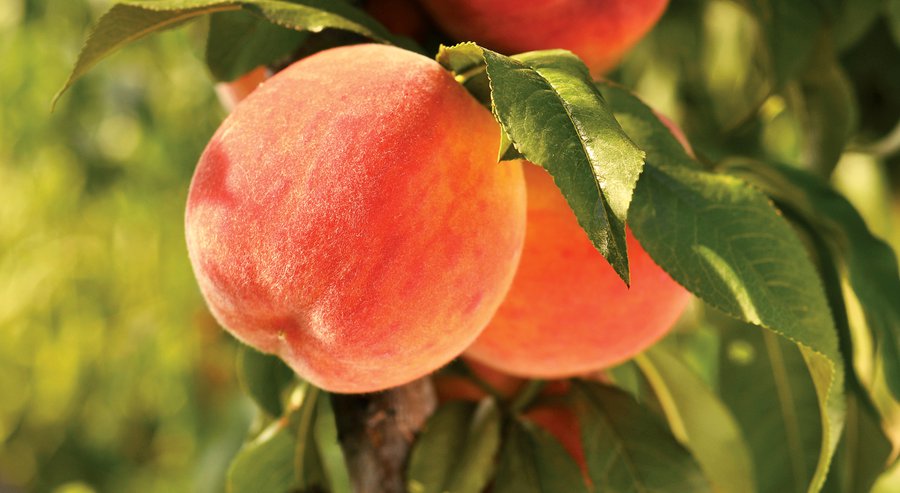
In a repeat performance from two years ago, Mother Nature has again deprived us of our locally-grown peaches and plums this summer. “We have no peaches or plums,” said Andrea Darrow, who owns Putney’s Green Mountain Orchards with her family. Although it was a mild winter, the late freeze brought two days in April of 12 to 13 degrees, and “that does a number on” the peaches and plums, Darrow said. Dummerston’s Scott Farm has no peaches this year, either, said Zeke Goodband, the farm’s fruit tree orchardist and orchard manager. “April was warmer, historically, and the trees broke dormancy early. Then we got the April cold and it damaged the plum blossoms,” Goodband said. “It’s the first time in 40 years there was no plum crop,” in the area, he added. “The peach buds were damaged by very cold temperatures earlier than that,” Goodband said. “It’s disappointing ... it’s wonderful fruit.” But this year, “it’s not happening,” he said. Jan Spanierman at Walker Farm in Dummerston said the farm stand got no local peaches or plums this year. “We don’t grow them,” Spanierman said, but buy them from local orchards. Not this year, though. And it’s not just Windham County that’s hurting. A statewide decline Steve Justis, executive director of the Vermont Tree Fruit Growers Association, said this year’s early warming and late freeze “did pretty much wipe out the stone fruit” in the state. In a recent Boston Globe article, UMass Extension commercial fruit tree specialist Jon Clements estimated a 99-percent drop from Massachusetts’s previous year’s harvest ["The year there were no peaches in August,” Food & Dining, August 3, 2016]. Pointing to the baskets of stone fruit from New Jersey and Pennsylvania, Spanierman said they were the most locally-grown Walker Farm could get. “Even Glastonbury, Connecticut, which is famous for their fruit, had none for us this year,” she said. With piles of stone fruit in supermarkets, why should anyone care whether locally-grown peaches and plums made it this year? “It provides summer cash flow,” said Goodband, whose orchard specializes in apples, which hit their seasonal and sales peak months later. Another reason the loss of local, late-summer fruits is a bummer: flavor. A side-by-side comparison between a locally grown peach and a store-bought peach immediately reveals differences in taste and texture. In a 2014 interview with The Commons, Read Miller of Dwight Miller Orchards in Dummerston explained why: “[Local] peaches are juicier than the ones you find in the grocery store. It’s not because we do anything special to our trees. It’s because our peaches are direct-to-customer, and are tree-ripened." “A tree-ripe peach is a peach that actually ripens on the tree,” Miller said, rather than getting picked before its time, which is the industry standard. Many prefer tree-ripened peaches because they believe such fruit offer the best flavor, texture, and juiciness. Blueberries are great, apples are good “Blueberries are very good this year!” Darrow said, explaining that this crop ripens later and “was more dormant during the freeze." Darrow’s farm’s apple crop is mixed this year. Because of the late freeze, “in some spots there are no apples,” she said. “We checked in with Cornell [University]” about the freeze, “and at that stage of development you can expect up to 90 percent loss” in affected areas, she said. “Down at the bottom of the hills, the tops of the trees are okay, but at the bottom, “few of the fruits survived, Darrow said, explaining inversion — “the cold draws down” — negatively affected trees at lower elevations as well as the bottoms of trees in higher areas. “We had a 30-to-40-percent loss in apples,” Darrow said, but optimistically noted her orchard has 125 acres, “so it might not be so bad." Darrow said she initially thought an early variety of apple, the Zestar, suffered more damage, but it turned out to be fine. “Other earlies look good: Paula Red, Ginger Gold. The Macs are good in some places. Macouns uphill are OK, but it depends on how high up they were,” Darrow said. “We should have an average size crop compared with last year’s bumper crop, so growers are pretty happy,” Justis said. “So far, knock wood, hail damage has been minimal in Vermont, unlike the New York side of Lake Champlain,” and, “the recent rains have been very helpful in getting the apples to size up." “Other than it being dry, things look pretty good” for apples, Goodband said, noting his workers began picking the first crop — “an old Russian variety” — at the end of July. Gravensteins are next, he said, and “those are the first great eating apple” of the season. “It’s not a bumper crop, but it’s a decent crop,” Goodband said of his apples this year. “We got more than we thought [we would] in the orchards. “There’ll be plenty of apples for everyone,” he said. Источник - http://www.commonsnews.org

08.09.2016

USA - Adaptations to climate change impact long term crop yields

As the globe continues to spin toward a future with higher temperatures, crop yields will likely decrease if farmers do not adapt to new management or technology practices. Establishing new strategies is particularly difficult for sorghum farmers in West Africa where seed varieties and fertilizer are scarce, while drought and unpredictable rainfall are prevalent. Using more heat-resistant sorghum varieties may yield the most benefits, research shows. “Climate change will impact both natural and agricultural ecosystems on the planet. The difference is that farmers can do things to adapt to the changing climate, and hopefully alleviate the impacts on their crops,” says Kaiyu Guan, an environmental scientist at the University of Illinois. Guan and his colleagues conducted a research project modeling practices farmers could adopt, weighing them against climate change scenarios. “We started with a long list of adaptation options, but we finally narrowed it down to five that we believe are more feasible options for the future and for the sorghum farmers in West Africa,” Guan says. The team uses 30 years of historical precipitation and temperature data—from 1961 to 1990—as well as eight different scenarios to project future climate changes from 2031 to 2060. Drawing from a new schematic of crop yield response under historical/current and future climate developed by the co-author David Lobell from Stanford University, they were able to determine the impact on crop yield from five management practices. A summary of the findings show: Late sowing, or choosing a safer time to plant, did not show much benefit. Increasing seed density and using more fertilizer results in higher crop yield, with or without climate change. Changing the length of thermal time required for sorghum to grow results in a reduction in crop yield. Collecting rainfall to use during a dry spell will only marginally benefit crop yield with or without climate change. Using sorghum varieties that are more resilient to heat stress during the flowering period proves to have the most potential for greater crop yield with higher temperatures in the future. Guan says this research confirms what previous studies have concluded. “If farmers don’t do anything about climate change in West Africa, there will be a severe impact—a net loss in crop yield. We have to do something. We also discovered that most of the approaches are not as effective as what we expected.” But, it’s the novel way the team uses well-validated crop models to address the specific research question for which Guan sees the most value in assessing the potential impacts of the five farm management strategies. “Our goal is to quantify the impact of a specific proposed adaptation option to determine how effective each adaptation is,” Guan explains. “The new framework allows us to make those calculations so that the five adaptations in the eight climate change scenarios can be assessed against what the crop yield would be if no adaptations were initiated by farmers.” Guan adds that this study provides detailed data for sorghum grown in the region of West Africa and a suggestion that the use of more heat-tolerant varieties of sorghum is the adaptation that will be most helpful. He believes this information will be useful to government agencies as they decide where to invest research dollars for adapting to climate change. “People have said for a long time that some adaptation should be possible. But identifying which specific investments are most likely to help, and by how much, is still a pressing need, especially given the billions of dollars now being earmarked for adaptation,” says Lobell. Getting new heat-tolerant varieties to West African farmers could be the next challenge. The current common practice is that farmers save seed from each year’s harvest and use the same variety over and over, Guan says. He suggests that perhaps government funding agencies or non-governmental organizations might be tapped to establish a way to distribute heat-tolerant sorghum varieties to these developing countries. “Assessing climate adaptation options and uncertainties for cereal systems in West Africa” is published in Agricultural and Forest Meteorology. The article is co-authored by Kaiyu Guan, Benjamin Sultan, Michela Biasutti, Christian Baron, and David B. Lobell. The work was funded by the Rockefeller Foundation, the US National Science Foundation, the NERC/DFID Future Climate for Africa Programme, and the France-Stanford Center for Interdisciplinary Studies. In addition to being an assistant professor in ecohydrology and geoinformatics in the Department of Natural Resources and Environmental Sciences in the College of Agricultural, Consumer and Environmental Sciences at U of I, Guan has a joint appointment as a Blue Waters professor affiliated with the National Center for Supercomputing Applications (NCSA). Source - http://rockrivertimes.com

08.09.2016

See the completely autonomous tractor in action

We live in a changing world and farming is changing with it. Our growing population and a greater environmental awareness means farmers need to produce more food, more sustainably from the same amount of land. It’s ultimately technology that will make the difference. CNH Industrial set out to take technology in a different direction that would allow farmers to integrate new technology into existing fleets and give them access to real time data wherever they are. The company believes this technology will, in the future, change the face of farming for the benefit of all. This concept, the autonomous tractor, which has been conceived by CNH Industrial’s innovation team, is truly independent and driverless. In this video, you can see the company's new autonomous tractor. It was filmed entirely on location on a working farm in Kentucky, USA in June 2016. Source - http://www.freshplaza.com

08.09.2016

USA - Group Touts New Sugarcane Insurance Opportunities in Louisiana

The American Sugar Cane League says Louisiana sugarcane farmers have until the end of September to make crop insurance decisions for the 2017 crop under a new insurance program. In a news release, the league says the new program provides for improved disaster and crop loss coverage for sugarcane. The release says the new program follows more than two years of talks involving the league, the Louisiana Farm Bureau and the U.S. Department of Agriculture Risk Management Agency. Jim Simon, manager of the American Sugar Cane League, said key points include a new provision to more accurately calculate potential yield losses. Source - http://www.insurancejournal.com

08.09.2016

India - Crop insurance for drought-hit farmers in September end

After much dilemma over delay in drought relief to the farmers, the Madhya Pradesh government has decided to distribute Rs 4,416 crore as crop insurance benefit to 20.47 lakh farmers from September-end. "This is the highest relief amount the state government will pay to the farmers for 2015. It will not only be a financial help to the farmers during the crisis but will also encourage others to take up crop insurance scheme," Dr Rajesh Rajora, principal secretary of agriculture and farmer welfare department, told TOI. Of the total insurance benefit to be distributed to the farmers, the Centre and the state governments will contribute equally, he said. Of the total 88 lakh farmers in the state, around 28.8 lakh farmers opted for crop insurance in 2015. The benefit will be distributed in all 51 districts, of which 17 districts have claims of more than Rs 100 crore. While farmers in Sehore have claimed a loss of Rs 442 crore, those in Dewas have claimed Rs 434 crore as crop insurance benefit. In Ujjain and Vidisha, more than Rs 300 crore will be distributed to the farmers while in Sagar, Hoshangabad, Shajapur, Mandsaur the claims have crossed Rs 200 crore mark. Source - http://timesofindia.indiatimes.com  

08.09.2016

Bolivia - Hail destroys fruit and citrus crops

The mayor of Sapahaqui, Justino Calle, stated that last weekend's hailstorm had destroyed the October fruit and citrus harvest in a devastating five minutes. The damage hasn't yet been quantified but have authorities have begun a damage assessment in the hope of Governnment of La Paz assistance for the area. "On Friday afternoon, when we were at a summit of farmers in Caracato, there was an unexpected and tremendous hailstorm that destroyed the fruit trees that were maturing in less than five minutes. Then on Saturday, when we were going to harvest the fruit we found that they were on the ground," he said. He said that nearly 20 communities had been affected by the hailstorm which damaged the only source of income for farmers in the area. Thus, they asked the departmental authorities for aid. "We can not quantify the damage because each hectare has between 100 and 150 trees, so we still can not evaluate the economic damage there's been. I asked for an assessment at the time, but we still don't know the scope of the damage. We've seen the fruits on the floor and it was very sad," he added. He also said that the damask variety and the pears intended for domestic consumption had been the most affected fruits and urged authorities to aid them at this desperate time. Source - http://www.freshplaza.com

08.09.2016

Canada - It may not be a record but this year’s hail damage will be close

Increased hailstorms across Alberta have crushed many crops, and hail claims are soaring this year. “We’re trending to be similar to 2012, which was the record claim year,” said Nikki Booth, communications manager with the Agriculture Financial Services Corporation. “At this point in time, it’s looking like we will not be as high as 2012, but we need to see what the remainder of the season looks like.” Four years ago, the province paid out slightly more than $450 million on 6,898 approved claims (which AFSC calls “contracts”). As of Aug. 10, about 9,224 crop insurance claims had been filed across the province, including 8,363 claims for hail. “The number of contracts we have paid out on is under the number paid in 2012, so at this point in time, we aren’t seeing the trend above 2012 like we were a few weeks back,” said Booth. Southern Alberta had the highest number of hail claims, with the central and the Parkland areas following behind, and northern Alberta having very few hail claims. Hailstorms were common across the province at the end of June and throughout July. Crops in southern Alberta have suffered from lack of moisture, with yields less than normal, according to the Canadian Crop Hail Association Report for Aug. 11. This is a sharp contrast to the rest of the province, which has experienced high levels of moisture, and flooding in some areas. Some crops are being cut for feed due to severe hail damage. Alberta isn’t alone when it comes to hail damage this year, with claims also up in Saskatchewan and Manitoba. And the wet weather is also causing problems for adjusters, who can’t get out on the land to survey damaged crops. Farmers need to be patient while waiting for claims to be adjusted, and should contact their insurance providers directly for advice about appropriate check strips, said Booth. “There’s no typical hail claim,” she said. “Some payouts had quite a bit of damage, and some farmers have lost their entire crop. It’s going to depend on crop types and the age of the crop. It’s pretty varied. We won’t know until the early fall how much we’ve paid out in hail.” Some producers, including those along Lacombe, Ponoka and Red Deer in ‘Hail Alley,’ have been hammered multiple times by hail. Bad years often mean more producers will purchase crop insurance. “Traditionally, we do find that after producers have experienced a challenging year, we do see an uptick in the number of producers who are taking insurance,” said Booth. “We did see a bit of an increase — about 300 to 400 more crop insurance policies sold at the beginning of this year — as a result of the dry conditions last year.” Whether that trend will continue because of this year’s hail damage remains to be seen, said Booth. “Obviously we’ve seen some pretty significant weather and this has impacted producers, but I don’t know if buying crop insurance is a trend,” she said. “We’ll see how many producers add on hail insurance when they renew or purchase insurance next year. It’s too early to tell because those policies aren’t available at this time.” While the final number of hail claims may not be known until October, AFSC posts weekly claim numbers on its website. “We’re trying to provide producers with as much information as we can, and what they can expect on the storm they have been dealing with,” said Booth. Source - http://www.albertafarmexpress.ca/

07.09.2016

India - BKU protests crop insurance scheme

The Haryana unit of Bharatiya Kisan Union (BKU) held a protest in Karnal against the government's crop insurance scheme. Hundreds of farmers gathered and protested from ITI Chowk to chief minister's camp office. They gheraoed the camp office breaking police barricades where heavy police deployment was made. After two hours of protest, Amrinder Singh, officer on special duty (OSD) to CM Manohar Lal Khattar, came to talk to protesting farmers. Despite his efforts, farmers could not be pacified. When the protesting farmers were given assurance of a meeting with the CM, they relented. Leading the protest Haryana BKU chief Gurnam Singh Charuni said, "On Thursday, a five-member team of BKU will meet CM in Chandigarh to discuss the crop insurance policy. It is an anti-farmer scheme and should be taken back." Source - http://timesofindia.indiatimes.com

07.09.2016

USA - Farm Credit Announces Fall Sales Closing Dates for Crop Insurance

The crop insurance agents with MidAtlantic Farm Credit want to remind producers that important fall sales closing dates are approaching for purchasing crop insurance. Wheat and barley sales close on September 30, pasture rangeland and forage (PRF) closes on November 15, and nursery, orchards, and vineyards close on November 22. Unpredictable weather, such as drought, hail, and other natural disasters, threaten crops and can put a farmer’s source of income at risk. “Farming is an uncertain business,” says Kathi Levan, MidAtlantic Farm Credit’s crop insurance manager. “The insurance plans we offer can help put a farmer’s mind at ease, knowing that if and when a natural disaster occurs, they are covered. Their family and their business will be protected.” Producers are encouraged to contact their crop insurance agent as soon as possible to learn about the options available to them. “Our experienced crop insurance agents can help tailor an insurance package to fit your business’s needs,” says Levan. “We’re here to help anyone who may be considering crop insurance or who are interested in learning more about our products.” Source - http://www.pressreleaserocket.net

07.09.2016

USA - Farmers can get loans for drought loss, crop damage

Area farmers are now eligible for emergency loans due to crop loss and damages from drought conditions. Public Affairs and Community Outreach Specialist with the USDA Farm Service Agency Lynnette Wright said producers can borrow up to 100 percent of actual production to a maximum amount of $500,000. She added farmers must have suffered at least a 30 percent loss in crop production to be eligible for this assistance. Wright said when the U.S. Drought Monitor measured a D3 drought in 15 counties, those counties and any neighboring counties were fast-tracked to a Secretarial Disaster Designation. Yates, Schuyler and Steuben Counties are part of the 24 counties recently declared to be a disaster area due to the continuing drought conditions in the region. Gov. Andrew M. Cuomo made the announcement Aug. 31, which means farmers in those areas may be eligible for assistance, including emergency loans, from the United States Department of Agriculture Farm Service Agency. The additional counties that are part of the disaster declaration include Erie, Niagara, Genesee, Livingston, Monroe, Ontario, Seneca, Wyoming, Cayuga, Chemung, Tioga and Tompkins Counties. The federal government also named nine counties as contiguous disaster counties, including Allegany, Cattaraugus, Chautauqua, Broome, Cortland, Onondaga, Oswego, Orleans and Wayne Counties. "Strong agriculture is critical to the vibrancy of Upstate New York and this year's hot, dry summer has created significant challenges to this crucial industry," Cuomo said. "From Western New York to the North Country, New York's growers and producers are major drivers of our economy and the benefits they provide to the community are immeasurable. In these difficult times, we must ensure that they have full access to all the resources necessary for making a full recovery." Wright said farmers have to file a complete loan application, noting funding for this program is administered by Congress. The loan approval process can take as long as 60 days once a complete application is received and loan funds will be made available within 15 business days of loan approval. Wright said farmers should contact their local Farm Service Agency (FSA) office to see what programs they are eligible for, and to report their losses. State Agriculture Commissioner Richard A. Ball, state lawmakers and other farm leaders will be conducting on-site assessments of farms affected by the drought, while the state works closely with Cornell University expert hydrologists and climate professors to help understand and study the outlook for recovery. Disaster declaration is based on reporting of crop loss to the federal Farm Service Agency and a D3 designation by the U.S. Drought Monitor. The federal government declared 15 counties as primary natural disaster areas and an additional nine counties as contiguous disaster counties due to a recent drought. In addition, several other counties in the North Country, the Finger Lakes, Central New York and the Southern Tier regions are also requesting primary disaster declarations. "Our hearts go out to the farmers and ranchers affected by the drought in New York," said United States Agriculture Secretary Tom Vilsack. "President [Barack] Obama and I are committed to ensuring that agriculture remains a bright spot in our nation's economy by sustaining the successes of America's farmers, ranchers and rural communities through these difficult times. We're also telling New York producers that USDA stands with you and your communities when severe weather and natural disasters threaten to disrupt your livelihood." Source - http://www.observer-review.com

07.09.2016

India - Survey to ascertain crop loss in Chitradurga dist

Minister for Social Welfare, H. Anjaneya, who is also the district in-charge Minister, has said that the officials of the departments concerned have been sent to the district to take up a scientific survey to ascertain crop loss to ensure that suitable compensation is given to farmers. Speaking after reviewing the drought situation in Challkere taluk on Tuesday, the Minister said that the district has seen drought for more than 50 years in the last seven decades. Mr. Anjaneya said that groundnut , a major crop in the district, has withered owing to scanty rain. He further said that groundwater table in all the six taluks has also depleted considerably. “Other crops, including maize and millet, have also started to wither,” he added. “The farmers in the district have lost hopes of even getting back their investment on seeds and fertilizers… they have spent more than Rs. 15,000 per acre….,” he said. The survey of crop loss in the district would be completed in the next 10 days and a detailed report would be sent to State government for further action, he said. He also asked farmers to register for crop insurance so that they can get suitable compensation for the crop loss. “The officials concerned in all the taluks should create awareness among farmers about the procedures that should be followed to get their crops insured,” he said. In order to find a permanent solution to the drinking water problem in the region the State government has intensified the work on the Upper Bhadra Project. “The project might see the light of day by the end of next year,” he said. Deputy Commissioner Srirangaiah and other officials were present. Source - http://www.thehindu.com

07.09.2016

USA - Louisiana Flooding to Cost Farmers at Least $110 Million

Heavy rains that recently caused historic flooding in south Louisiana will cost the state’s agriculture industry at least $110 million, according to preliminary estimates from the LSU AgCenter. That figure is expected to grow as farmers realize the full extent of flood damage, said AgCenter economist Kurt Guidry. Many factors — including crop yield and quality reductions, increased production costs, infrastructure damage and loss of stored commodities — are not immediately clear. And daily rains that are typical of summer weather patterns could slow the fall of floodwaters, delay harvest and cause even more damage to crops and animals. The soybean crop will likely take the hardest hit, with about $46 million in yield losses expected. Very little of the 420,000 acres of soybeans in affected areas had been harvested before the flood, Guidry said. “This is particularly true in the sugarcane-growing region, where soybeans were ready to be harvested at the time of flooding,” he said. “Many of those acres that flooded will experience nearly 100 percent losses.” Yield reductions will cost the Louisiana rice industry about $33 million. Much of the south Louisiana crop was already harvested, but about 20 percent, or 72,000 acres, remained in the field during the flood. Those fields may be a total loss, and any rice that is harvested will likely sell for lower prices because of sprouting and reduced milling quality, Guidry said. Farmers may not be able to produce a ratoon, or second, crop, he said. At least $3 million worth of sugarcane will have to be replanted, Guidry said. About 15 percent of the 100,000 to 120,000 acres that is planted every August and September was planted before the flood, he said. Poor field conditions may delay or prohibit planting the rest of those acres before harvest season. “Once harvest begins, producers do not have the labor or resources to both plant and harvest at the same time,” Guidry said. “This could cause some acres to not be planted. This has a tremendous multiplier effect due to sugarcane’s multiyear production cycle.” Corn-producing areas did not receive heavy flooding damage, although wet field conditions have delayed harvest, which can cause plants to fall over and grains to sprout, Guidry said. Those issues could cost corn farmers $10 million. Other crops, including vegetables, fruits, sweet potatoes, cotton and grain sorghum, also received some flood damage. It is not yet clear how many livestock deaths the flood caused. Reduced pasture resources and forage availability will cost producers nearly $2 million, Guidry said. The AgCenter will release a more detailed assessment on the flood’s damage to farming within a few weeks. “Weather conditions over the next several weeks will be highly influential of the exact nature of the impacts for several commodities,” Guidry said. “Better conditions, mostly in terms of dry conditions, could help many of these crops rebound and certainly would allow for timelier harvest and limit production and quality issues.” Source - http://www.proag.com

06.09.2016

USA - Grains resume losses. But cotton and soyoil gain

Can grain futures, recovering from multi-year lows, manage a third winning session in a row? Not if early deals are anything to go by. It was bears, rather than bulls, who returned stronger from the long US weekend, to send corn and wheat futures lower. That said, there was some unfinished business left over from before the holiday, with INTL FCStone late on Friday revealing upbeat US crop yield estimates, of 175.6 bushels per acre for corn. That represented an upgrade of 0.6 bushels per acre on the broker's estimate last month, and was well above too the forecast of 175.1 bushels per acre by the US Department of Agriculture (which updates its figures next Monday, in the monthly Wasde crop report). Furthermore, FCStone's estimate beat a 174.8 bushels-per-acre estimate from Informa Economics, earlier on Friday. Harvest looms And this wasn't bears only cause for cheer, with the seasonal wind in bears' favour, given that autumn brings harvest, and with it a ramp up in supplies which tends to depress prices. "This week will see corn harvest expand in the southern Corn Belt, with above-normal temperatures," said ag advisory group Water Street Solutions, although there may be "some rain disruption possible later in the week. Not that the group appeared among the uber bears, adding that with corn prices "close to locking in crop insurance floors, farmers are rightfully reluctant sellers at these levels". They are "leaving the selling to speculators who are already tipped quite bearish. "If yield reports the next couple weeks begin to indicate any doubt of the 175 bushels-per-acre expectation, look for the possibility of short covering by funds and end-user buying to continue." 'Not quite as good as expected' Indeed, actual yield results will trump estimates, and the early talk from the early harvest is a little less impressive than the hype. "Early yield reports are now filtering in to the trade from the Delta and Southern Corn Belt with a general trend of 'good, but maybe not quite as good as expected'," Water Street Solutions said. Benson Quinn Commodities said that some reports on corn cut for silage "are seeing lower-than-expected yields", with the broker noting too that Midwest temperatures last month were 1.8 degrees above normal, which can be a bad sign. "Out of the five years this warm, two of the years had large yield decreases 5-10 bushels. Two other years we saw a decrease between 2-4 bushels," the broker said. "What typically happens with a fast finishing crop is smaller than normal kernel depth, thus needing more kernels to equal a bushel." Futures retreat Still, investors are rightly leery of taking too much store of anecdotal yield reports – especially from areas outside the Corn Belt, where the harvest battle will really be won or lost. Corn futures for December stood 0.5% lower in Chicago as of 08:50 UK time (02:50 Chicago time), at $3.27 a bushel, although the contract remained above its 10-day moving average. That said, the contract is at that level still up 3.6% so far this month, recovering from lows last week which, in spot contract terms, saw corn notch up a seven-year low. Corn vs wheat Chicago wheat eased too, depressed by its fellow grain, given the huge job that wheat has to do to price itself into the feed ration at the expense of the likes of corn, and reduce huge world supplies. The job in feed for wheat is particularly important given a world harvest which while a record in quantity terms is seen as being poor on quality – implying a particularly large volume of feed supplies to clear. Chicago wheat for December dropped 0.6% to $3.96 ѕ a bushel, lowering its premium to its corn peer below $0.70 a bushel – and taking it further below a mid-July high of $1.18 Ѕ a bushel. Russian pressure As an extra pressure, there is still debate on the impact of Russia's announcement on Friday that it was to ditch its wheat export tax for two years. This will only enhance the competitiveness of Black Sea prices which are feeling pressure from a record Russian harvest, besides the broader weakness in world markets. On Monday, Moscow-based consultancy Ikar reported Black Sea prices for Russian wheat with 12.5% protein at $170.50 a tonne, down $1.50 from a week earlier. SovEcon, another Russian consultancy, quoted wheat prices in the Black Sea area down $2.50 week on week, at $172.50 per tonne. 'In need of drier weather' Still, there was at least some deference to the concerns over supplies of higher grade wheat, with hard red winter wheat futures, as traded in Kansas City, down a more modest 0.4% at $4.11 Ѕ a bushel for December. Earlier, the contract's premium to Chicago wheat hit a five-month high of $0.14 ѕ a bushel. Minneapolis-traded hard red spring wheat, higher protein still, eased just 0.1% to $4.91 a bushel. Meanwhile, in Australia, Commonwealth Bank of Australia's Tobin Gorey reminded of potential quality issues in the domestic crop, as January wheat futures nudged Aus$0.10 higher to Aus$231.10 a tonne in Sydney. "A deluge of rain over the weekend has left Victorian and New South Wales crops in need of drier and warmer weather," he said. "Forecasters though say these regions will see periodic rainfall this week, so concerns over milling grade supplies are likely to continue to dog the market." Oil in demand Still, for real gains, it was needed to travel back to Chicago and the oilseeds complex, where soyoil for December jumped 1.2% to 33.42 cents a pound, crossing back above its 10-day and 20-day moving averages. The rise followed strong gains in the last session in rival vegetable oil palm oil, in Kuala Lumpur, and which continued on Tuesday before profit-taking set in. The benchmark contract touched 2,662 ringgit a tonne, close to a two-month high, before easing back to 2,641 ringgit a tonne, a loss of 0.1% on the day. Earlier, a Reuters poll underlined ideas of tightening Malaysian stocks, showing that investors expect official data to show inventories in the country falling last month to 160m tonnes, their lowest in more than five years, sapped by reviving Chinese demand, and modest output. Flat beans Back in Chicago, soybeans themselves struggled to follow soyoil higher, given the pressure from the forthcoming US harvest and mounting US yield estimates. FC Stone lifted by 0.3 bushels per acre to 50.1 bushels per acre its forecast for the US soybean yield this season, well above the USDA figure of 48.9 bushels per acre. It was also above the 49.5 bushels per acre expected by Informa, albeit in line with an estimate from Commodity Weather Group. November soybean futures held flat at $9.52 Ѕ a bushel. Revived auction demand In New York, cotton for December rose by 0.6% to 68.18 cents a pound, reversing Friday's losses, helped by a firm performance by futures on China's Zhengzhou exchange. There, January futures rose by 1.0% to 14,010 yuan a tonne, helped by signs of reviving appetite for cotton sold from China's huge state stockpiles, amid a disposal programme set to close this month. On Monday, 22,400 tonnes of cotton were sold, equivalent to 75% of volumes offered, achieving an average price of 13,096 yuan a tonne. On Friday, 20,000 tonnes were sold, for a similar price, of 13,100 yuan a tonne, and on Thursday, just 15,800 tonnes were sold, 53% of volumes offered, at 12,966 yuan a tonne. Source - http://www.agrimoney.com

06.09.2016

Bangladesh - In the face of climate change

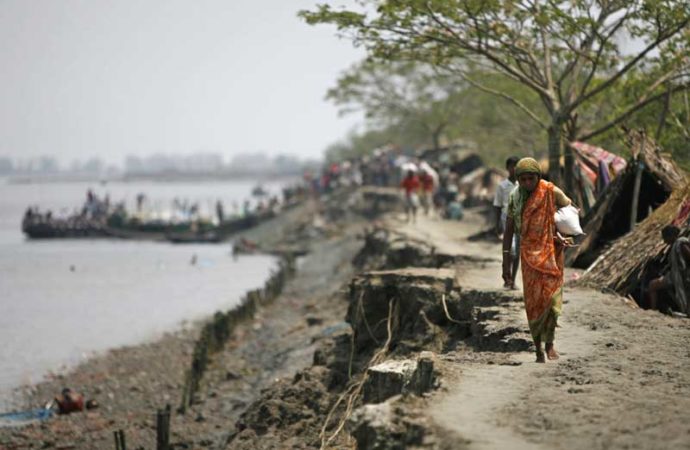
Climate change is a problem for the whole world, but Bangladesh is particularly vulnerable Climate change is the most daunting environmental issue of our time. It has instigated a wide range of challenges for countries, and many of us are already confronting the adverse impacts of it. The impacts are multi-dimensional and extensive, ranging from ecology to economy, and other decisive sectors as well. Bangladesh is a small country. It has a long history of being a neutral and peace-loving country, but now the name of this land is frequently uttered in the world forum due to its enormous vulnerability to climate change impacts. Bangladesh is one of the poorest countries in the world, where remittances and the garment industry are the premier contributing sources of its economy. On the other hand, Bangladesh is also one of the largest deltas of the world, a majority of which is hardly above sea level. So, due to both economic and geographic characteristics, Bangladesh is accounted to be the most vulnerable country to climate change in the world. From the inception of its journey in 1971, it has been enduring extreme climatic events like cyclones, tidal bores, floods, storms, etc. Over the last few years, it has undergone frequent and intense natural disasters due to climate change. The memories of devastating Sidr and Aila in the recent past are not to be blurred anytime soon, which swept over Bangladesh in 2007 and 2009 respectively, claiming thousands of lives, and bringing uncountable economic losses. The country is densely populated, contributing to 2.19% of the world’s population, but in terms of greenhouse gases emissions, it contributes a tiny proportion of 0.14%. Despite negligible contribution of greenhouse gases, Bangladesh is facing devastating impacts of climate change. Many environmental experts are projecting more dangerous climate events in the upcoming days. It is predicted that if the sea level rises by one metre as glaciers melt gradually, 17% of Bangladesh will be inundated permanently, and 19 districts will be affected directly. Other impacts like temperature increase, droughts, etc are evidently present in Bangladesh now, affecting the daily lives of people. In addition, increases in cyclones, flash floods, and floods are prevalent as we are extremely prone to such devastation, with 80% of the total land area being hardly above sea level. We used to expect floods once within 10 years, but now it occurs once in every two years. Salinity intrusion has become a severe problem in the southern part of Bangladesh. Due to frequent occurrence of tidal bores, cyclones, etc, saline water intrudes agricultural land easily and as a result depletes its productivity. If we attempt to estimate the sectoral impacts of climate change, then we can note that losses are uncountable. We are mainly an agricultural based economy, and this sector provides about 50% of total employment. Due to extreme temperature, drought, heavy fall, and salinity intrusion, crop-yielding is decreasing rapidly. People are losing their sources of livelihood and employment. Food security may become another issue in the coming days for Bangladesh, as rice production in the southern part of the country is decreasing due to salinity intrusion. On a positive note, Bangladesh is undoubtedly privileged with a wide diversity of ecosystem, including the mangrove forests and the longest sea beach, and has long coastal areas in its southern part, covering 19 districts. The Sundarbans, a world heritage site, is also being affected badly by climate change-induced natural disasters. Many species of this forest are on the verge of extinction due to climate change. Even urban areas like Dhaka and Chittagong are being affected directly by extreme temperature and water lodging. It is worth mentioning that 40% of the urban population in Bangladesh lives in slum areas. Moreover, more slums are being formed by refugees, and existing slums have become over-crowded. All these slums are creating new issues like air pollution and accommodation problems. For a research project titled “Socio-economic Impacts of River Erosion: A case study on Faridpur district,” I had the opportunity to work on this issue particularly. During my field work, I observed how devastating impacts of river erosion can be. People are being deprived of their basic needs such as education, health, and other modern facilities as they have to move frequently from one place to another. Recently, I sought consultation of Dr Niaz Ahmed Khan, a professor in the department of development studies in Dhaka University, regarding the impacts of climate change in Bangladesh. Dr Khan was stressing on social impacts of climate change. He said: “The economic impacts of climate change are undoubtedly foreseeable by experts and analysts, but the social impacts need to be scrutinised as well. Most importantly, livelihoods of vulnerable groups inhabiting coastal and char lands will be seriously affected, which will result in explicit and implicit impact. The first being a loss of cultivable land and forest areas, while the latter is likely to manifest itself in the form of social inequality, exclusion, leading towards social instability. Major SDG development goals like poverty alleviation, environmental sustainability, and bio-diversity preservation will therefore be hampered in the long run.” It’s high time to preserve our planet for our next generation. We should not consider climate change as an isolated problem for any specific nation, rather let’s consider it as our common problem. We need to be responsible for mitigating the impact of climate change successfully and efficiently. Source - http://www.dhakatribune.com

06.09.2016

India - Crop insurance scheme hits premium hurdle

India’s most ambitious crop insurance scheme till date is likely to be derailed in its very first phase, as states are hesitant to implement it because of excess financial burden. Launched in January to provide succour to farmers in case of crop loss or damage due to unseasonal rainfall, hailstorm, drought, and other natural calamities, the Pradhan Mantri Fasal Bima Yojana (PMFBY) is being implemented for the first time in the ongoing Kharif season across India at a total annual budgetary allocation of Rs 5,500 crore by the Centre. Targeted to bring 50 million farmers under the insurance net, the scheme is already facing hiccups. Under PMFBY, it has become mandatory for states to share the premium jointly with the Centre. To make it an attractive option for farmers, their contribution has been kept low and uniform. They have to pay 2 percent in the case of Kharif crops, 1.5 percent for rabi crops and 5 percent for horticultural crops. The sum insured will vary between Rs 35,000 and Rs 75,000 depending on the districts. In some cases, states’ share of the premium is so high as to account for up to 60 percent of a state’s agriculture budget. “States are not showing interest due to the high premium rate,” P C Sudhakar, a senior officer of Agriculture Insurance Company Limited (AICL), says. A public sector enterprise, AICL offers crop insurance programmes across India. But states are unwilling to pay a high premium, hence the delay in notification. Till date, 22 states have issued tender notification for implementing the scheme. For most states, the notification was made in June-July. A few notified in August. It was late as the sowing season was over. In India, only 22 percent farmers have crop insurance, according to AICL. For the majority of them, it was a compulsion, as the premium was deducted from sanctioned agricultural loans under the previous schemes. But the benefits under the compulsory insurance were small because the states rarely paid their share in the premium. PMFBY makes it compulsory for states to pay their share. At present, crop insurance covers only 50 million hectares (26 percent) of the total 194 million hectares under cultivation in the country. “The government plans to increase insurance coverage by 50 percent,” Rajeev Chaudhary, the chief risk officer of AICL, says. In dilemma After PMFBY was approved by the Union Cabinet, Bihar was the only state which openly raised the issue of excess financial burden. On April 1, the Centre asked all states to close issuing notification for PMFBY by July 31. Chief Minister Nitish Kumar returned the file on August 1 that directed the state to issue the notification, refusing to implement the Central scheme. After a long tussle with the Centre, Bihar finally decided to implement PMFBY on a pilot basis in some districts on August 10. “The state government has decided to implement the scheme on a pilot basis in a few districts to assess its effectiveness. Based on the feedback, we will decide about its implementation across the state,” Alok Mehta, Bihar’s cooperative department minister, says. The state’s premium amount for the Kharif season is expected to be around Rs 650 crore, which is almost one-fourth of its total annual agriculture budget. “The expected total premium amount the state has to pay for both the cropping seasons (combining Kharif and rabi) is around Rs 1,300 crore, which is too high,” Pushkar Priyadarshi, AICL’s regional manager, says. The late notification and limited implementation are likely to restrict PMFBY’s reach. “The state has to bring 3.5 million farmers under insurance cover. Delayed notification may further discourage them not to go for it,” Priyadarshi adds. On his part, Union Minister of Agriculture and Farmers’ Welfare Radha Mohan Singh says the states received a larger share of the Central tax pool after the 14th Finance Commission’s recommendations. So, paying a high premium should not be a problem. “The problem lies in the intention to serve farmers.” Unfair practices In a bid to lessen the financial burden, states are resorting to various tricks that go against the rules and spirit of PMFBY. Delay in the notification is one such thing. Like Bihar, Gujarat also issued PMFBY notification in the middle of July. Another trick is reducing the amount of sum insured under the scheme to bring down the premium. Rajasthan and Uttar Pradesh have resorted to this. Rajasthan has to cough up 36 percent of its total agriculture budget for implementing PMFBY. According to an estimate by the AICL’s state unit, the expected premium for the Kharif season would be about Rs 1,800 crore for the state. To reduce financial burden, Rajasthan has scaled down the premium to Rs 1,109 crore. In the current budget, Rajasthan has allocated only Rs 676 crore under PMFBY. The state has also put an insurance benefit cap on farmers owning up to seven hectares of land, thus further limiting PMFBY’S reach. Farmers having more than seven hectares will have to bear the entire premium amount. Among the states, Rajasthan has the highest premium rate of 21 percent. By paying less premium, states may shrug off responsibility, but farmers will be victims, agriculture experts say. Rajasthan has also made it mandatory for beneficiaries to share their Aadhaar and Bhamashah card numbers. Launched in 2008, the Bhamashah card was introduced to provided financial inclusion to families. This has worked in favour of the state. There are people who hold Aadhaar cards, but they are not linked to bank accounts. Also, many families do not own Bhamashah cards. Uttar Pradesh has also reduced its sum insured. In defence, Uttar Pradesh Director of Agriculture Statistics and Crop Insurance Vinod Singh says the higher premium was based on the scale of finance (SOF) method, which he termed unscientific. SOF is a method adopted to calculate the cost of crop production. It is calculated by a committee headed by the district collector and comprises bank and agriculture officials, experts from the National Bank for Agriculture and Rural Development and farmers. SoF counts the cost of cultivation on the basis of land quality and takes into account irrigation expenses and facility as well as the cost of fertilisers, seeds and labour. SOF also varies from one district to another. To bring down the premium, Uttar Pradesh resorted to an earlier method of multiplying the average yields of crops by the minimum support price which is uniform across the country. “A committee calculates SOF. It is prone to human intervention and so it comes up with a high cost. The premium and the insured amount are thus high. Whereas the earlier method ensures a low amount,” M K Makwana, the regional manager of AICL, Jaipur, says. The Centre is, however, silent on the malpractices. In Madhya Pradesh, the expected premium amount for Kharif crops is around Rs 1,485 crore, which is around 60 percent of the state’s total annual agriculture budget. The yearly premium even exceeds it. Naturally, the government is uneasy. Speaking about PMFBY, Vinay Prakash Singh, chief executive officer of the District Cooperative Central Bank in Vidisha, says proper marketing was not done to popularise the scheme. The bank is in charge of implementing PMFBY in Madhya Pradesh. “The scheme is new and due to lack of robust marketing, the message is not reaching the farmers. Insurance companies are not engaging with non-loanee farmers. They are dependent on banks,” he adds. In India, insurance companies are not encouraged to do business with non-loanee farmers. So, they depend on banks. The P K Mishra committee on crop insurance had in 2013 the adoption of the Spain model where the government-run insurance company has legal power, an AICL official says. Source - http://www.millenniumpost.in

845
of 1225