Australia - Farmers welcome increased drought support but say more money is needed for biosecurity

15.06.2016 279 views

Rural lobby group AgForce says the short-term positives of the 2016-17 Queensland budget could be overshadowed by poor policy decisions.

Treasurer Curtis Pitt has handed down the Palaszczuk Government's second budget, with total spending to exceed $52 billion next financial year.

Media player: "Space" to play, "M" to mute, "left" and "right" to seek.

Of that, $453.9 million, or less than 1 per cent, has been allocated to the Department of Agriculture and Fisheries. That includes what the Treasurer described as an "unprecedented" $78 million support package for drought-hit rural Queensland. "The Palaszczuk Government is focused on dealing with the legacy issues in Queensland agriculture associated with rural debt, on stimulating renewal and investing for the future," Mr Pitt said. But AgForce chief executive Charles Burke was sceptical, particularly as the organisation continued its substantial campaign against the Government's move to introduce tougher tree clearing laws. "There's an acknowledgement of rural and regional Queensland needing some recognition and some financial incentives," Mr Burke said. "Are they enough to overcome some of the other policy aspects the Government is looking to implement that have a big impact on agriculture? We'll have to wait and see." Agricultural production for 2015-16 was valued at more than $17 billion, or just over 5 per cent of the gross state product.

Stamp duty scrapped for family farm transfers

As part of the $78 million package, the Government will abolish the stamp duty on inter-generational farm transfers, something AgForce had long called for. "The reality is that most other states in Australia already have that exemption, and that was why we have for many years been saying that Queensland needed to get in line with the rest of the states," Mr Burke said. Grants of up to $2,500 will be available for farmers to seek financial advice, access succession planning services or take out multi-peril crop insurance. Other budget measures include:
  • $24 million in continued funding for the Drought Relief Assistance Scheme
  • $3.7 million over three years in additional financial support for rural school students in drought-affected regions
  • $3.7 million extra for better wild dog control
  • $3.5 million for the Queensland Climate Risk and Drought Resilience program, to be delivered in partnership with the University of Southern Queensland.

New dedicated office to deal with rural issues

The Government has decided to act in line with a number of proposals flagged by Mount Isa MP Rob Katter in his chairman's report from the Rural Debt and Drought Taskforce. A new Office of Rural Affairs will be established, which Agriculture Minister Leanne Donaldson claimed would lead to better coordination on cross-departmental issues. "I see this as something that is a real step forward," Ms Donaldson said. "By ensuring that this office falls within my department, I can be sure that the issues that fall across regional Queensland ... are not lost between different ministerial portfolios." It has the cautious support of Queensland Farmers Federation chief executive Travis Tobin. "Any information to get an on-the-ground picture is a good thing," he said. "I understand over the next couple of months, the details are going to be worked through, and we would hope to be a part of those discussions."

Opposition criticises 'more bureaucracy'

But the Opposition's Deb Frecklington was critical of the Government's move, saying that even the members of the Rural Debt and Drought Taskforce were divided on the idea for a dedicated office. "It sounds like this is going to be another bureaucracy, set up in Brisbane, and I'm not sure why the ministers can't talk to each other," she said. The Government will also reform the Queensland Rural Adjustment Authority (QRAA), as suggested by Mr Katter. QRAA will be re-branded as the Queensland Rural and Industry Development Authority, tasked with a broader role to help deliver better, and more timely, data on rural debt. Additionally, the Palaszczuk Government will introduce new farm debt mediation legislation to require lenders to conduct formal mediation. "Having a legislated mediation process before bank enforcement action can deliver more positive outcomes for all parties," Ms Donaldson said.
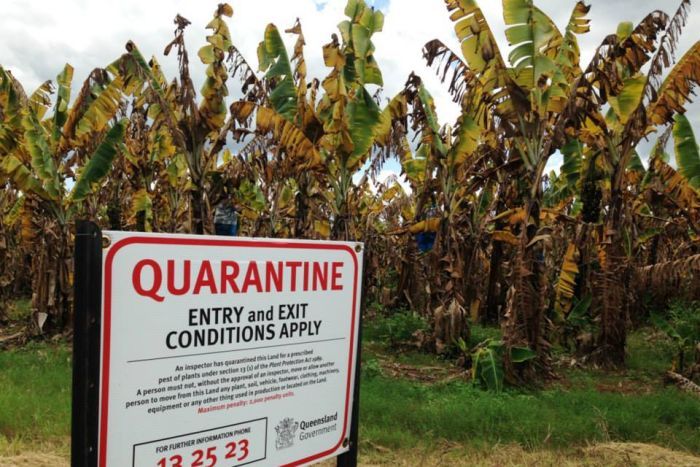
[caption id="" align="alignnone" width="700"]Queensland budget saw additional funding announced to begin implementing the recommendations of the Biosecurity Capability Review. PHOTO: There is money in the Queensland budget specifically for the ongoing battle against the threat of Panama disease Tropical Race 4. (ABC Rural: Charlie McKillop)[/caption]

More money for biosecurity, but not enough

Staffing numbers within Biosecurity Queensland will increase slightly as the Government moves to implement the recommendations of a wide-ranging review that called for an immediate funding injection. The 2016-17 state budget has committed a $10.8 million boost to the state's biosecurity agency. The funds will be spent over the next four years to better prevent and manage pest and disease incursions, critical to protecting the state's billion-dollar agricultural trade. "Is that going to be enough to give us the surety that it will be able to deliver on all those biosecurity issues?" Mr Burke said. "We think that is a little light-on." The Government will also provide another $5.2 million to the ongoing battle against the devastating banana disease, Panama Tropical Race 4 (TR4), taking the total cost next financial year to $7.3 million. Ms Donaldson said there would be no let-up in surveillance, testing and grower education to prevent the disease spreading beyond the property in the Tully Valley where it was found in March 2015. "In addition, we are working with industry on research to find ways of managing Panama TR4 in the years ahead," she said. "That research concentrates on measures that will allow growers to operate if the disease spreads." TR4 affects Cavendish bananas, which comprise more than 90 per cent of a crop that is worth $600 million to the Queensland economy. Source - http://www.abc.net.au
08.03.2026

Mexico - Jalisco Launches Program to Strengthen Women in Agriculture

The Council for Agricultural and Agroindustrial Development of Jalisco (CDAAJ) launched the Tejiendo Campo (Knitting the Field) initiative to strengthen the productive, organizational and commercial capacities of rural women producers in the state, aiming to improve their integration into formal agricultural value chains.

08.03.2026

India - Farmers’ association seeks to declare Virudhunagar drought-hit

Southern Districts Farmers’ Association has demanded declaration of Virudhunagar district as drought-hit and appealed to the district administration to immediately begin enumeration of crop loss.

08.03.2026

USA - Bigger animals, bigger damage? Elk study prompts crop, safety worries

An Ohio legislator is proposing a $1 million study on the feasibility of reintroducing elk back into Ohio. They are interested mostly in the habitat of Southeastern Ohio. What is to keep the elk in that part of Ohio?

08.03.2026

Fiji - Flood damage hits sugar sector

Sugar Industry Minister Tomasi Tunabuna confirms multi-agency assessments underway to support affected farmers.

08.03.2026

South Africa's agricultural exports reach record highs in forth quarter

The Department of Agriculture said  that South Africa’s agricultural exports reached its highest level since the COVID-19 pandemic in the fourth quarter of 2025.

08.03.2026

Dominica Government invests in new citrus facility to boost agriculture

The facility in Londonderry will produce 50,000 disease-free citrus plants every 18 months, boosting the citrus industry.

05.03.2026

Financing Sustainable Agriculture in Brazil’s Cerrado Biome

Brazil’s Cerrado biome, the country’s second-largest, plays a central role in national agricultural production while also hosting significant biodiversity and ecosystem value. 

05.03.2026

Advanced technology helps Irish agriculture detect and manage invasive species

Invasive species are an increasing threat to Ireland’s environment, wildlife and food production systems. Recent discoveries, including the appearance of Asian Hornets in Cork, have highlighted just how serious the risk can be.