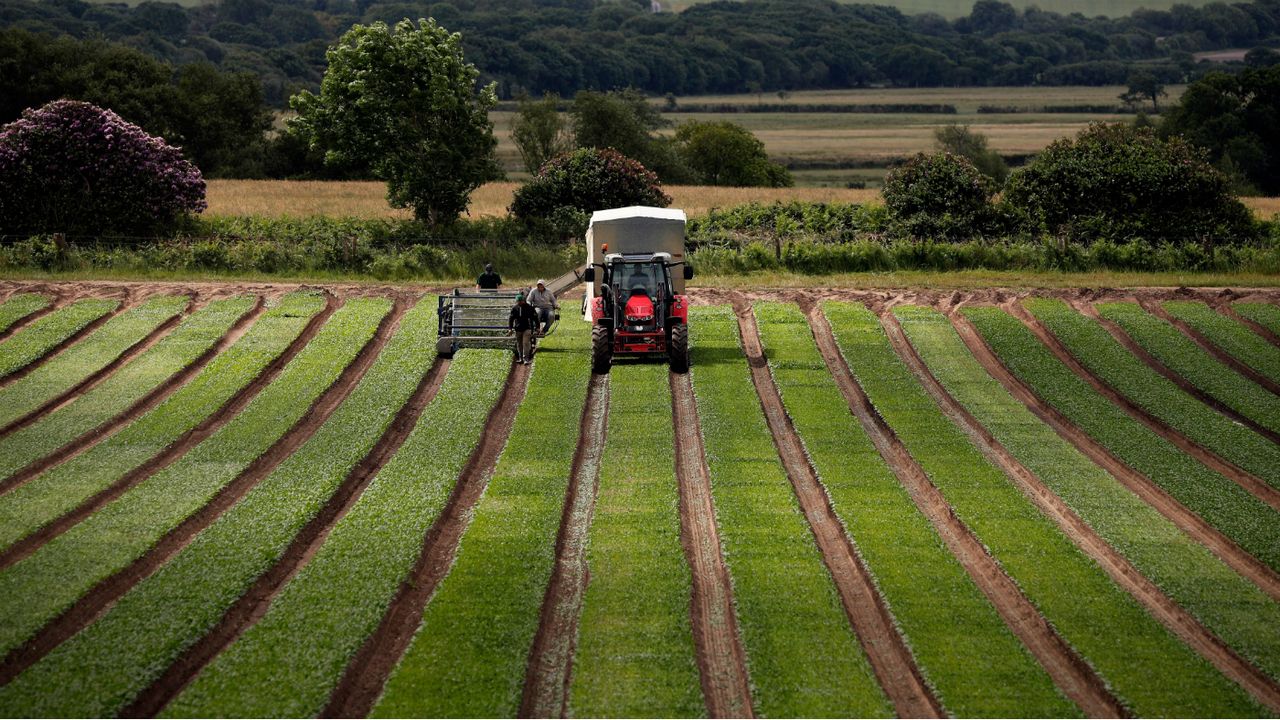
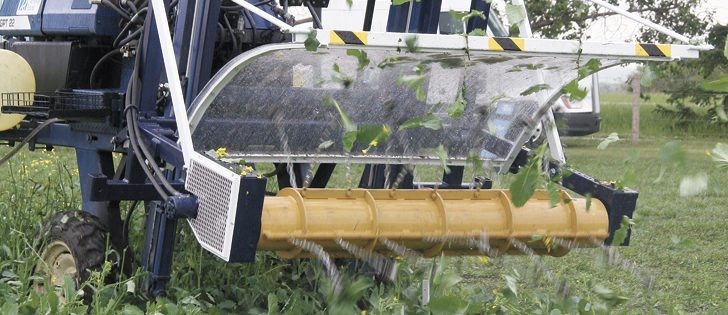
Invented by Ken Cole of Farming Smarter in Lethbridge in 2015, the concept is simple. Chains with golf balls on the ends are attached to a rotating drum. The drum can be mounted on a small tractor or a unit used for working on small research plots.
The speed and rotation of the drum can be controlled to simulate hail damage from zero to 100 percent.
“There was a research need to simulate hail to answer those questions like yield, recovery attempts and now, people are interested in it when it comes to breeding,” said Rodney Werezuk of Alberta Innovates Technology Futures at Vegreville.
Plant breeders are developing shatter resistant varieties to prevent hail from smashing canola pods, and this machine can test mature crops to assess pod damage.
Werezuk had previously simulated hail damage by manually beating the crop with chains or throwing rocks, but that was not practical. With this machine, more golf balls can be added or the crop can be hammered with heavy chains.
Alberta Innovates, Alberta Pulse Growers and Alberta Financial Services Corp., which provides hail insurance, are working to together with units at Fahler, Vegreville and Lethbridge.
The unit was demonstrated on canola plots during CanolaPalooza at Lacombe June 28.
The units can move through the crops and beat them down, and researchers will then assess damage and watch to see if later applications of fungicide or micronutrients make a difference in plant recovery.
“The point is to assess hail damage and the yield loss attributed to the amount of hail damage at different stages of the crop,” said Tom Penner of AFSC.
“We can never determine the damage of these plants when we are in the field because they recover so well,” he said.
The corporation hopes to create a chart that shows expected plant recovery at different levels of loss about 10 days after the event. It may also be used to train hail adjusters.
Data should be analyzed by the end of the year followed with practical information to help farmers make better decisions about crop recovery. Geography will also be considered.
“Part of the way the crop responds to hail is due to the environment,” Werezuk said.
“The weather in Fahler is different from Lethbridge, so you might find a difference between the sites.”
Insurance companies consider Alberta to be the most hail prone in Canada.
Source - www.producer.com
Canada - Hail simulator helps determine crop recovery expectations
08.07.2016 504 views
Invented by Ken Cole of Farming Smarter in Lethbridge in 2015, the concept is simple. Chains with golf balls on the ends are attached to a rotating drum. The drum can be mounted on a small tractor or a unit used for working on small research plots.
The speed and rotation of the drum can be controlled to simulate hail damage from zero to 100 percent.
“There was a research need to simulate hail to answer those questions like yield, recovery attempts and now, people are interested in it when it comes to breeding,” said Rodney Werezuk of Alberta Innovates Technology Futures at Vegreville.
Plant breeders are developing shatter resistant varieties to prevent hail from smashing canola pods, and this machine can test mature crops to assess pod damage.
Werezuk had previously simulated hail damage by manually beating the crop with chains or throwing rocks, but that was not practical. With this machine, more golf balls can be added or the crop can be hammered with heavy chains.
Alberta Innovates, Alberta Pulse Growers and Alberta Financial Services Corp., which provides hail insurance, are working to together with units at Fahler, Vegreville and Lethbridge.
The unit was demonstrated on canola plots during CanolaPalooza at Lacombe June 28.
The units can move through the crops and beat them down, and researchers will then assess damage and watch to see if later applications of fungicide or micronutrients make a difference in plant recovery.
“The point is to assess hail damage and the yield loss attributed to the amount of hail damage at different stages of the crop,” said Tom Penner of AFSC.
“We can never determine the damage of these plants when we are in the field because they recover so well,” he said.
The corporation hopes to create a chart that shows expected plant recovery at different levels of loss about 10 days after the event. It may also be used to train hail adjusters.
Data should be analyzed by the end of the year followed with practical information to help farmers make better decisions about crop recovery. Geography will also be considered.
“Part of the way the crop responds to hail is due to the environment,” Werezuk said.
“The weather in Fahler is different from Lethbridge, so you might find a difference between the sites.”
Insurance companies consider Alberta to be the most hail prone in Canada.
Source - www.producer.com
ScaleAgData Stakeholder Engagement Event
22.10.2024The ScaleAgData project is pleased to invite you to our second stakeholder event. Building on the discussions and connections formed during our first webinar, this event will focus on fostering collaboration among stakeholders, providing updates on our project’s progress, and outlining future opportunities for engagement.
Moldova - May frosts caused heavy damage to fruit orchards
10.05.2026The first frosty nights of May have significantly worsened estimates of damage to Moldova's fruit sector from spring frosts. According to initial assessments by fruit market operators, between a quarter and a third of the country's total orchard area was seriously affected.
India - Delhi raises crop damage compensation after 10 years by over 50% to Rs 75,000 per hectare
In a major relief for farmers, the Delhi government has increased compensation for crop loss caused by rain and hailstorms from Rs 20,000 per acre to Rs 75,000 per hectare.
Why Tech-Driven Agro-Insurance Has Stumbled in Ethiopia
For decades, Ethiopia’s agricultural sector has remained trapped in a dangerous paradox.
UK - Rural crime cost Wales £2.2m last year despite fall in offences
Rural crime cost Wales an estimated £2.2 million last year, with organised criminals continuing to target tractors, livestock and farming equipment despite an overall fall in offences, according to a new report.
Kenyan Agro-Insurance Startup, Pula Raises US$ 20 Million in Series B Round
Pula, a Kenyan startup that offers insurance to small-scale farmers, aims to serve more than 100 million farmers in Africa after raising US$ 20 million in its Series B round.
USA - USDA announces $52M to boost public access to private lands for hunting, fishing
The U.S. Department of Agriculture is announcing $52 million to help state and tribal governments encourage private landowners to allow public access to their land for hunting, fishing and other wildlife-dependent recreation through the Voluntary Public Access and Habitat Incentive Program (VPA-HIP).
Hope Grows in Malawi’s Grain Stores as Farmers Battle Post-Harvest Losses
Some grain rots in poorly ventilated storage. Some is eaten by pests. Some is damaged during drying or transportation before it ever reaches the market.
Canada - AFSC extends several northern Alberta seeding dates for 2026
Alberta’s Agriculture Financial Services Corp. (AFSC) is extending the recommended seeding dates in the province’s northeast, northwest and Peace regions for several crops for the 2026 growing season only.
India - Elephants run amok in Konaje agricultural farm, cause massive crop damage
A herd of elephants, including calves, wreaked havoc on an agricultural farm belonging to Yashodhara Gowda at Pallattadka in Konaje village of Kadaba taluk.