The Chinese navel orange industry is going through a couple of rough patches. Asian Citrus Holdings, a prominent citrus producer and public company, has recently reported significant pretax losses due to damage done by the citrus greening disease and typhoons. The Group has reported that its orange production output has decreased by 86% in the first half of the current financial year and will not be paying out interim dividend.
Industry hit by greening disease
China's largest navel orange producing region is Jiangxi in Ganzhou province, followed by Guangzhou, Hunan and Chongqing.
In 2014 and 2015, the industry has been heavily impacted by the effects of the citrus greening disease, or Huang Long Bing. The disease has taken hold in the Southern provinces of Fujian, Guangdong, Jiangxi, Ganzhou and Guangxi.
One of the hardest hit regions is Jiangxi province, where an estimated 13,000 hectares have been infected. Pingyuan in Guangdong has also witnessed a severe reduction in acreage. Sanming, a production centre in Fujian province, has lost around a third of its total production.
There are significant problems with farmers that are not aware of how to best battle the disease. For example, the planting of new orchards near infected ones is recurrently done. Some of the affected areas have started to replace navel oranges with other citrus varieties, including tangelo, tangerine and pomelo.
Typhoons, that have damaged other citrus varieties, have had little effect on navel orange production, as most orchards are situated further away from the coast. A small number of orchards in Fujian and Jiangxi province, including the ones of Asian Citrus Holdings, have recorded damage.
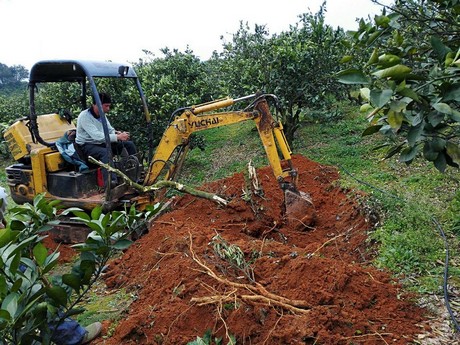
[caption id="" align="aligncenter" width="460"]

Trees infected by greening disease being removed from orchards in Jiangxi province[/caption]
 High hopes for internet technology
Urbanisation has had a large effect on all sectors of agriculture in China. Young people are moving away from rural regions to the big cities on the East coast. The workforce that remains is ageing. This trend impacts production output, sector innovation and progress. Older generations tend to rely more on traditional knowledge, such as concerning weather conditions, and invest less in orchard management and crop enhancement. This has partly facilitated the spread of the greening disease, by not handling infected trees and areas well.
Evolving internet technology is starting to offset above trends. Online presence can boost sales and early-adopters of the internet among orchards and local cooperatives are seeing their leaps of faith being converted into profits.
The evolving e-commerce industry brings around other positive changes for the sector. Online sales tend to involve a younger generation. Circles of local friends have become involved in online sales through Wechat groups, online platforms or websites such as Taobao. Online suppliers are competing on quality and consumer-oriented thinking, adding value to he product. Marketing and branding is becoming increasingly important to differentiate online and offline. E-commerce might lead younger people back to farming, bringing innovation, new concepts and investments with them.
The government is chipping in to this trend. The city of Guangzhou is a pioneer in this area. With support from the Guangzhou government, a number of local varieties have been selected to be transformed into high-profile brands. Cooperation has been launched with research institutes and national experts to enhance the quality of orchard management.
Modernization of the industry is attracting the involvement of younger talents, new commercial players and capital flows. China's citrus industry is developing towards standardization and modernization. A number of big companies are capitalising on this trend. Asian Citrus Holdings, Zhongshan North South Fruit Supply, Chongqing Fengjie Navel Orange Industry and Guangzhou Agriculture Finance Big Data Technology are consolidating the market. They are the forerunners of the industry. These companies employ the internet and social media for brand development and product placing. Simultaneously they are investing in big data analysis for real-time crop monitoring, growth pattern analysis, crop enhancement and market analysis.
Battle against rising production costs
Cost base for the production of navel orange production has been increasing year on year. Labour costs have gone up from an estimated 50 Yuan per day in 2009 to 100 to 120 Yuan per day currently. In addition, prices of pesticides, fertilizers and other auxiliary products are continuing to rise. Finally, many farmers still are not sufficiently educated in how to employ pesticides and fertilizers, leading to increased costs in terms of waste, lower yields, declining soil fertility and pollution.
Navel orange prices came down in the 2015 season compared to a year before. Some regions, such as Xunwu county in Ganzhou, did not manage to sell their entire crop and were left with 20% unsold stock.
To offset price decreases caused by overproduction, the government is trying to introduce varietal differences to extend the season. For example, the government of Chongqing is invested in late varieties and the government of Yunnan is pushing the production of earlier varieties. In addition, investments in cold storage facilities should also help to spread out sales over a longer period of time.
Source - freshplaza.com