HISTORY
Cotton is a plant, it grows wild in many places on the earth, but it has been known about, cultivated and put to use by people of many lands for centuries.
Scientists and historians have found shreds of cloth or written reference to cotton dating back at least seven-thousand years. The oldest discovery was made in a Mexican cave, where scientists unearthed bits and pieces of cotton bolls and cloth. Archaeologists have also found cloth fragments in the Indus Valley of India (Pakistan) dating about 3000 B.C. In 1500 B.C., cotton was referred to in a Hindu Rig-Veda hymn mentioning “threads in the loom.” It is generally believed that the first cultivation of cotton was in India, though it grew wild in several locations around the world. People living in Egypt’s Nile Valley and across the world in Peru were also familiar with cotton. Cotton was grown by American Indians in the early 1500’s, documented from sightings by the Coronado expedition 1540-42. The Spaniards raised a cotton crop in Florida in 1556. In England, in the early 1700's, during the height of the British Empire, it was against the law, to either import or manufacture cloth from cotton. These laws were enacted to protect the powerful English sheep and wool industry of that time. These restrictions also kept the cotton industry from expanding to the American Colonies. However, by the early 1600's, cotton had been introduced to North America and in 1607 the first seed was planted by colonists along the James River in Virginia. The colonists had the ability to produce much cotton but were restricted by the mechanical know-how. It was Samuel Slater, an English mill worker, who changed this by migrating to America in 1790 and building the first American cotton mill from memory. With the development of the cotton mill, Eli Whitney saw the need for a faster means of removing the lint (cotton fibers) from the seed. In 1793, he invented a machine known as the cotton gin. This invention revolutionized the way lint was separated from the seed. Up to that time, for centuries, the separation process had all been done by hand. With Whitney's gin, short for the word engine, lint volume was increased for each worker from 1 lb. To 50 lbs. per day.
Harvesting the cotton by hand was another limitation of productivity. An experienced laborer could pick approximately 450 pounds of seed cotton (cotton removed from the plant with seeds intact) by hand per day. A picking device was first patented in 1850 and a stripper (a machine that strips both open and unopened bolls and trash from the plant) in 1871. In the early 1930’s, after years of development and change, the Rust Brothers of Mississippi used a one row mechanical cotton picker (a machine that used revolving spindles or barbed points to grab and pull the cotton from the open boll) of their design to pick approximately 8,000 pounds of seed cotton in one day. This was quite an improvement in cotton harvest efficiency.
The colonists had the ability to produce much cotton but were restricted by the mechanical know-how. It was Samuel Slater, an English mill worker, who changed this by migrating to America in 1790 and building the first American cotton mill from memory. With the development of the cotton mill, Eli Whitney saw the need for a faster means of removing the lint (cotton fibers) from the seed. In 1793, he invented a machine known as the cotton gin. This invention revolutionized the way lint was separated from the seed. Up to that time, for centuries, the separation process had all been done by hand. With Whitney's gin, short for the word engine, lint volume was increased for each worker from 1 lb. To 50 lbs. per day.
Harvesting the cotton by hand was another limitation of productivity. An experienced laborer could pick approximately 450 pounds of seed cotton (cotton removed from the plant with seeds intact) by hand per day. A picking device was first patented in 1850 and a stripper (a machine that strips both open and unopened bolls and trash from the plant) in 1871. In the early 1930’s, after years of development and change, the Rust Brothers of Mississippi used a one row mechanical cotton picker (a machine that used revolving spindles or barbed points to grab and pull the cotton from the open boll) of their design to pick approximately 8,000 pounds of seed cotton in one day. This was quite an improvement in cotton harvest efficiency.
THE PLANT
There are several species of “wild cotton” (cotton that grows uncultivated ) in the world. They have been found in Australia, Africa, Arizona, Central America, Lower California, Brazil, Mexico and other tropical countries and islands. Because of problems related to their refinement, they are not economically feasible to use. Through genetic assistance and breeding, today’s cottons have evolved from these “wild” sources and are more processing friendly. Currently, there are five prominent types of cotton being grown commercially around the world. They are Egyptian, Sea Island, American Pima, Asiatic and Upland. Because of their need for a long, sunny growing period with at least 160 frost free days they are grown between latitudes 45 degrees north and 30 degrees south. The major producing countries within this region are the United States, Peoples Republic of China, India, Pakistan and Republic of Uzbekistan. Also, Brazil, Australia, Egypt, Argentina, Turkey, Greece, Syria and others produce significant, but lesser amount In the U.S. there are fourteen major cotton growing states that produce Upland cotton. They are Alabama, Arizona, Arkansas, California, Georgia, Louisiana,
Mississippi, Missouri, North Carolina, Oklahoma, South Carolina, Tennessee, Texas and Virginia. Some cotton is also grown in Florida, Kansas and New Mexico. American Pima cotton is grown in Arizona, California, New Mexico and Texas. All of these states form a region in the United States known as the Cotton Belt and have three things in common, lots of sunshine, water and fertile soil, very important to growing a good cotton crop.
Upland cotton being the most common type in the U.S. has a staple length (length of fiber) of 13/16 to 1 ¼ inches. The American Pima has a staple length of 1 5/16 to 1 ½ inches. These plant types grow and mature at different rates and lengths of time, but basically mature within a 30 day period of each other.
Cotton plants have a general time frame in which they grow and produce after planting (introducing the seed to moist soil). With ideal conditions, the planted cotton seed will germinate (to begin to grow) or sprout and emerge in about five to ten days. The first 2 leaves that are visible on the young cotton plant are seedling leaves called cotyledons (cot-a-lee-dons). They are useful for absorbing sunlight into the plant. The sunlight is then converted through a process known as photosynthesis, into nourishing carbohydrates that will help the plant grow.
In about two to four weeks they turn over the photosynthetic task to true leaves (leaves produced subsequent to the cotyledons) which continue the feeding process for the duration of the plants life. The plant continues to grow, adding leaves and height, and in approximately five to seven weeks, small flower buds called squares (a small flower bud covered with fringed leaf-like parts called bracts) will appear on the cotton plant. As this square develops, the bud swells and begins to push through the bracts until it opens into an attractive flower. Within three days, the flower will pollinate(the transfer of pollen from the anther to the stigma of the same or another flower) itself, change from a creamy white or yellow color to a pinkish red, and then wither and fall, exposing a small, green, immature cotton boll (a segmented pod containing 32 immature seeds from which the cotton fibers will grow). This boll is considered a fruit because it contains seeds. As the fibers continue to grow and thicken within the segmented boll, it enlarges until it becomes approximately the size of a small fig. Now, the cotton fibers have become mature and thickened with their primary growth substance, cellulose (a carbohydrate, the chief component of the cell wall in most plants). An average boll will contain nearly 500,000 fibers of cotton and each plant may bear up to 100 bolls
In the U.S. there are fourteen major cotton growing states that produce Upland cotton. They are Alabama, Arizona, Arkansas, California, Georgia, Louisiana,
Mississippi, Missouri, North Carolina, Oklahoma, South Carolina, Tennessee, Texas and Virginia. Some cotton is also grown in Florida, Kansas and New Mexico. American Pima cotton is grown in Arizona, California, New Mexico and Texas. All of these states form a region in the United States known as the Cotton Belt and have three things in common, lots of sunshine, water and fertile soil, very important to growing a good cotton crop.
Upland cotton being the most common type in the U.S. has a staple length (length of fiber) of 13/16 to 1 ¼ inches. The American Pima has a staple length of 1 5/16 to 1 ½ inches. These plant types grow and mature at different rates and lengths of time, but basically mature within a 30 day period of each other.
Cotton plants have a general time frame in which they grow and produce after planting (introducing the seed to moist soil). With ideal conditions, the planted cotton seed will germinate (to begin to grow) or sprout and emerge in about five to ten days. The first 2 leaves that are visible on the young cotton plant are seedling leaves called cotyledons (cot-a-lee-dons). They are useful for absorbing sunlight into the plant. The sunlight is then converted through a process known as photosynthesis, into nourishing carbohydrates that will help the plant grow.
In about two to four weeks they turn over the photosynthetic task to true leaves (leaves produced subsequent to the cotyledons) which continue the feeding process for the duration of the plants life. The plant continues to grow, adding leaves and height, and in approximately five to seven weeks, small flower buds called squares (a small flower bud covered with fringed leaf-like parts called bracts) will appear on the cotton plant. As this square develops, the bud swells and begins to push through the bracts until it opens into an attractive flower. Within three days, the flower will pollinate(the transfer of pollen from the anther to the stigma of the same or another flower) itself, change from a creamy white or yellow color to a pinkish red, and then wither and fall, exposing a small, green, immature cotton boll (a segmented pod containing 32 immature seeds from which the cotton fibers will grow). This boll is considered a fruit because it contains seeds. As the fibers continue to grow and thicken within the segmented boll, it enlarges until it becomes approximately the size of a small fig. Now, the cotton fibers have become mature and thickened with their primary growth substance, cellulose (a carbohydrate, the chief component of the cell wall in most plants). An average boll will contain nearly 500,000 fibers of cotton and each plant may bear up to 100 bolls
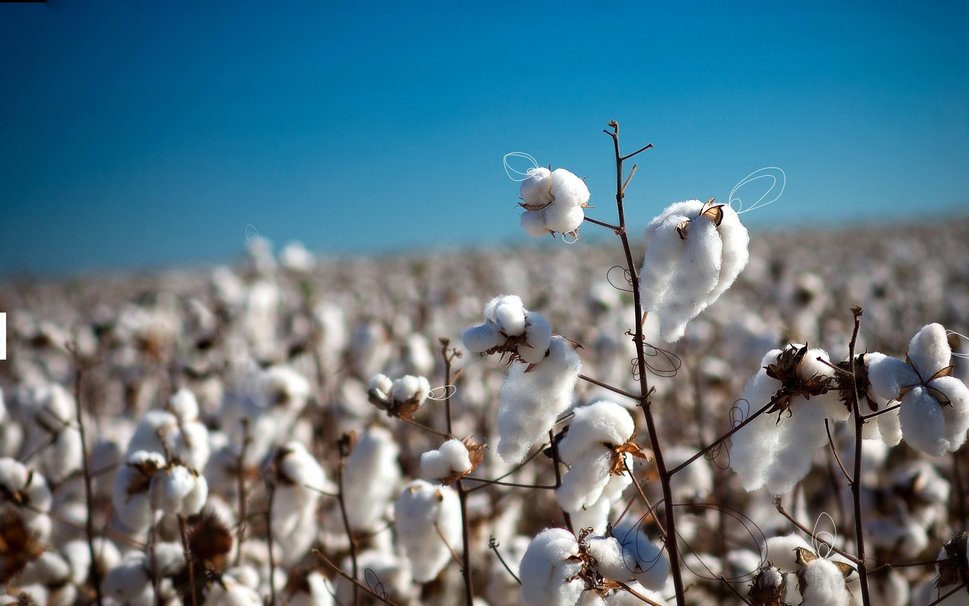
 In about 140 days after planting or 45 days after bolls appear, the cotton boll will begin to naturally split open along the bolls segments or carpels and dry out, exposing the underlying cotton segments called locks. These dried carpels are known as the bur, and it's the bur that will hold the locks of cotton in place when fully dried and fluffed, ready for picking.
The growth cycle of the various cotton species vary in length, but the sequence of fruit production remain the same. Weather, insects and moisture can adversely affect optimum conditions for plant growth and it is the farmer's responsibility to adjust to these conditions to optimize yield.
In about 140 days after planting or 45 days after bolls appear, the cotton boll will begin to naturally split open along the bolls segments or carpels and dry out, exposing the underlying cotton segments called locks. These dried carpels are known as the bur, and it's the bur that will hold the locks of cotton in place when fully dried and fluffed, ready for picking.
The growth cycle of the various cotton species vary in length, but the sequence of fruit production remain the same. Weather, insects and moisture can adversely affect optimum conditions for plant growth and it is the farmer's responsibility to adjust to these conditions to optimize yield.
PRODUCTION
Before cotton can be processed into the many products it becomes. It must be planted, irrigated, nurtured with fertilizer, protected from unwanted weeds, grasses and insects and harvested. This usually means loosening the soil to the depth of 1 to 2 ½ feet with tillage equipment. This will allow water and cotton roots to penetrate the soil and support the plant. A seedbed (the row in which the cotton seed will be planted) is prepared by listing (forming land into ridges and furrow) the soil. This allows for faster warming of the soil in the spring and directs irrigation water across the field. Small amounts of soil enriching nutrients, such as nitrogen, phosphorus, potassium, may be added to the soil at this time. Planting may be done by hand, but in the more advanced regions of the world, mechanical plantersare used. When the soil reaches optimum temperature, about 65 degrees, these implements will place the seeds in the soil, usually 1 to 2 inches deep, depending on soil type. The mechanical planters can cover as many as 12 rows at a time. In some cotton production regions, where soil erosion is a problem, conservation tillage is used. In this system, crop residue from the previous crop or a cover crop is left on the soil surface to protect the soil from heavy rains and winds. A special planter is used to open the soil and place the seed without disturbing the protective cover. As the plants demand it, when available, additional water is delivered to the fields. Sometimes only from natural rainfall, called rain-feed farming, or through irrigation (water application through artificial means), called irrigated farming. This can be accomplished in 3 different ways; 1) furrow irrigation takes place by simply running water down a seedbed furrow, 2) sprinkler irrigation is much like lawn sprinklers where pressurized water is sprayed out over an area, and 3) drip tape irrigation, this is a relatively new method of irrigation using buried tubing that releases water into the soil beneath the plant.
Most of today's commercial cotton farms use a combination of weed control methods. Such as, Cultivation which is done mechanically by machines called cultivators, hand rogueingor weed removal by people with the use of weed hoes and the application of chemical herbicides (chemicals used to control weeds). Chemical herbicides can be applied before or after the cotton is planted. Once the cotton plant has emerged, cultivation and hand rogueing must be done very carefully in order to kill the weeds but not harm the growing cotton plant. If the weeds were allowed to grow, they would compete for nutrients in the soil that are necessary for a healthy and productive cotton plant.
When the cotton plant is in it's seedling stage, it is very susceptible to soil borne fungal disease. There are several diseases that can stunt the growth of the plant, cause leaves to fall off, attack the roots and make the plant wither and die. If the effects of disease don't kill the plant, low yields and a poor quality cotton will result. Development of disease resistant cotton seed has become a priority in the industry. Cotton varieties resistant to some fungi and other destructive organisms have been developed and are being used in certain areas. There is still more research to be done before fungal disease is no longer a factor in producing cotton.
The plant's food, or nutrients, are referred to in agriculture as fertilizer. Nitrogen, phosphorus, potassium, sulfur, calcium and magnesium are the primary fertilizer elements (macronutrients) but there are several trace elements (micronutrients required in small quantities for optimum plant growth) also. These include copper, manganese, zinc, molybdenum, boron, chlorine and cobalt. Starter fertilizer is usually added to the soil before the seed is planted to provide nutrients to feed a healthy seedling. As the cotton plant grows, its nutrient requirement is monitored and any additions needed are applied.
Insect pests have plagued the cotton growing industry over the years and they are a source of constant concern to growers. Insects such as aphid, mite, bollworms, boll weevil, lygus, thrip, White flye, and pink bollworms cause serious destruction to the cotton plants' squares, bolls, leaves, and fiber resulting in a monetary loss to the cotton grower. The pink bollworm is responsible for the most cotton damage and has been found in all of the cotton producing countries, including the United States. The spread of this pest is being held in check by plowing cotton stalks under more than 6 inches deep immediately after harvest to remove over-wintering habitat. There are also beneficial insects or predator insects that feed on various insect pests. Most growers use the services of a crop consultant to monitor their fields for insect pest populations and advise them on treatment. If the insect pest population increases to a level that may severely affect the field's production potential, the grower may then be advised to use an insecticide (a chemical product used to suppress or eliminate an insect pest). These products may be applied by a ground application vehicle specially designed to avoid damaging the cotton plants. Airplanes and/or helicopters are used for air applications, flown low over the field by trained pilots to deliver their load.
As the plants demand it, when available, additional water is delivered to the fields. Sometimes only from natural rainfall, called rain-feed farming, or through irrigation (water application through artificial means), called irrigated farming. This can be accomplished in 3 different ways; 1) furrow irrigation takes place by simply running water down a seedbed furrow, 2) sprinkler irrigation is much like lawn sprinklers where pressurized water is sprayed out over an area, and 3) drip tape irrigation, this is a relatively new method of irrigation using buried tubing that releases water into the soil beneath the plant.
Most of today's commercial cotton farms use a combination of weed control methods. Such as, Cultivation which is done mechanically by machines called cultivators, hand rogueingor weed removal by people with the use of weed hoes and the application of chemical herbicides (chemicals used to control weeds). Chemical herbicides can be applied before or after the cotton is planted. Once the cotton plant has emerged, cultivation and hand rogueing must be done very carefully in order to kill the weeds but not harm the growing cotton plant. If the weeds were allowed to grow, they would compete for nutrients in the soil that are necessary for a healthy and productive cotton plant.
When the cotton plant is in it's seedling stage, it is very susceptible to soil borne fungal disease. There are several diseases that can stunt the growth of the plant, cause leaves to fall off, attack the roots and make the plant wither and die. If the effects of disease don't kill the plant, low yields and a poor quality cotton will result. Development of disease resistant cotton seed has become a priority in the industry. Cotton varieties resistant to some fungi and other destructive organisms have been developed and are being used in certain areas. There is still more research to be done before fungal disease is no longer a factor in producing cotton.
The plant's food, or nutrients, are referred to in agriculture as fertilizer. Nitrogen, phosphorus, potassium, sulfur, calcium and magnesium are the primary fertilizer elements (macronutrients) but there are several trace elements (micronutrients required in small quantities for optimum plant growth) also. These include copper, manganese, zinc, molybdenum, boron, chlorine and cobalt. Starter fertilizer is usually added to the soil before the seed is planted to provide nutrients to feed a healthy seedling. As the cotton plant grows, its nutrient requirement is monitored and any additions needed are applied.
Insect pests have plagued the cotton growing industry over the years and they are a source of constant concern to growers. Insects such as aphid, mite, bollworms, boll weevil, lygus, thrip, White flye, and pink bollworms cause serious destruction to the cotton plants' squares, bolls, leaves, and fiber resulting in a monetary loss to the cotton grower. The pink bollworm is responsible for the most cotton damage and has been found in all of the cotton producing countries, including the United States. The spread of this pest is being held in check by plowing cotton stalks under more than 6 inches deep immediately after harvest to remove over-wintering habitat. There are also beneficial insects or predator insects that feed on various insect pests. Most growers use the services of a crop consultant to monitor their fields for insect pest populations and advise them on treatment. If the insect pest population increases to a level that may severely affect the field's production potential, the grower may then be advised to use an insecticide (a chemical product used to suppress or eliminate an insect pest). These products may be applied by a ground application vehicle specially designed to avoid damaging the cotton plants. Airplanes and/or helicopters are used for air applications, flown low over the field by trained pilots to deliver their load.
 A method of insect pest control being practiced on a limited basis is called integrated pest management (I.P.M.). This method coordinates the use of insecticides and the dispersal of beneficial insects purchased to aid in suppressing unwanted insects. Research is being done to find insects to control a wider spectrum of insect pests, a limiting factor of effectiveness in today's I.P.M. practices.
Pest management in cotton production today contributes a substantial share of the costs involved in raising a crop. The cotton farmer is reluctant to treat weed and insect pests unless absolutely necessary to protect crop yield potential. The correct decisions and timing of both irrigations and pest control measures is an ally to a grower's success as he/she guides their crop to maturity.
When enough bolls have opened naturally, harvest aids are applied to the plant to help speed up the maturation process. This, also, is done either by ground or air application. Defoliation helps the leaves to dry and fall off and to help any of the remaining unopened cotton bolls to open. This practice enables the grower to hasten the opening of the cotton bolls which can then be gathered quickly, in a short period of time. It is essential that the crop is harvested before weather and rain can damage or ruin its quality and reduce yield. Frost also causes the plant to shed its leaves naturally and assists in splitting bolls, but may occur too late in the season to benefit harvest. Now the cotton crop is ready to be harvested.
For centuries cotton has been picked by hand. Hand picking is done in the less progressive cotton growing regions of the world. It is very inefficient and no longer practiced in modernized countries.
A method of insect pest control being practiced on a limited basis is called integrated pest management (I.P.M.). This method coordinates the use of insecticides and the dispersal of beneficial insects purchased to aid in suppressing unwanted insects. Research is being done to find insects to control a wider spectrum of insect pests, a limiting factor of effectiveness in today's I.P.M. practices.
Pest management in cotton production today contributes a substantial share of the costs involved in raising a crop. The cotton farmer is reluctant to treat weed and insect pests unless absolutely necessary to protect crop yield potential. The correct decisions and timing of both irrigations and pest control measures is an ally to a grower's success as he/she guides their crop to maturity.
When enough bolls have opened naturally, harvest aids are applied to the plant to help speed up the maturation process. This, also, is done either by ground or air application. Defoliation helps the leaves to dry and fall off and to help any of the remaining unopened cotton bolls to open. This practice enables the grower to hasten the opening of the cotton bolls which can then be gathered quickly, in a short period of time. It is essential that the crop is harvested before weather and rain can damage or ruin its quality and reduce yield. Frost also causes the plant to shed its leaves naturally and assists in splitting bolls, but may occur too late in the season to benefit harvest. Now the cotton crop is ready to be harvested.
For centuries cotton has been picked by hand. Hand picking is done in the less progressive cotton growing regions of the world. It is very inefficient and no longer practiced in modernized countries.
 As the mechanical cotton picker moves through the field, the cotton plants are guided through the picker head (a unit that contains the picking components). The seed cotton, or locks, in the bur encounter revolving barbed spindles attached to a picking bar (a vertical bar that contains 18 to 20 spindles) attached to a rotating drum. The locks are grabbed by the barbed spindle and pulled from its bur. The rotating drum then moves the picking bar toward the doffer. A doffer is a series of curricular, rubber lined pads, stacked 18 to 20 high, that remove cotton from the spindle. The seed cotton and spindles pass through the doffer where the cotton is removed or doffed from the spindle to fall to the picker door (a side component of the picker with channeling to facilitate the movement of cotton). An air vacuum created by a fan then sucks the cotton away from the door and blows it into the basket. The spindle now continues on its rotation passing through the moistener pads (small finned pads stacked 18 to 20 high, which add water and/or moistening agent to the spindles) where they are lubricated to assist in cleaning them. This sequence repeats itself continually while the cotton is being picked. Spindle type cotton pickers harvest most of the cotton grown in the United States.
In some areas of the Cotton Belt, brush strippers are used to harvest seed cotton. These machines remove bolls and burs from the plant with rotating brushes and bats. Material is fed into a field cleaner where much of the burs and sticks are removed and blown into a large basket. They are used primarily in dryland farming cotton areas in Texas where the cotton plant varieties are more compact in stature. Small plant size is important when using a stripper because they tend to accumulate more trash (leaves, bolls, stems and branches) in their harvested product.
Today’s modern cotton harvesters can cover up to 6 to 8 rows at a time and can harvest up to 190,000 pounds of seed cotton a day. These new cotton harvesters are a major improvement over the hand methods of the past.
As the mechanical cotton picker moves through the field, the cotton plants are guided through the picker head (a unit that contains the picking components). The seed cotton, or locks, in the bur encounter revolving barbed spindles attached to a picking bar (a vertical bar that contains 18 to 20 spindles) attached to a rotating drum. The locks are grabbed by the barbed spindle and pulled from its bur. The rotating drum then moves the picking bar toward the doffer. A doffer is a series of curricular, rubber lined pads, stacked 18 to 20 high, that remove cotton from the spindle. The seed cotton and spindles pass through the doffer where the cotton is removed or doffed from the spindle to fall to the picker door (a side component of the picker with channeling to facilitate the movement of cotton). An air vacuum created by a fan then sucks the cotton away from the door and blows it into the basket. The spindle now continues on its rotation passing through the moistener pads (small finned pads stacked 18 to 20 high, which add water and/or moistening agent to the spindles) where they are lubricated to assist in cleaning them. This sequence repeats itself continually while the cotton is being picked. Spindle type cotton pickers harvest most of the cotton grown in the United States.
In some areas of the Cotton Belt, brush strippers are used to harvest seed cotton. These machines remove bolls and burs from the plant with rotating brushes and bats. Material is fed into a field cleaner where much of the burs and sticks are removed and blown into a large basket. They are used primarily in dryland farming cotton areas in Texas where the cotton plant varieties are more compact in stature. Small plant size is important when using a stripper because they tend to accumulate more trash (leaves, bolls, stems and branches) in their harvested product.
Today’s modern cotton harvesters can cover up to 6 to 8 rows at a time and can harvest up to 190,000 pounds of seed cotton a day. These new cotton harvesters are a major improvement over the hand methods of the past.
 Prior to the development of the module builder, most cotton picked by machines was dumped into cotton trailers and hauled to a cotton gin (a place where seed and fiber are mechanically separated). This system became inefficient when the trailers were filled faster than the gin could process the cotton and the cotton pickers had to cease harvesting while waiting for trailers to empty. This challenge was met with the invention of the module builder in 1972. This implement allows cotton to be dumped from the picker onto the ground and be compressed hydraulically to form a module (tightly pressed stack) of cotton. Each module holds 12-14 bales. This module can be left in the field for storage and later be hauled directly to the gin or transported by a module mover to the gin’s storage yard. The use of these builders allow the pickers to continue harvesting, unimpeded by ginning problems or delays.
Source - cottonsjourney.com
Prior to the development of the module builder, most cotton picked by machines was dumped into cotton trailers and hauled to a cotton gin (a place where seed and fiber are mechanically separated). This system became inefficient when the trailers were filled faster than the gin could process the cotton and the cotton pickers had to cease harvesting while waiting for trailers to empty. This challenge was met with the invention of the module builder in 1972. This implement allows cotton to be dumped from the picker onto the ground and be compressed hydraulically to form a module (tightly pressed stack) of cotton. Each module holds 12-14 bales. This module can be left in the field for storage and later be hauled directly to the gin or transported by a module mover to the gin’s storage yard. The use of these builders allow the pickers to continue harvesting, unimpeded by ginning problems or delays.
Source - cottonsjourney.com