

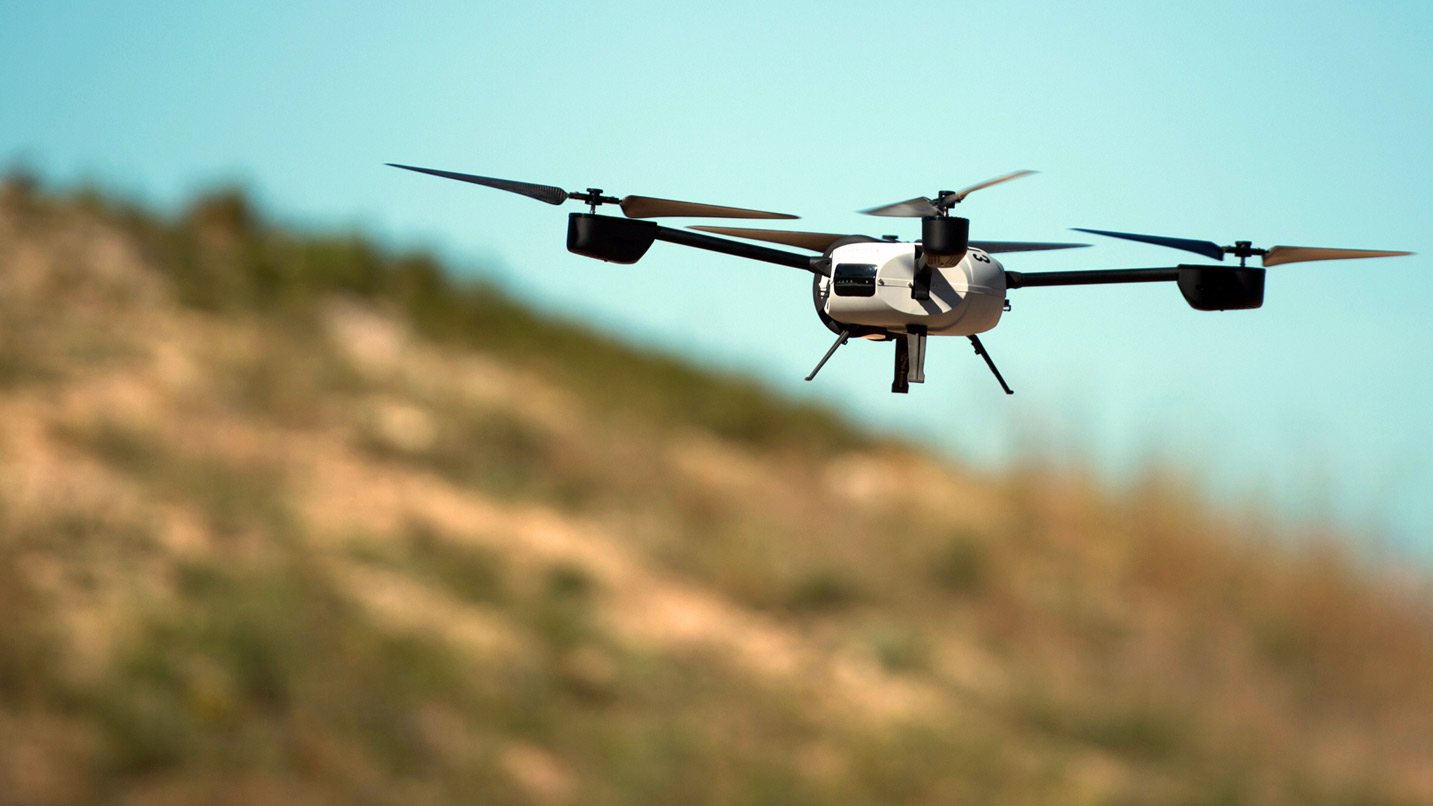
Swarms of drones and robots instead of farmers - is it science fiction? No, it is what promised by the European 'Swarm Robotics for Agricultural Applications' (SAGA) project, coordinated by the Istituto di Scienze e Tecnologie della Cognizione del Consiglio Nazionale delle Ricerche (Istc-Cnr) and presented in Rome during Maker Faire.
 The functioning of the SAGA system.
"The test for the first drone prototype, programmed to supervise a field and detect weed presence by using artificial vision algorithms, will be ready in a few months. Drones will be able to communicate so they can aggregate and map the areas where intervention is more urgent. Their behaviour is similar to that of bee swarms when they identify areas with more pollen. This way, interventions can be limited to the most problematic areas thus saving money, reducing environmental impact and increasing production," explains Vito Trianni, Istc-Cnr researcher and Saga coordinator.
The functioning of the SAGA system.
"The test for the first drone prototype, programmed to supervise a field and detect weed presence by using artificial vision algorithms, will be ready in a few months. Drones will be able to communicate so they can aggregate and map the areas where intervention is more urgent. Their behaviour is similar to that of bee swarms when they identify areas with more pollen. This way, interventions can be limited to the most problematic areas thus saving money, reducing environmental impact and increasing production," explains Vito Trianni, Istc-Cnr researcher and Saga coordinator.
 "Soon, it will also be possible to intervene on single plants directly. For example, drones could be equipped with micro-sprays. Robots will work in groups to cover wider areas. In addition, they will be able to deal with weeds mechanically instead of chemically, providing support to organic cultivation too."
Play to watch an interview with dr. Trianni
Greenhouse applications
Greenhouses are widely used in Sicily, especially in the area between Syracuse and Agrigento. Is this technology applicable to greenhouses?
"It will definitely be in the future and, actually, robot swarms could be very important for greenhouse crops. It is also true that greenhouses are structured, therefore fixed monitoring devices and rail robots could be used. But these are details, this technology is perfectly in line with greenhouse needs."
Viruses
At the moment, the area is trying to deal with the New Delhi virus (Tomato leaf Curli New Delhi virus - ToLCNDV), which is decimating tomato and courgette crops and causing many economic and social problems in the area.
Play to watch a video on the uprooting of affected plants
How can drones be used in this instance?
"The New Delhi virus causes leaves to yellow and curl. These elements could be recognised by drones. Our solutions can be adapted for different problems thanks to various artificial vision techniques. We just need to set up automatic classifiers. We are also thinking about using deep neural networks and deep learning, i.e. the method used by AlphaGo, the software used by Google DeepMind."
 Plants affected by the virus in Vittoria.
"After identifying the disease, a swarm of drones and/or robots could identify and map outbreaks to prevent the spreading of the virus. Of course we would have to consider whether it would be economically viable."
Plants affected by the virus in Vittoria.
"After identifying the disease, a swarm of drones and/or robots could identify and map outbreaks to prevent the spreading of the virus. Of course we would have to consider whether it would be economically viable."
Plants affected by the virus in Vittoria.
"After identifying the disease, a swarm of drones and/or robots could identify and map outbreaks to prevent the spreading of the virus. Of course we would have to consider whether it would be economically viable."At the heart of the drones is an innovative hardware, manufactured by Avular, a Dutch company that, through the University of Wageningen, develops artificial vision and drone control algorithms for agricultural applications.
Source - http://www.freshplaza.com










