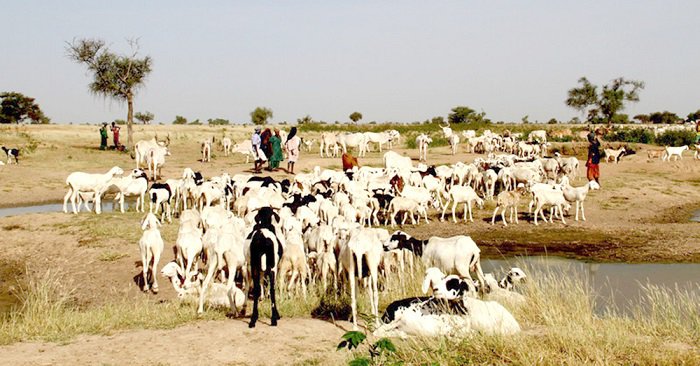
Over the past years, around Christmas, I had made it an annual ritual to be visiting Ahumbreo, a small village in the Central Region where goats are relatively cheaper. Ahumbreo is on the way to Agona Swedru.
Last Saturday was such a disappointing one when in my usual preparation towards Christmas, I got to the village and was shocked to learn that goats were not available for sale.
Curious to know the reason, they intimated that there were no goats in the village as they were attacked by a strange disease early this year leading to a virtual extinction of the highly sought-after four-legged animal in seasons such as this.
Immediately, the subject of livestock insurance came to mind and I wish to throw more light on the subject as we have only five days to Christmas.
Epidemic breakout last year
In December 2015, the detection of bird flu in Tema and its environs and other parts of the country triggered the interest in what livestock insurance could do to salvage the situation and also to make farmers get back to business in the event of an epidemic.
Following this sad news, many financial experts joined in the chorus to call on poultry farmers to seek financial risk protection.
Many have likened it to be a subset of agricultural insurance, while another school of thought suggests that it should be a stand-alone policy. That notwithstanding, it should be made clear that agriculture is not only about crops but extends beyond that to include animal production and rearing.
Livestock Insurance
Livestock insurance is a restricted policy largely offered by specialist insurers, often associated with Lloyds in the UK.
The policy is primarily patronised by farmers, camel and cattle herders; and some pet owners.
Generally, the loss of livestock by slaughter, death, disease or theft can occur through several unaccountable causes. This type of insurance, therefore, provides adequate compensation in the event of loss of livestock.
What livestock insurance covers
There is no standard cover for this type of policy because the nature of cover varies from one insurance company to another.
Thus, the policies are usually tailor-made for the particular risks. Meanwhile, death following within 14 days of accident or injury, slaughter on humanitarian grounds and a slaughter certified by a qualified veterinary officer or the insurer’s consent, must be consequent to the happening of the following:
- Compulsory slaughter due to an epidemic (e.g. bird flu).
- Fire, lightning, earthquake, explosion and aircraft;
- Riot and malicious damage
- Electrocution
- Loss in transit, while on foot or vehicle, at any public sale, market or yard or while straying from same or insured’s premises.
- Sheep, cattle or poultry being attacked by foxes, as well as dogs.
- Theft and unexplained disappearance normally after a minimum of one month
- Death following illness or disease. This will include anthrax, TB and brucellosis.
- Breeding risks of selected types of animal from death from pregnancy or parturition (delivery).
- Infertility following accident, illness to e.g. bulls and rams.
- Territorial limits – the territorial limits of the cover are always clearly defined. Indeed if the Savannah Accelerated Development Agency (SADA) had had this policy in place, the many guinea fowls reportedly suspected to have flown to Burkina Faso and Togo would have been duly compensated for!
Types of Livestock Insurance
There are several types of Livestock insurance, but the two most common ones are:
- Insurance on a ‘specified animal basis’, with no upper limits.
- ‘Unspecified basis’ - Here there is usually an upper limit of cover per animal say GH¢300 and if the insured wants to exceed this limit, a special policy will be issued.
Typically, the indemnity covers only the market value of the animal(s), at the time of the loss. While the condition of average applies to livestock insurance, some insurers are able to modify the average principle to meet the customer’s expectation.
What is not covered under a Livestock Insurance Policy
Generally, the following exclusions apply:
- Slaughter without the insurer’s consent or veterinary officer’s certification
- Castration or surgical operation (unless carried out by a specialist veterinary or deemed to be necessary to save the animal’s life)
- Radioactive contamination
- Inoculations (unless necessitated by accident, injury, illness or disease)
- Sonic bangs, war risks, etc.
- Excesses: some insurers will impose compulsory excesses to certain aspects of the cover, e.g. theft and unexplained disappearance. Excess may be imposed either on a loss or per animal basis.
Special underwriting aspects
Due to the delicate nature of this policy, certain special underwriting techniques, such as the following, are required:
- Detailed knowledge of farming practices and livestock habits.
- Type of livestock is important (particularly where diseases are concerned)
- Value at risk
- Purpose of use of livestock
- Previous loss history
- Breed characteristics
- Degree of state of veterinary controls
- Market values at the time and place of loss
- Consequential loss
The aforementioned are by no means exhaustive and much will depend on the individual underwriters’ practice and judgement.
The way forward
While it is not clear the number of insurance companies offering livestock insurance in Ghana, it is becoming more burgeoning to include this type of insurance in their books.
Similarly, as a social intervention package, the government may also leverage on the enormous benefits that abound in livestock insurance.
For instance, while it is welcome news that the government has paid some compensation to the poultry farmers who suffered losses in last year’s bird flu outbreak, a long-term government’s commitment should include collaboration with the farmers and insurers, in particular, to provide an insurance cover. Moreover, the distinction between livestock insurance and bloodstock insurance, which is the insurance for camels, horses, donkeys, etc., must be noted.
Livestock insurance is rather concerned with poultry, goats and sheep. In this regard, the mandate of the Ghana Agricultural Insurance Pool (GAIP), whose original focus seems to be on crops, should have the same focus extended to livestock insurance. It is refreshing to learn that they have started talking extensively about it in recent times.
As I take this opportunity to wish all readers of the ‘Insurance Bakery’ a Merry Christmas and a prosperous New Year, let us be reminded that we may be paying more for the goats we would be consuming this Yuletide not because they are so expensive but because they are scarce owing to epidemics you and I may not have heard about, thus wiping out a ‘generation’ of the livestock.
Source - http://www.graphic.com.gh