Ongoing waves of cold during early April are taking a toll on fruit tree blossoms in parts of the northeastern United States.
Farmers are holding their breath as they wait out the cold to inspect the impact on trees and vines.
The combination of a very mild winter, above-average temperatures during March and the most recent bout of below-freezing temperatures have caused damage to some fruit crops.
[caption id="" align="alignnone" width="437"]

In this photo taken in Syracuse, New York, on April 3, 2016, a female cardinal takes in the wintry scene with snow on blossoming trees. (Photo/Grayson Jones)[/caption]
"The amount of damage varies from orchard to orchard and from tree to tree," according to Jason Coopey, co-owner of Way Fruit Farm in Stormstown, Pennsylvania.
Coopey stated that thus far apricots and plums have sustained the most damage, but overall his orchards, which are on the tops of hills have fared better than some locations farther south and east and those located in valleys, where the cold air tends to settle.
"We expect significant losses, 90-100 percent of peaches and plums, now at full bloom," according to Chris Harner, of Harner Farms in State College, Pennsylvania.
"Apples are farther behind [in central Pennsylvania] but are entering sensitive stages where we can have damage or loss," Harner said.
Fruit trees in the blossoming stage, as opposed to budding, are very susceptible to damage with temperatures in the middle to upper 20s.
According to the Fruit Tree Production Guide, compiled by the Pennsylvania State University, a 90 percent kill of apples, cherries and peaches can occur with temperatures of about 25 F for 30 minutes. However, the damage at specific temperatures varies from variety to variety.

Additional waves of cold air will follow through the second weekend of April.
A warmup prior to the end of the week could do more harm than good. The brief warmup could push some trees on the verge to blossom and vines to bud break before cold returns.
"The prior warmth is what contributed to blossoming of some trees three to four weeks ahead of average," Coopey said.
There were some days in southern and eastern Pennsylvania, Virginia and New Jersey, where temperatures jumped into the 70s to near 80.
As of late March, the weather has remained chilly enough in much of the New York state Finger Lakes region to prevent or limit bud break of most varieties of grapes, according to Cornell University.
However, the cold blast in mid-February, which was surrounded by mild conditions much of the winter, caused significant damage to some non-native varieties of grapes in the Finger Lakes region. Low temperatures during the outbreak dipped to between minus 18 to minus 8 degrees Fahrenheit.
[caption id="" align="alignnone" width="650"]

Fresh snow and single-digit temperatures gripped the Lake Seneca, New York, area Tuesday morning, April 5, 2016. (Photo/Timothy Merwarth)[/caption]
"As long as temperatures stay where they are projected, we should be okay," according to Timothy Merwarth, of Hermann J. Wiemer Vineyard located in Dundee, New York.
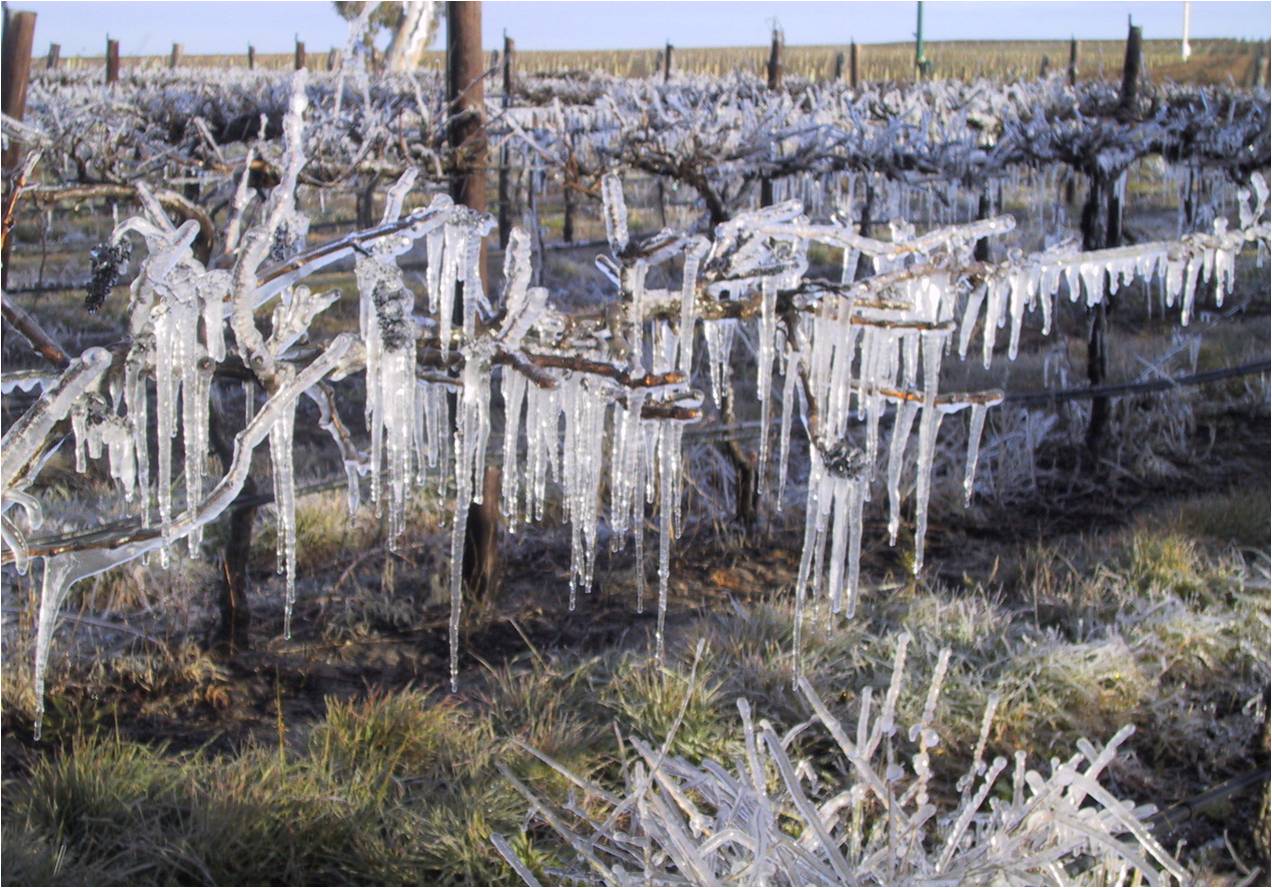
Grape growers will utilize wind machines and bonfires where practical, as needed, during cold waves.
There is concern for damage from the cold to vineyards, similar to fruit trees, farther south in the mid-Atlantic region since bud break was further along farther south.
Another cold wave will invade the Midwest and Eastern states this weekend.

"Moderate cold with a little wind is okay and better than a heavy frost with very low temperatures," Coppey said.
The full scope of the damage may not be realized until the trees and vines are setting fruit later this spring.
Source - accuweather.com