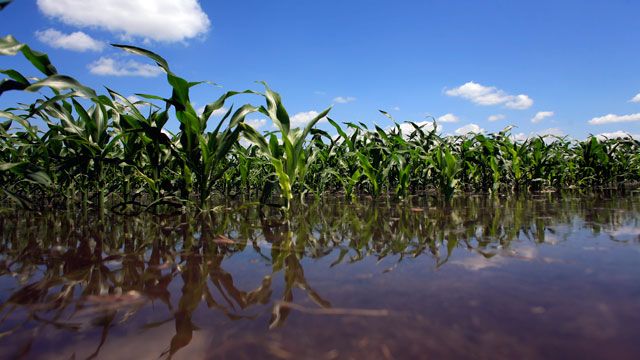
Almost 50 percent of corn crops across Bell County had to be replanted after heavy rainfall during the spring washed out the seeds and fertilizer and damaged growing crops, agriculture experts said.
“We estimated that 35,000 acres in Bell County had to be replanted,” Lyle Zoeller, Bell County extension agent said. “There is probably about 65 to 70,000 acres of corn in the county. So that is a significant economic impact for Bell County’s corn production.”
Robert Fleming, longtime owner of Fleming Grain and Cattle, is one of the farmers across the region hit with a devastating loss.
“This is the first time in my career that I had to replant 40 percent of my acres because of the heavy rainfall,” Fleming said.
Fleming describes his corn crop this year with one word — “ugly.”
For 25 years his production has included wheat, corn and running cattle. He operates in four counties: Bell, Falls, Limestone and Freestone.
Of his nearly 2,000 acres of corn, he had to replant 800 acres in a tedious and tiring effort to be ready for harvest near the July timeline.
“The first crop was severely wiped out from the wet weather and the ground was being restricted of oxygen so the seeds couldn’t emerge,” Fleming said. “Economically, it was terrible.”
Flooding was costly for farmers
Fleming said it was a huge expense to replant the crop which set him behind schedule.
“When you have these multi-inch rainfall events on freshly planted corn crops …it can’t take that kind of water — nothing can,” Fleming said.
According to the National Weather Service, rainfall totals for the Temple area are more than six inches above average for this time of year. Of the region’s total rainfall of 24.3 inches, the Temple area received 18.7 inches from just February to the end of May.
“When we plant we just need timely showers,” he said. “Because of our heavy black ground we don’t require a whole lot, but just normal rainfall.”
Fleming said it costs him almost $70 an acre for the corn seeds alone. That means this year he spent an unbudgeted $56,000 on seeds to replant 800 acres. He said he spent $16 an acre on extra fertilizer.
Those costs don’t include running equipment and the grueling time spent on labor. The biggest hit he said he will see will be at harvest time with a subpar yield.
He said he expects to lose at least $100 an acre for replanting and the loss in yield.
He said at harvest he is expecting some good corn, some fair corn and a lot of “very, very poor corn.”
“It is all about timing and what Mother Nature wants to throw at us,” Fleming said. “It is nothing we did genetic-wise, the variety of corn or time of year we planted.”
Zoeller said corn farmers typically start planting corn in February. But said after the unprecedented spring rains, they had to replant several acres during the second half of March through the first week of April.
“It is not uncommon for portions of fields that may have a low spot, or uncommon to have to replant pieces or corners, but typically we don’t have full fields being replanted.”
Last spring, Zoeller said conditions were similar.
“We have two wet springs in a row where it is not typical to have so much moisture on corn,” Zoeller said.
Saturated soil caused more problems
Replanting was the first issue. The second issue came with overly saturated soils, Zoeller said.
“For a lengthy period of time,” he said. “We lost a whole lot of our fertilizer. Nitrogen is extremely water-soluble and will leak out beneath the plant root zone or it will denitrify and we will lose it back into the atmosphere.”
Zoeller said the result was losing a tremendous amount of fertility in those fields.
He said many of the corn producers went back and reapplied nitrogen fertilizer in May, which in turn revived several acres of the crop.
Fleming said he first planted on Feb. 20 and it took about 10 days to finish planting. He said the last four days of planting were for nothing because his crops were hit with five inches of rainfall in a single night after the work was done.
“We had a ground temperature that was cold and the cold rain on top of it,” he said. “So it seals off the ground and there is no oxygen.”
He said he called that “practice planting” and joked he might as well have gone on vacation during that time instead.
“We knew the forecast was in for rain and we were trying to get through,” he said. “It was just the stage the seeds were in when they got that cold heavy rainfall. So that caused the bad germination.”
“So we had to go in there and destroy what little crop came up,” Fleming said. “Plow it up and start all over again.”
Production delays resulted from replanting
Fleming said it set him back almost 30 days from schedule, which is now a concern as the corn attempts to pollinate during the hot weather.
“Our yield on the late corn is surely not going to be what it was on the early corn that we didn’t destroy,” Fleming said.
Zoeller said most of these corn producers diversify their agricultural enterprises to manage risks.
“That is why most producers don’t just produce one commodity,” Zoeller said. “So if cropping is not going good right now maybe beef cattle is and that is what they can rely on for a while.”
He said they often grow crops that are on different timelines like wheat and corn. Wheat is planted in October and harvested in May. Corn is planted in February and harvested in July.
“We plant more corn than anything else,” Zoeller said. “For us, the timing of the excess moisture was most significant on the corn.”
Zoeller said after dealing with droughts from 2010 to 2012 farmers are trying to bounce back from two extremes.
Summer showers now welcome
Fleming said with the replanted corn, right now they are desperately in need of showers especially as the temperatures continue to rise.
“The older corn is not that critical but the rain would provide a little more yield,” he said. “The later corn we replanted — the 40 percent — needs rain today…it needed rain last week.”
Fleming said when he planted his wheat crop during the fall some of it was also damaged by rain.
“This multi-inch rainfall is just killing us,” he said.
Fleming said farmers have a safety net through the Federal Crop Insurance Corp. with a program that helps protect their fields in cases like this.
“But I have not seen a dime yet,” he said uncertain about the delay. “My company, I suspect, they are probably going to take it out of the premium.”
Fleming said after the middle of June the rain just “shut off on them.”
Farming is no doubt frustrating at times, Fleming said, adding it is up to “Mother Nature and the good Lord to provide for you.”
Source - www.tdtnews.com