Americans might think that there’s a formula to determine the amount of premium subsidies growers get through the federal crop insurance program. They’d be wrong. The subsidies are based on what politicians think taxpayers are willing to pay.
That’s one conclusion of a new article by Carl Zulauf, professor emeritus at Ohio State University, on the “farmdoc daily” website of the University of Illinois. Professor Zulauf says the lack of any “objective rationale” for the current mix of premium subsidy rates is likely to bring the crop insurance program under increasing scrutiny.
Increasing scrutiny, followed by far-reaching reform, is exactly what the program deserves.
The average cost of the Department of Agriculture’s crop insurance program has risen from $3.3 billion a year between 2000 and 2004 to $8.6 billion a year from 2010 to 2014, and the main driver of this increase has been the premium subsidies. Since Congress passed the 2000 Agricultural Risk Protection Act, the subsidies have soared from less than $1 billion a year to more than $6 billion a year (Figure 1).
These costs started to spike in 2011 and have stayed high during a time when growers have been making record profits.
Figure 1: Premium subsidies have ballooned since 2000.
[caption id="" align="aligncenter" width="687"]
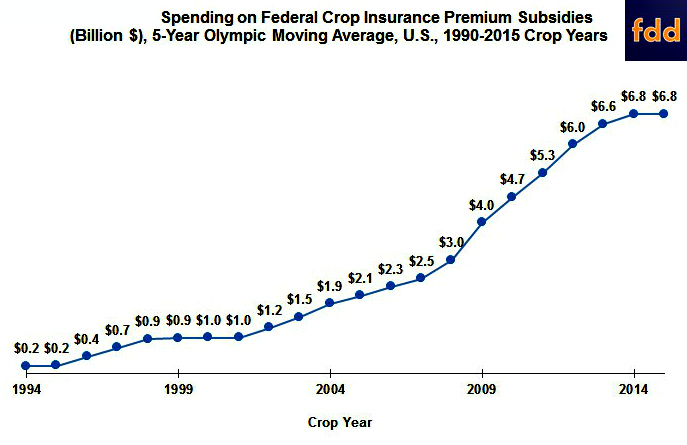
Source: Zulauf, C. "Why Crop Insurance Has Become an Issue." farmdoc daily (6):76, Department of Agricultural and Consumer Economics, University of Illinois at Urbana-Champaign, April 20, 2016.[/caption]
Proponents of the crop insurance program claim that the only reason subsidies skyrocketed was that crop prices were at record highs, and now that prices are normalizing, the subsidies should go back down. But Zulauf says that although the subsidies may drop a bit, three other things affect the amounts: the subsidy rates set by Congress, crop insurance product types (revenue vs. yield insurance) and changes in risk ratings. Drops in crop prices alone won’t greatly shrink the subsidy amounts, he concludes.
It’s ridiculous to think that taxpayers are paying billions of dollars a year for the crop insurance program when the rates that taxpayers support are being set arbitrarily. Common sense reform is needed now more than ever to stem the tide of wasteful spending on crop insurance.
Source - http://www.ewg.org