

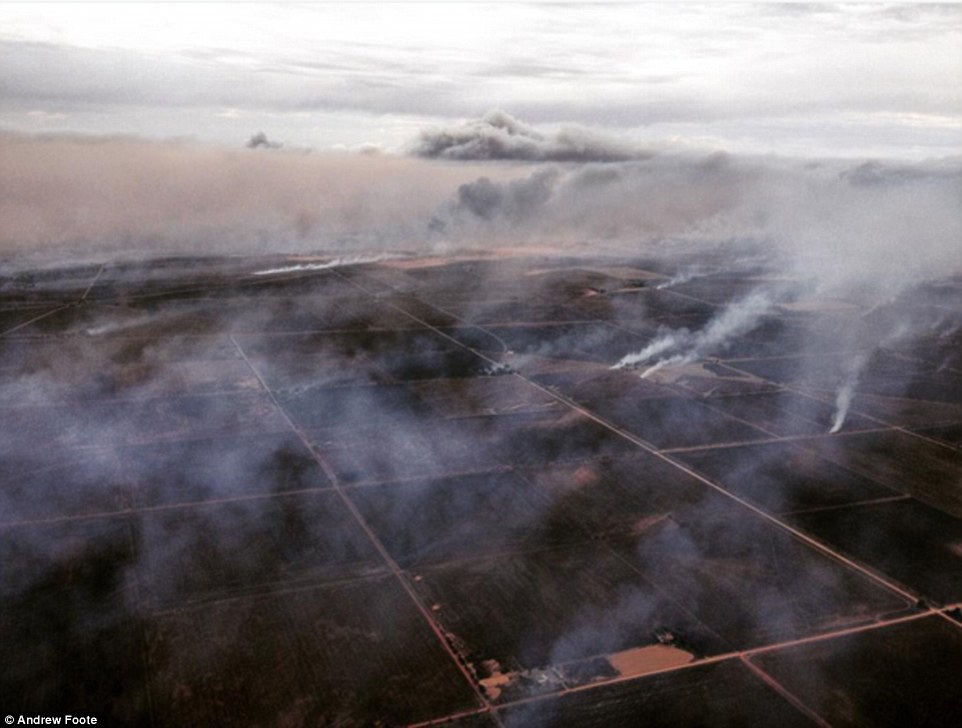

Cattlemen south of Medicine Lodge, Kansas, move a herd of cows and calves to a safer spot in a pasture as spots of fires break out during the Anderson Creek Wildfires March 24.
Desperately welcomed rains came to Barber and Comanche counties in Kansas over the weekend of April 16 to 17. And with them, some relief from the tinder dry conditions that allowed the Anderson Creek Fire to rage on for so long.
As farmers and ranchers start the recovery, there are a few options open to them for federal assistance. On April 6, ranchers and landowners identified by the Farm Service Agency as having land in the path of the fires were invited to a special meeting at the Barber County Heritage Center in Medicine Lodge, Kansas, to go over what federal assistance options are available to them following the fire.
State and local officials from the Farm Service Agency, National Resources Conservation Service and U.S. Department of Agriculture were on hand to answer questions about the program funding and requirements to rebuild fences and infrastructure, compensation for livestock losses and any USDA loans that could tide producers over until their land is returned to productivity.
Blaine Rutherford with Kansas Farm Service Agency, Manhattan, covered the Livestock Indemnity Program and the Emergency Livestock Assistance Program available through FSA.
The LIP, he explained, compensates for eligible livestock deaths due to the fires, while the ELAP covers losses that aren’t covered by LIP or the Livestock Forage Disaster Program.
As he began, Rutherford, along with the rest of the slate of speakers, stressed the importance of documentation from participants.
“Documentation will make your participation a lot easier as you go into the county office,” he said. Documentation can include photos, but also any financial records proving ownership of livestock, veterinarian records pertaining to the death of the livestock in the fires or as a result of the fires and even tax records from previous years.
Livestock Indemnity Program
It’s vital that if livestock owners suffered any losses from the fires they begin the two-part application with the FSA office as soon as possible. They have 30 days from when the loss of livestock is apparent to file a “notice of loss,” Rutherford explained. The second part is to apply for payment, and they can either file this at the same time as they notice of loss, or they can do it by the end of the application period, which is April 1, 2017. This can be difficult for some cattlemen who may still be covering the thousands of acres that burned looking for livestock losses, or who might have livestock co-mingled with other herds in the chaos of the wildfire efforts and are still sorting.
To be covered under the LIP, eligible livestock that were maintained as part of commercial operations of a farm or ranch must have died no later than 60 calendar days from the ending date of the fire, or in the case of newborns, within seven days of the wildfire. And they had to have been owned by an eligible livestock owner on the day they died. So, for example, show cattle, rodeo stock or pets wouldn’t be covered under LIP.
This is where it can get complicated, since many beef cattle herds in the affected counties were either in the middle or toward the end of spring calving season. Several ranchers in the room had questions about pregnant cattle that were nearing full term that were caught in the fire and died—does the unborn calf count for this program? It would depend on how close to term that cow was on the day she died in the fire, Rutherford said.
“If she had calved that day of the fire, would the calf have been viable?” Rutherford asked. “If yes, there could be some compensation. If not, then there would only be compensation for the mother.” Some cattlemen have heavy bred cows that have suffered fire-related injuries and they’re trying to nurse them along until the calves can be born. For those, it depends on the timing of the death of the livestock, if it happens within the allotted time period after the fire.
Rutherford stressed ranchers must contact their FSA offices with questions about these individual cases so they can meet program requirements and deadlines.
Additionally, the loss of livestock must exceed normal mortality rates for farms, which are set by the State Committee and can be found at the county FSA office, Rutherford explained.
One rancher had a question about losing calves to coyotes that had been pushed into new territory by the wildfires and were preying on concentrated groups of calves that had been gathered to save from the fires.
“The program only reimburses livestock loss due to the weather event or reintroduced predators,” Rutherford said. “So, if it was a wolf, then yes. But it won’t cover loss from coyotes.” Another instance would be if a cattleman has more surviving calves than momma cows and he can’t keep up with feeding them, they die, but it’s not directly related to the weather event. Those losses wouldn’t be covered either.
He emphasized ranchers should still document these losses, because if they keep their application for payment open until April 17, 2017, and there is another eligible weather event between now and then, such as a tornado, their mortality rates could rise and they could be eligible for higher payments.
As with every federal assistance program, there are payment limits per individuals and entities of $125,000 each, and they are ineligible for payments if the average adjusted gross income of the individual or entity is more than $900,000.
In filing for the application of payment, producers have to have proof of death, and this is where documentation is key to the process, Rutherford stressed. There are three categories of documentation that FSA can use: verifiable documentation; producer records with verifiable documentation; and third party verification.
“Verifiable documentation can be checked with a third party,” Rutherford explained. That might include rendering truck receipts or certificates, veterinarian records, tax and other financial records or written contracts, among others.
“The documents must provide data that identify the type, kind, weight range and number of livestock,” he added. “These can be verified by a source. So we can go to the veterinarian and check, or go to the sale barn and look at their records, for example.”
Another category of documentation would be the producer’s own records combined with verifiable documentation. So, that might include a sale catalog, calving journal, vaccination and branding records, dated pictures and the like. But they also must have verifiable beginning and ending records to back them up. So, purchase records of a number and type of cattle, as well as a veterinarian’s records for treatment of cattle after the fires might work.
If the owner doesn’t have either of these two categories of records it’s possible FSA could accept third party verification. But, Rutherford explained, there has to be a verifiable document that shows the beginning and ending herd number, and the owner has to certify in writing no other proof of death is available.
“The third party has to complete, on their own, a form that has specific details about how they have knowledge about the deaths, the number, type, kind and weight ranges,” he said. And, the third party cannot be affiliated with the owner.
Emergency Assistance for Livestock
Rutherford explained the “Emergency Assistance for Livestock, Honeybees and Farm-Raised Fish Program,” or ELAP, covers losses that aren’t covered by other disaster assistance programs, like the Livestock Forage Disaster Program, or the LIP. There are four categories of loss covered by ELAP. But for this wildfire event, FSA is looking at this program to cover losses of feed and grazing due to wildfires on non-federal lands.
“This would cover purchased forage or feed stuffs; mechanically harvested forage or feed that you would use for your livestock; and the cost of purchasing livestock feed above normal quantities,” he explained.
Again, documentation is key. Producers have to prove they owned, or cash-leased or had a contract to purchase the livestock in the 60 days before the beginning of the wildfires, that the feed was intended for those livestock and that those livestock are physically located in the eligible county. The loss had to have happened during the program year—which in this case is Oct. 1 to Sept. 30. And they have to prove that the feed losses happened because of the wildfires.
ELAP covers harvested forage, such as hay in bales, if it was produced by the applicant to feed his livestock that are physically located in either Barber or Comanche counties, and if it was destroyed by the wildfire after harvest.
“So, take cane hay in bales, if it burned up, you are covered,” Rutherford said. “But, if it was in a windrow and not yet baled, and the fire burned it up, you wouldn’t be eligible.”
If a rancher had to purchase additional feed, those costs could be covered if the purchase was above normal quantities, and needed to maintain the livestock in the covered counties until feed becomes available, and if it was purchased during or after the wildfires.
As for the loss of grazing due to the wildfires consuming hundreds of thousands of acres of grassland, in Kansas the official grazing period begins May 1. And the rancher can’t get a grazing loss benefit on top of a payout for purchasing feed above normal costs. It’s one or the other.
Like in LIP, documentation comes from either verifiable records—those that can be independently verified—or reliable records—those acceptable to the county FSA committee. And here’s where it can get complicated.
In order to document the rancher lost feed he put up himself, he has to prove he had the ability to produce the kind and amount of forage lost, or he paid for that production of the forage he lost, and that he had indeed the amount of forage lost to fire. Rutherford explained proof might include documenting the rancher had the machinery to produce the bales, or had receipts from custom harvesters. It could get as deep as what type of forage, the number of acres harvested, the number of bales and how much they weight or the average tonnage produced in a year for that farm or ranch.
If the rancher has to go out and buy feed to tide his herd over, he’s going to need to show original feed receipts, invoices, load summaries, warehouse ledger sheets, and they all must include the name and address of the seller or licensed feed vendor. And, these records need to be backed up with two years of purchase records in order for the FSA to establish what “normal” would be for the rancher in a year.
One rancher asked if there’s a possibility CRP acres that didn’t burn could be opened up this spring for haying and grazing, and that authority needs to come from the national office. Typically, those acres aren’t opened up until July, but if there is a need to do so now, in April or May, that request has to come from the county FSA offices and committees, on up through the state and on to the federal level.
Rutherford also explained that unlike LIP payouts, which can be more timely, with ELAP there is a delay of a check to the applicant of up to a whole calendar year. And if any payments are made, they’re based on a minimum of 60 percent of the producer’s actual cost.
Source - www.hpj.com










