The impacts could extend well beyond California. According to industry reports, the state is the world's fourth-largest wine producer, selling an estimated $35 billion domestically and exporting $1.5 billion annually.
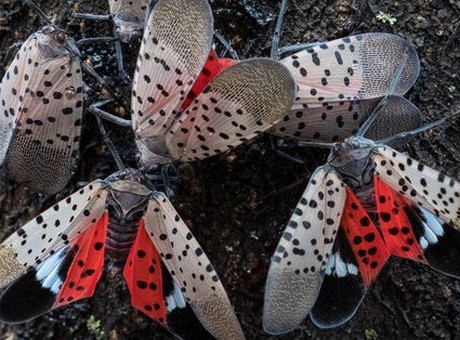
Around 44% of non-native insects arriving in California were first established elsewhere in the U.S. Given the speed with which the spotted lantern fly has spread, Hoddle realized the state needed a proactive approach to this predictable problem.
"Normally, when a bug shows up, we try to contain and eradicate it," Hoddle said. "But by the time the population is found, it tends to already be widespread and hard to handle."
The state Department of Food and Agriculture recently granted Hoddle $544,000 to test whether a tiny parasitic wasp, also originally from China, could be the solution to the looming problem. The wasp lays its own eggs inside the lantern fly's eggs. While developing, the wasp larvae eat and kill their hosts, and then emerge after chewing escape holes through the lantern fly eggs.
These wasps pose no threat to plants or people, but before they can be used to control the lantern fly, Hoddle must prove they won't cause unnecessary harm to other native insects. "We can't just release a Chinese parasite into the wild in California," Hoddle said. "Chances are low it will harm the wrong targets, but we have to be sure."
Safety testing will be conducted in a highly secure quarantine facility at UC Riverside. Native lantern flies, the subjects of safety testing, will be collected from natural areas in California and southern Arizona this summer.
Source - https://www.freshplaza.com
USA - Threat of insect invasion for Californian avocados
19.06.2019 974 views
The impacts could extend well beyond California. According to industry reports, the state is the world's fourth-largest wine producer, selling an estimated $35 billion domestically and exporting $1.5 billion annually.
Around 44% of non-native insects arriving in California were first established elsewhere in the U.S. Given the speed with which the spotted lantern fly has spread, Hoddle realized the state needed a proactive approach to this predictable problem.
"Normally, when a bug shows up, we try to contain and eradicate it," Hoddle said. "But by the time the population is found, it tends to already be widespread and hard to handle."
The state Department of Food and Agriculture recently granted Hoddle $544,000 to test whether a tiny parasitic wasp, also originally from China, could be the solution to the looming problem. The wasp lays its own eggs inside the lantern fly's eggs. While developing, the wasp larvae eat and kill their hosts, and then emerge after chewing escape holes through the lantern fly eggs.
These wasps pose no threat to plants or people, but before they can be used to control the lantern fly, Hoddle must prove they won't cause unnecessary harm to other native insects. "We can't just release a Chinese parasite into the wild in California," Hoddle said. "Chances are low it will harm the wrong targets, but we have to be sure."
Safety testing will be conducted in a highly secure quarantine facility at UC Riverside. Native lantern flies, the subjects of safety testing, will be collected from natural areas in California and southern Arizona this summer.
Source - https://www.freshplaza.com
ScaleAgData Stakeholder Engagement Event
22.10.2024The ScaleAgData project is pleased to invite you to our second stakeholder event. Building on the discussions and connections formed during our first webinar, this event will focus on fostering collaboration among stakeholders, providing updates on our project’s progress, and outlining future opportunities for engagement.
EU reaches agreement on use of new genomic techniques in agriculture
The European Parliament and EU Member States have reached a political agreement on the use of “new genomic techniques” (NGTs) in the agri-food sector, the Danish presidency of the council confirmed on Thursday. The deal paves the way for a new regulatory framework governing how these technologies may be used to develop more resilient and sustainable plant varieties.
Vietnam targets 400 000 ha in winter crop plan
Vietnam's Ministry of Agriculture and Environment reports that the northern region aims to plant 400,000–410,000 hectares of winter crops, with an estimated output of 4.8–5 million tonnes.
USA - NDFU president says new crop insurance rule will hurt farmers' bottom lines
A new federal crop insurance rule that drops buy-up option coverage for prevented planting insurance will be “bad news for North Dakota farmers,” according to North Dakota Farmers Union President Mark Watne.
Australia - $20 million to grow state’s aquaculture industry
The state government launched the $20 million Aquaculture Industry Development Program on Monday, aiming to strengthen and expand the seafood industry’s economic contribution to NSW.
FAO’s new Global Emergency and Resilience Appeal seeks $2.5 billion to support 100 million people in 54 countries
Inaugural Appeal focuses on cost-effective agricultural solutions that link urgent needs with long-term resilience.
India - Farmers devastated as severe storm wreaks havoc on crops
Farmers in southern India are under pressure as a recent storm has severely damaged their crops.
India - Rodents destroy 42 pc crops in Mizoram, over 5K farmers affected
According to the Agriculture Department, Mamit district, which shares borders with Bangladesh and Tripura, was the worst hit.
Hailstorm damages half of Argentinian cherry crop in the western Middle Valley
The storm that hit western Valle Medio in Argentina on Sunday threatened the cherry harvest. Hail covered roughly 30 kilometers from Chelforó to near Chimpay, with a width of 3 to 4 kilometers, according to producers' reports.