“Think about your home for a minute. Can you imagine strangers coming in and carrying items out in plastic bags and placing them along the side of the road?”
Terry Hudson described the reality his neighbors are facing after losing practically everything in the devastating floods that washed out farms and homes in West Virginia June 23.
Neighbors left in despair
Hudson, who owns Hudson Farms CSA, located just outside of Charleston, Kanawha County, said “karma smiled down on us,” having only a few branches and scraps washed up on his property. But his neighbors, just a half a mile away, suffered devastating blows to their home and property.
Rounding up as many workers as he could on his farm, Hudson and his team set to work, mucking out houses and helping locals remove debris from their property. He said as they cleaned out an elderly woman’s house, bagging her damaged items up and carrying them out to the street, “she just sat there and stared out into the yard all day.”
The flood waters that ripped through several West Virginia counties destroyed and damaged more than 4,000 homes, damaged 125 businesses and caused $36 million in damages, according to state officials. Kanawha, Greenbrier, Nicholas, Fayette, Clay, Roane, Summers, Monroe, Pocahontas, Webster, Lincoln and Jackson counties were placed under an emergency status.
“Some areas received 5-7 inches of rain in a matter of minutes,” said Brian Sparks, West Virginia University Extension agent for Fayette and Nicholas Counties. He saw streets littered with everything from mattresses to insulation, and some streets, including major highways, were completely washed out. “It’s just unreal — the push of this water,” he said.
While some homes were completely wiped out, others were left standing, filled with 5 inches of mud, water and a putrid smell — possibly from sewage, said Hudson. “I can’t really explain the depth of it,” he said. “It’s kind of like you’re in a war zone.”
Damage report
A flood damage report, compiled by the West Virginia Farm Service Agency (FSA), July 1, notes that 31 counties reported some level of storm damage and 5,300 farms were affected by flood waters, said Travis Wilfong, communications coordinator for the West Virginia Farm Service Agency.
The report also noted more than $3 million in crop, forage and pasture land damage and a loss of 700 head of livestock. Wilfong noted these numbers continue to increase as farmers continue to assess their land damages. “When these damages happen, the first thing people are concerned with are their homes,” he said. “Once they get their feet on the ground they start to assess the damages.”
“Our farmers lost their crops, their livestock, their high tunnels,” said Spencer Moss, executive director of the West Virginia Food & Farm Coalition (WVFFC). The WVFFC is made up of mostly small, sustainable farms, which Moss said encompasses most of the farm communities in West Virginia. They have pretty much lost their growing season and possibly their livelihood, said Moss.
A release from the West Virginia Department of Agriculture (WVDA) warned producers that flood water could be contaminated with E. coli and Salmonella, which takes up to 90 days for the bacteria to leave the soil. Other bacteria, like Listeria, could remain longer. Producers were urged to get rid of any produce that came in contact with the water and avoid any new planting activity until after that window.
“Fields are pretty much ruined,” said Sparks. “They have so much silt and debris on their fields and you don’t know what came through there.” From flooded pastures, to down crops and even vegetable gardens, Sparks and his team are working to inform producers of the potential hazards of the flood waters that crossed their property.

Fields of crops lay flattened and littered with debris following the flood waters that ravaged through parts of West Virginia.
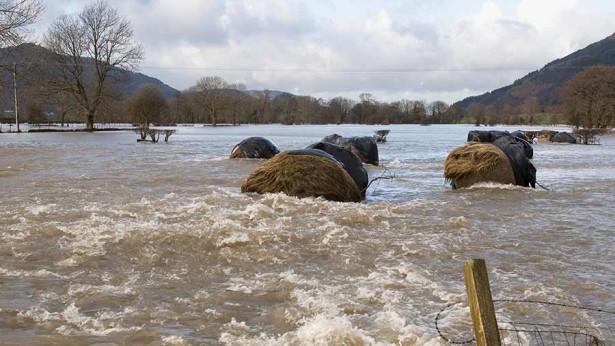
Producers are warned to not eat or feed any produce or hay that has been in contact with flood waters because of possible contamination.
Not as bad as they thought
As the water slowly begins to recede, and damages continue to be assessed, officials and farmers are noting the damages and losses are not as bad as they initially thought. Snuffer said, while many farms throughout the affected counties did experience significant damage, “we initially thought it was going to be a lot worse.”
There were many fields that experienced water damages and crops were affected, but livestock loss rates were low. Many producers worried they had lost their livestock, but it turns out, “the fencing was destroyed and the livestock left,” said Snuffer. Producers are finding their animals slowly returning from cover in the mountains, he added.
Sparks added, “we definitely had some damage, but I think most of it was confined to the small towns and villages.”

Many farmers are finding, the livestock they thought they lost to flood waters had only retreated to higher ground once fences were washed away.
Slowly the animals are returning to their home farms.
Source - www.farmanddairy.com