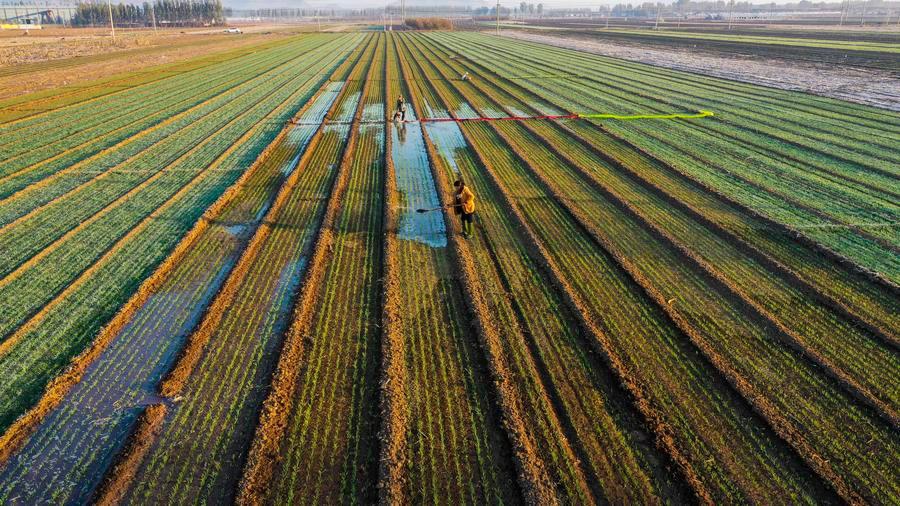
The new government’s budget is marked by a fractured approach to the farm sector, where perhaps the most significant spend has been on irrigation, after the large allocation to farm credit.
Credit push
A sum of ₹1,000 crore sounds good if instead of large irrigation projects and canal networks, the money is used largely for decentralised (rainwater) conservation and storage.
Agriculture in rainfed areas, plateau regions and mountain ecologies could get a boost if a network of tanks, ponds, wells, check dams is established along with efficient lift irrigation schemes for protective irrigation.
The new project “Neeranchal” to give impetus to watershed development in the country with an initial outlay of ₹2,142 crore is welcome. However, micro irrigation which is a relative success in Gujarat and is part of its agri development model, unlike other states, surprisingly finds no mention in the Budget.
There are also a number of small sum token schemes now known as the ‘₹100 crore schemes’..
However, a significant increase in farm credit from ₹7 lakh crore to ₹8 lakh crore is a desirable move given the extreme paucity of formal credit to farmers.
But this money should not go overwhelmingly to high end agriculture/agribusiness to support cold chains, warehouses, reefer trucks, high tech packaging etc. Significant portions of the credit portfolio must be made available to enable small and marginal farmers to become not just self-sufficient, but also entrepreneurial.
An important provision is the Long Term Rural Credit Fund set up for the purpose of providing refinance support to Cooperative Banks and Regional Rural Banks with an initial corpus of ₹5,000 crore.
These banks were being marginalised in the rural and farm credit sector resulting in the exclusion of marginal and small farmers in the last decade.
Another amount of ₹50,000 crore allocated for Short Term Cooperative Rural Credit is a good step as co-operative societies reach the last mile.
Another welcome step is the allocation of ₹200 crore to promote 2,000 farmer producer organisations. This essentially means promotion of existing and new farmer producer companies.
This new set of entities which number more than 500 already are struggling for working capital and investment support though they appear to be quite promising in the modern agribusiness context.
Mixed bag
Warehousing will get a boost with an allocation of ₹5,000 crore . This is needed since there is a pathetic shortage of storage facilities both for cereals and perishable produce and the warehouse receipt system has not really made any headway so far despite its extreme relevance for small holder agriculture.
The provision for financing 5 lakh Joint Farming Groups of landless farmers who lease in land is a welcome move too as these farmers who now cultivate more than 15 per cent of the land do not have any facility to avail loans in the absence of land titles.
But, financing alone may not help as seen in the Andhra Pradesh experience a few years ago when identity cards were given to make such farmers eligible for loans. In any case, this large provision will drive attention to the issue.
An unfortunate fact is that farmers are vulnerable to high levels of production and market risk but no measures exist to make crop insurance work or make markets deliver stable prices.
In this situation, the budget provision of ₹500 crore as a price stabilisation fund is highly inadequate.
There is no specific focus on the problem of making agriculture in rainfed areas viable — by investing in soil health, enhancing water retention capacity, identifying and producing locally adapted seed suited for the specific rainfed area and so on. A scheme to provide every farmer a soil health card in mission mode will be launched, for which Rs. 100 crore has been provided and an additional ₹56 crore to set up 100 Mobile Soil Testing Laboratories have been allocated.
This is adopted from the Gujarat experience and is much needed but to be effective, it requires participation of local agencies and institutions.
Disappointingly, there is just a very modest ₹100 crore allocation to a National Adaptation Fund to meet the vagaries of climate change. Conserving genetic diversity to save valuable genes that could build climate resilience and investment in breeding climate resilient crops, would have buffered Indian agriculture against climate shocks.
However, there is a worthwhile investment in the creation of a fund with a corpus of ₹10,000 crore for providing equity through venture capital funds, quasi equity, soft loans and other risk capital specially to encourage new start-ups in the MSME sector. This can also be leveraged for agribusiness ventures to support farming and farmers.
However, the Budget could have acknowledged the reality of malnutrition and made an allocation.
Source - http://www.thehindubusinessline.com/