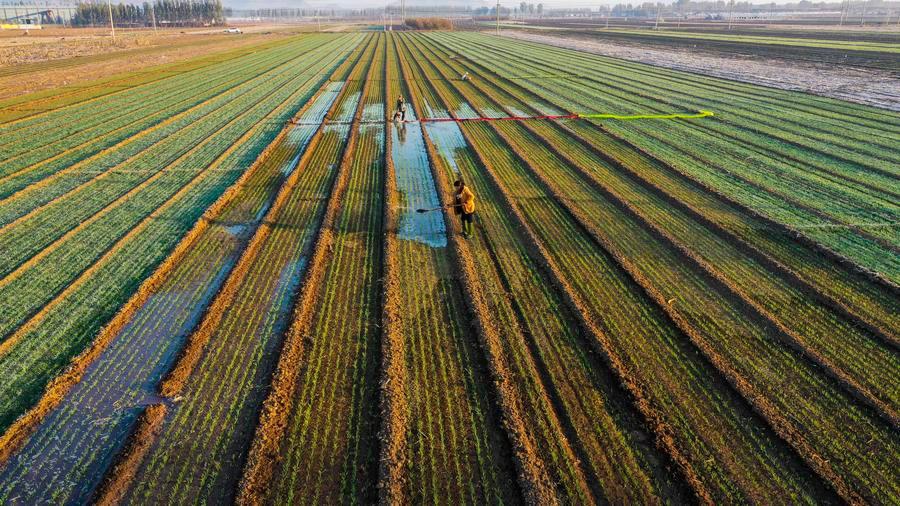
Experts participating in a workshop organised by the State Planning Board here on Tuesday highlighted the use of unmanned aerial vehicles (UAVs) and wireless sensor networks (WSNs) to improve agricultural output in Kerala.
Scientists from national research institutions and private agencies observed that drones with advanced sensors and imaging capabilities offered new and cheaper ways of capturing data on crop health, soil characteristics, meteorological parameters, and growth attributes of crops.
This, they said, would help to enhance yields and reduce crop damage, providing immense opportunities for small and marginal farmers to ensure a sustainable livelihood.
Jerry Daniel, Joint Director, Centre for Development of Imaging Technology (C-DAC), said wireless sensor networks could be deployed for real-time monitoring of soil conditions, pest attacks, ripening of fruits, and biological fertility. S. Selvarajan, Chief Scientist, NAL, said UAVs were emerging as a powerful tool for farmers to collect data for augmentation and improvement of agricultural management practices. He said drones developed by NAL had been deployed to identify plant stress and pest attack.
S.N. Omkar, Chief Research Scientist, Department of Aerospace Engineering, Indian Institute of Science, Bengaluru, said UAVs with powerful cameras and onboard computers had proved successful in mapping crop area and vegetation, assessing plant health, detection of crop diseases, and even identifying tree species in forests.
The drones could also be used to spot illegal activities such as ganja cultivation, poaching, and movement of extremists inside thick forests.
According to Jatin Singh, CEO, Skymet Weather Services, UAVs offered a potent data collection platform to support yield and weather-based crop insurance. Skymet, he said, was using drones for estimation of acreage and yield and assessment of crop loss for calculation of compensation.
The experts observed that efforts were on to develop UAVs with longer endurance, higher payload, and better imaging capabilities to provide more efficient inputs for the farm sector.
Source - http://www.thehindu.com/