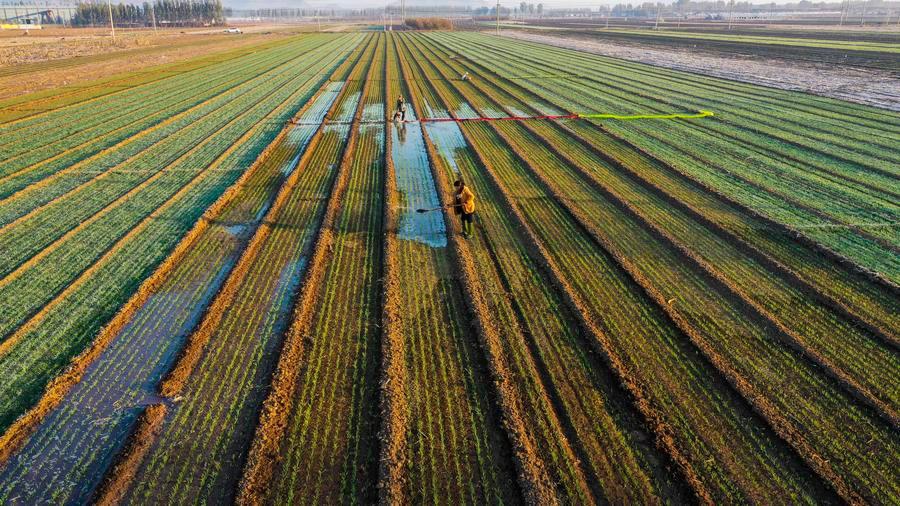
Around the same time as Cyclone Pam flattened the tiny Pacific island nation of Vanuatu early this month, untimely rains and hailstorms lashed Maharashtra in India destroying at least 5.5 million hectares of winter crops.
That was a big jolt to the nation still recovering from the worst calamity of its kind in Uttarakhand in June 2013 when thousands perished in flooding and landslides induced by heavy rains and, in September 2014, from the flash floods in Srinagar, the deadliest to hit the valley in 60 years.
The list of extreme weather events that crippled life in India in recent times gets longer when one includes the July 26, 2005, downpour — the heaviest in recorded history — that flooded the entire city of Mumbai and the August 6, 2010, cloudburst in Leh that dumped 14 inches of rain in two hours.
It was not just the extreme rain events that have surprised weathermen. The longest heat wave that swept northern India in June 2014 drove Delhi’s temperature to 47.6 degrees Celsius, the hottest in 62 years.
According to Global Climate Risk Index, published by Germanwatch, India is one of the three countries (besides the Philippines and Cambodia) affected by the most extreme weather events in 2013.
The Intergovernmental Panel on Climate Change (IPCC) has predicted that “rainfall patterns in peninsular India will become more and more erratic, with a possible decrease in overall rainfall, but an increase in extreme weather events”.
Indian climatologists agree. “There has been a 50 per cent increase in extreme rainfall events during the past 50 years in India,” Jayaraman Srinivasan, chairman of the Divecha Centre for Climate Change in Bengaluru, wrote in the journal Current Science after the Uttarakhand disaster.
“During the past few months there have been a few unusual weather events but there is no clear indication that these are related to global warming,” Srinivasan told IANS.
“I would argue that earth’s weather and climate are governed by non-linear processes, and hence one should expect unusual weather events now and then.”
He, however, added that “extreme rainfall events will increase as global warming proceeds unabated, and hence it is absolutely essential for us to be prepared to tackle more extreme rainfall events in the future”.
Bhupendra Nath Goswami, former director of the Indian Institute of Tropical Meteorology (IITM) in Pune, says his studies have shown that the occurrence of “extreme rainfall events” had been increasing over the country in the last five-six decades.
“We can say with a high degree of confidence that this increasing trend is due to global warming,” Goswami told IANS.
Global warming, Goswami said, “increases the moisture holding capacity of the atmosphere and makes it more convectively unstable, facilitating a stronger rain event.
“Because the atmosphere has become more unstable over the whole country, one or more such events can occur anywhere at a given time.”
Goswami said that all climate models predict an increasing trend of these extreme events into the future.
Therefore, “there is strong reason to prepare ourselves to face the potential disasters associated with increasing frequency and intensity of these events”.
“This erratic behaviour is a regional manifestation of climate change,” says R. Krishnan, a senior scientist at IITM, who has made a detailed analysis of long-term climate data sets.
“Our findings show that the pronounced surface warming of the Tibetan Plateau has altered the spatial distribution of atmospheric temperature, strengthened the sub-tropical westerly winds over the region and created favourable conditions for increased variability of the Western Disturbances activity,” Krishnan told IANS.
Western disturbance is a low pressure system that originates over the Mediterranean sea and moves eastwards, bringing winter rain and snow to the north-western parts of the Indian subcontinent.
Some British scientists suggest a possible link between the extreme events in mid-latitudes and rapid loss of the ice cap that covers the Arctic Ocean.
How will the extreme rainfall events impact Indian agriculture?
According to Minister of State for Agriculture Sanjeev Balyan, an analysis by the Indian Council of Agricultural Research has revealed that nearly 81.3 million hectares of area spread over 122 districts in 11 states may suffer from extreme weather events.
He recently told parliament a study predicted an 18 percent reduction in crop yields for maize and six percent for wheat and rice by 2020.
The impact on agriculture in the Ganges river basin — the largest food producing region in India — may be particularly pronounced according to a report in the journal Climatic Change by scientists of the Indian Institute of Technology in Kharagpur.
On the basis of Regional Climate Model simulations they predict that the Gangetic basin may face an increasing incidence of “precipitation extremes” during summer months in future. Crop productivity of wheat is expected to reduce, they report.
Another Global Climate Model simulation study by researchers at the CSIR-Fourth Paradigm Institute in Bengaluru shows “intensification of extreme rainfall over most parts of India by the end of the century”.
According to their report in Current Science, the increase in temperature, coupled with a decline in rainfall in the west coast, will have drastic consequences on the production of crops.
“Over other regions, increases in heavy precipitation can increase surface run-off and lead to intense floods and landslides.”
Source - http://www.eco-business.com/