Growing up in rural Nigeria, Adaeze Akpagbula spent her school years baby-sitting her family’s chicks through the night, adjusting the coal heater, food and water needed to keep the poultry, and the family income, alive.
Despite her best efforts, unpredictable temperatures, humidity and air quality changes led to the deaths of thousands of chicks, a lesson that would propel her to commit her life to making African farms more climate-resilient.
“Nigeria’s unprecedented rainfalls and weather patterns are not predictable, and with heat and cold stresses our birds were dying,” the 34-year-old agricultural engineer said in a telephone interview with Context.
“We understand that innovation is pivotal to combating climate-related issues around food insecurity,” she said.
“We understand that innovation is pivotal to combating climate-related issues around food insecurity.”
– Agricultural engineer Adaeze Akpagbula
Akpagbula last year launched a remote-sensing device called PenKeep that monitors and controls environmental conditions in poultry farms. She is now extending the technology into aquaculture and greenhouse farms.
Alongside container farms in South Africa cultivating soldier flies for animal feed, solar-powered fish and crop dryers in Tanzania and machine-learning pest detectors in Kenya, Africans are coming up with innovative solutions to overcome the effects of climate change on food production.
Such solutions are going to be needed as Africa, according to a new United Nations report, is the continent most impacted by hunger.
Together with conflict and economic crises, climate shocks are leaving Africa at the epicentre of a hunger crisis, with one in five – some 300 million people – short of food.
It is also the continent most vulnerable to climate shocks, while contributing the least to carbon emissions.
“Current societal inequalities, such as resource constraints, make it even more difficult to source funds to adapt to these changes,” said Mulako Kabisa, from the Global Change Institute research platform at the University of the Witwatersrand in Johannesburg.
“Home-grown solutions matter because they take into cognizance the local context … and what will be sustainable in the long run,” she said in emailed comments.
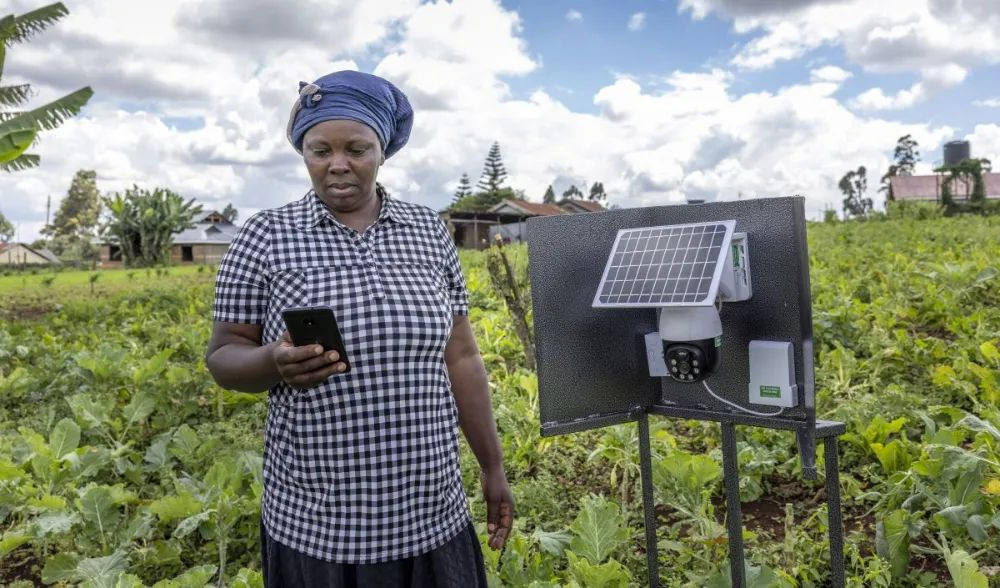
PenKeep’s solar-powered device interprets data from sensors that monitor environmental changes including temperature, water levels and air quality in poultry coops. Farmers are alerted of condition changes through SMS, email or an alarm.
It is being used by more than 1,200 chicken farmers in western and northern Nigeria, with more than 100,000 chickens monitored in the company’s first six months. Subscriptions of around $US15 a month make it more affordable for farmers, Akpagbula said.
Users can also use an artificial intelligence management app called FS Manager that provides farmers with information including management advice, weather updates and book-keeping services.
“Nigeria has millions of poultry farmers…but they are not producing enough…because they are spending so much on energy and they have a lot of poultry mortality as a result of their environment,” said Akpagbula.
Farmers using PenKeep have seen poultry mortality rates decrease by 72 per cent, Akpagbula said.
In east Africa, Tanzanian Evodius Rutta also utilises the continent’s abundance of sun through his MAVUNOLAB Solar Dryer that helps subsistence fish processors and farmers rapidly dry out produce including fish, fruits and vegetables, preventing post-harvest food loss.
Small-scale fish processors at Lake Victoria in western Tanzania have begun using his dryer, reducing the drying time of 250 kilograms of fish from 12 hours to four.
Climate variability has led to erratic rains that can spoil up to 50 per cent of fishermen’s harvests as they do not have access to cold storage, said Rutta, a sustainability researcher and MAVUNOLAB innovation hub founder.
“Because of the rains and high tides, it has also become very dangerous for fishermen that go to the sea and the lakes,” Rutta, told Context in a telephone interview.
“We need low-cost solutions for farmers to adapt to changing climate patterns because it’s going to be unavoidable,” Rutta said, adding that he was getting requests from farmers in Zimbabwe, Uganda and Kenya to use his invention.
Climate change can impact environmental factors such as temperature and humidity that can in turn influence the life cycle and spread of crop pests, according to the UN’s Food and Agriculture Organization.
Pests are already responsible for at least 40 per cent of crop loss worldwide.
Kenyan computer scientist Esther Kimani witnessed this first-hand growing up when pests decimated up to one-third of her family’s pea, potato and maize crops in the south of Kenya.
By the time the pests were detected, the destruction was so severe that even using pesticides became pointless.
Kimani was inspired to invent the Early Crop Pest and Disease Detection Device – a solar-powered tool that uses AI and machine learning-enabled cameras to rapidly detect and alert farmers of pests and diseases.
Kimani’s invention is being used by more than 5,000 farmers across Kenya since its launch in 2020. A group-leasing model reduces the cost to each farmer to $US3 per month.
The device also advises farmers about which pesticides to use when, according to predicted climatic changes.
Kimani estimates that more than 3,000 acres of land have been protected from pest infestation by her invention.
She recently won the Royal Academy of Engineering’s African Prize for Engineering Innovation, for which Akpagbula and Rutta were also short-listed.
Some home-grown innovations are also focusing on protecting agricultural output while reducing carbon emissions.
South Africa’s Philafeed helps build tailor-made black soldier fly container farms. The fly larvae feed on food waste, diverting planet-heating methane emissions from landfills.
The larvae can also be used as a protein feed for livestock, reducing the need for carbon-intensive soya and fish meal.
The larvae manure, a byproduct known as frass, helps increase soil and plant tolerance against drought and flooding, and in turn can increase crop yield in times of climate uncertainty.
“Through black soldier flies we want farmers to be able to diversify their income if there is a failed season due to climate change,” said Maya Zaken, Philafeed co-founder.
Philafeed is currently piloting its new container model in Cape Town.
Despite initial funding challenges and struggles to get farmer buy-in, Akpagbula has faith that her innovation, alongside others on the continent, will soon become essential to farmers as climate shocks become more severe and more frequent.
“People always say why now? Why you doing this now?” said Akpagbula. “I tell them it’s because of the urgency of the climate crisis.”
Source - https://sightmagazine.com.au