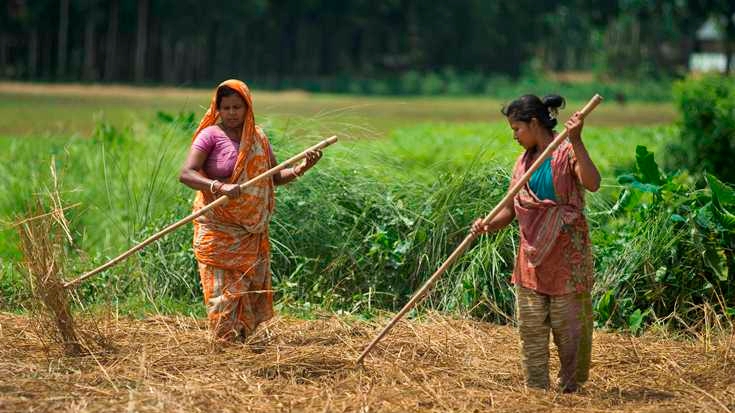
Technology-driven modern farming is in sight in Bangladesh as Prime Minister Tarique Rahman Wednesday unveiled a set of master plans to implement "smart agriculture" initiatives for boosting agricultural production, diversifying farm products and addressing climate-change impacts.
As part of this drive, "Farmer Card" was already launched on 14 April. Through this card, farmers will directly receive 10 different types of services.
The Prime Minister outlined the package initiatives in parliament on Wednesday.
Responding to a written question from Tangail-6 lawmaker Md. Rabiul Awal, he said the Farmer Card would allow farmers to access 10 categories of services directly, including subsidised inputs, low-cost machinery, irrigation support, agricultural credits, crop insurance, training, and real-time weather and market information. Rahman notes that Bangladesh is an agrarian country where the sector plays a central role in ensuring food security, reducing poverty and sustaining economic growth. However, he mentions that climate change, population pressure, shrinking farmland and technological limitations continue to pose significant challenges.
He says the Farmer Card had been introduced to address these challenges and transform agriculture into a sustainable and profitable sector by increasing production and productivity. Through the card, farmers will receive services such as fair-price agricultural inputs, government subsidies and incentives, affordable irrigation, easy loans, crop insurance, marketing support, training, digital access to weather- and market data, and advisory services on pest and disease control.
"The programme would gradually be extended to all farmers nationwide," he tells the House.
The prime minister further says the government has undertaken a series of complementary initiatives to modernise agriculture. These include expanding the use of high-yielding seeds, balanced fertiliser application and modern irrigation systems, alongside a canal-excavation programme covering 20,000 kilometres. "Subsidies are also being provided to promote mechanisation, making equipment such as tractors, harvesters and reapers more accessible."
Rahman mentions a crop- zoning system introduced to ensure optimal land use and bring fallow land under cultivation by aligning crops with local soil and climate conditions.
And special projects are under way to utilise underused land in Sylhet and riverine char areas through improved water management and targeted interventions.
He says the government is placing strong emphasis on diversifying agricultural produce beyond rice to include fruits, vegetables, pulses, oilseeds, spices and flowers, in an effort to stabilise farmer incomes and expand export opportunities.
The prime minister also says that to ensure transparency and accountability, subsidies and incentives for seeds, fertiliser and machinery will be distributed through the Farmer Card.
Low-interest agricultural loans and crop-insurance schemes are being introduced, he reveals, alongside rehabilitation programmes for farmers affected by natural disasters.
In the 2025-26 fiscal year, Tk 7.0 billion has been allocated for agricultural rehabilitation, with over 2.5 million small and marginal farmers already receiving free inputs under the programme.
Rahman says the government is constructing modern cold- storage facilities and warehouses to reduce post-harvest losses, along with mini -cold -storage units for perishable goods and air-flow systems for onion preservation.
Also, plans are in place to establish agricultural export zones in the northern region and expand procurement centres.
He further says agricultural research and innovation are being prioritised through institutions such as Bangladesh Agricultural Research Institute, Bangladesh Rice Research Institute and Bangladesh Institute of Nuclear Agriculture, which are working to develop high-yielding, disease-resistant and climate-resilient crop varieties.
Highlighting climate adaptation, the prime minister says "climate-smart agriculture" initiatives are being implemented, including the cultivation of salt-, drought- and flood-tolerant crops, improved water management and environmentally sustainable farming practices.
"Efforts are under way to reduce irrigation, fertiliser and pesticide use, introduce prepaid irrigation systems and apply Alternate Wetting and Drying (AWD) methods to conserve groundwater."
He adds digital tools, including mobile applications such as "Khamari Apps", will support farmers with location-specific guidance on crop selection, weather conditions and efficient input use, while precision-agriculture techniques are also being promoted.
He says the government will publish a comprehensive white paper investigating alleged money laundering and corruption during the previous administration and take legal action against those responsible. To a supplementary question in the National Assembly, the prime minister says the issue of financial crimes and capital flight has been given priority in the ruling party's election manifesto.
The session was chaired by Speaker Hafiz Uddin Ahmed.
Rahman said 11 high-priority cases related to money laundering involving deposed prime minister Sheikh Hasina, her family members, and associated individuals and institutions are currently under active investigation.
Other cases he names include several major business groups and individuals, including S. Alam Group, Beximco Group, Bashundhara Group, Summit Group, Nasa Group, Orion Group, Nabil Group, Sikder Group, former land minister Saifuzzaman Chowdhury, and businessman H.B.M. Iqbal, along with their associated entities.
He says legal processes are ongoing to recover the siphoned-off funds as part of what he describes as the government's "highest-priority strategy" to combat corruption, money laundering, and financial crime.
Citing findings by a white-paper committee formed during the interim period, the prime minister says an estimated $234 billion was illicitly transferred out of Bangladesh between 2009 and 2023 - averaging around $16bn annually.
Efforts are under way to recover the funds through strengthened international cooperation, including information sharing, asset tracing, and mutual legal- assistance agreements with foreign governments. Bangladesh is currently prioritising 10 destination countries for illicit funds: the United States, the United Kingdom, Canada, Switzerland, Australia, Thailand, the United Arab Emirates, Singapore, Malaysia, and Hong Kong.
Rahman says agreements have already been reached or initiated with Malaysia, Hong Kong and the UAE, while negotiations with the remaining countries are ongoing through respective foreign ministries and agencies.
In the same parliamentary session, the prime minister outlines plans to expand digital employment and skills training.
Responding to a question from Natore-4 MP Abdul Aziz, he says the government aims to train 1,000 freelancers over five years and issue 2.0 million freelancer ID cards during the same period. Around 7,500 cards have already been distributed.
Rahman says the ICT Division is implementing multiple initiatives to expand employment through digital services. These include training programmes, online service delivery, and entrepreneurship support.
He adds that Bangladesh Hi-Tech Park Authority plans to train 2,400 people in advanced technologies such as artificial intelligence, machine learning and virtual reality by 2026.
At present, 83 government services are available online, with plans to add 10 more within the next year. A committee has also been formed to improve the operation of hi-tech and software parks and to facilitate the introduction of PayPal services in Bangladesh.
Source - https://today.thefinancialexpress.com.bd