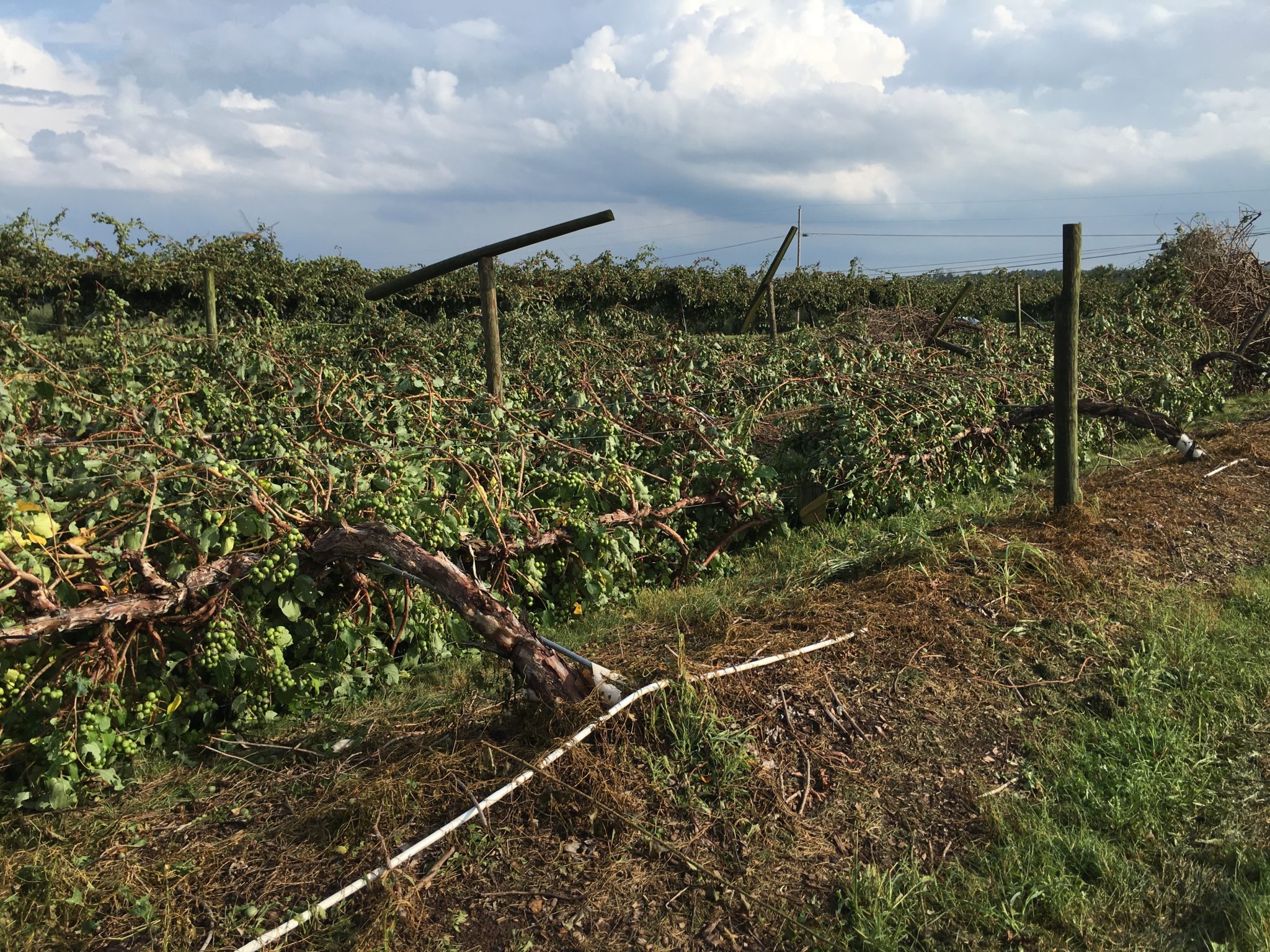
Figures from the Department of Environment, Food and Rural Affairs (DEFRA) show that England has suffered its second-worst harvest since records began. Wheat, winter barley and oilseed rape all saw double-digit declines.
Most winemakers have only just started harvesting grapes this week, so trade body Wine GB was reluctant to provide an official estimate on the 2024 crop.
However, CEO Nicola Bates told Decanter.com: ‘Like many wine regions in Europe, we have experienced challenging conditions this year and are expecting reduced production due to high disease pressure that has required proactive management.
‘Vintage variation is common in our cool climate and despite record volumes last year [21.6 million bottles], our five-year production average stands at 12.4 million bottles. A comprehensive account of this year’s harvest will be published in December.’
Anecdotally, many English winemakers expect this year’s harvest to be down by between 20% and 70%.
Hampshire has arguably been hit the hardest, so we headed to the county to find out how growers have coped with the grim weather.
‘An incredibly challenging season’
Esteemed Champagne producer Vranken Pommery gave the nascent English sparkling wine industry a major stamp of approval when it expanded into Hampshire back in 2016.
The company now has around 50 hectares of Chardonnay, Pinot Noir, Pinot Meunier and Pinot Gris vines in Old Alresford, which is near Winchester.
‘We are down to about half of what we would expect in a normal year, and around one-third of last year’s record crop,’ said Vranken Pommery’s cellar master Clément Pierlot.
‘I think Hampshire was hit more than many other counties. We had a very good year last year, so we know it’s a cycle, and we have to accept it.’
Will Perkins, head winemaker at Vranken Pommery’s Pinglestone Estate in Old Alresford, put on a brave face when discussing the challenges his team has faced this year.
‘This has been an incredibly challenging season,’ he admitted as he stood in a wet, muddy vineyard, flanked by rows of Pinot Meunier vines. ‘However, to have reached this point with the quality that we’ve got in the vineyard is testament to everybody’s application.
‘We’ve had to be really receptive this year to the conditions. The disease pressure has been super high. The quality we have is amazing, and we are delighted by what we do have to showcase for 2024, given all of the challenges of the season.
‘From January through to today, we haven’t had a window of more than six days without rain, so it has been super challenging. On 1 August, we had 40ml of rain in an hour. It was so localised, just here and in an adjacent vineyard. That was at the most sensitive period for downy mildew in the UK. We have had to be very contextually nimble and adaptive. It has been an incredibly meticulous approach.
‘We had to prioritise saving premium parcels. We are down, but the quality is high, which is reflective of the dedication and the passion of the team.’
Downy mildew gives growers nightmares
Downy mildew has been the primary concern for English winemakers during this year’s damp, humid growing season.
Fred Langdale, vineyard director at Exton Park, which is around 10 miles south of Pommery’s vineyard in Hampshire, is also facing substantial losses. ‘The quality of the fruit was actually good, but the quantity was down around 20% on what we anticipated at the beginning of the season,’ he said. ‘There were a lot of areas where the fruit hadn’t ripened, so we had to be very selective with our picking.
‘The challenging weather came in late June at Exton Park, when it was very damp during flowering. Humidity levels then remained high for the whole summer which put more pressure on the vines, with a risk of downy mildew.
‘Pinot Meunier was hit harder, as it flowered during a wetter period than our Chardonnay and Pinot Noir. Although this wasn’t detrimental to the quality of the grapes, it did affect the bunch weight.’

Harvest 2023 at Exton Park. Credit: Exton Park
Low yields expected across England
Producers across Sussex also experienced challenging conditions this year, but vineyards in Kent appear to have fared better.
Tamara Roberts, CEO at Ridgeview Wine Estate in East Sussex, said: ‘As we near our 30th anniversary, this year’s growing season has proven to be one of the most challenging.
‘However, our strategy of partnering with growers across southern England has been invaluable, especially as our eastern sites have been less affected by the wet weather.
‘Diversifying our grape sources is key to the quality of wine we produce. All have very different characteristics and contribute something special to our English sparkling wine.’
Gusbourne Estate, which owns 16 vineyards across 90ha in Kent and West Sussex, reported a similar situation. CEO Jonathan White said that many vineyards have suffered from mildew, but he added that West Sussex in particular is expected to produce significantly less fruit than last year’s bumper crop.
‘Thanks to careful work in the vineyard, we are confident that only pristine, clean fruit will be picked,’ he said. ‘Any fruit which does not meet our exacting standards will remain in the vineyard. The result is that the 2024 harvest will be considerably smaller in quantity, but we expect the wines to still reflect our usual exceptional quality.’
Plumpton Wine Estate in East Sussex is only picking half the fruit it harvested last year, citing ‘challenges with disease pressure due to constant rain’.
Winemaker Nicholas Brewer at Oastbrook Estate, which is on the Sussex-Kent border, said: ‘2024 has been a challenging year in England, with reduced yields and a late harvest, but it’s a story of less is more, with our grapes ripening well, with no disease.’
Sussex, Kent and Hampshire account for 64% of the UK’s total vineyard area, according to Wine GB. The southwest of England, which makes up around 6% of the country’s area under vine, also had a torrid season.
Duncan Schwab, head winemaker at Sandridge Barton in Devon, expects volumes to be down by 70% compared to last year. He added that many producers in the southwest of England have experienced similar declines.
Producers grapple with climate change
Climate change has allowed English wine sparkling producers to rival the Champenois in terms of quality. The south of England now has similar weather conditions to the Champagne region in the 1960s and 1970s, while the terroir is also similar.
However, experts suggest that the English wine industry will need to grow increasingly resilient as it grapples with climate change moving forward.
Tom Lancaster, an analyst at the Energy and Climate Intelligence Unit (ECIU), said: ‘This year’s harvest was a shocker, and climate change is to blame. It’s clear that climate change is the biggest threat to UK food security, and these impacts are only going to get worse until we reduce our greenhouse gas emissions.’
Matt Strugnell, the head of viticulture at Ridgeview, added: ‘There is uncertainty about what climate change will mean for us. Building climate resilience into our vineyard management is absolutely key and we are embarking on a journey to investigate in detail what is happening with our soils.
‘This coupled with a more detailed approach to pruning should mean healthier vines in the long term and healthier vines should be better equipped to deal with a changing climate.
‘This season has been a reminder that we grow grapes in a marginal climate. It will always present us with challenges, but personally, I think this is what makes our wines more exciting and interesting – growing these varieties on the limit.’
Producers across the country did what they could to save as many grapes as possible during the torrential downpours of 2024.
‘It has been a challenging year, but we are used to these kinds of conditions,’ said Pierlot at Vranken Pommery. ‘We have a lot of experience with these conditions in Champagne as well. We realised that we would not be able to make a normal yield this year. You have to prioritise certain plots.
‘It’s a relief to see how good the juice is, because we were scared a month ago. We were worried about downy mildew and botrytis, but the fruit is very healthy. It won’t reach the ripeness of 2022, but it will be fine.’
Langdale at Exton Park added: ‘We would usually let the cover crops between each row grow tall and flower to create an effective habitat for insects. However, this year we had to cut these shorter to decrease humidity and allow more air to flow through the vines.
‘We also undertook more intense leaf stripping to expose the grapes to the sun and wind to keep them as dry as possible. Our careful canopy management at the correct times of year encouraged the canes to grow upwards rather than tangled to maximise airflow and we were very precise about our selection of products used to spray the vineyard. All of this combined had a positive effect on counteracting the challenging weather conditions.’
Reserve wines will help producers
Last year, English winemakers enjoyed a record harvest, which produced 21.6 million bottles, following near-perfect weather conditions. Wine GB called it a ‘miracle harvest’ and reported that the top 25% of vineyards recorded an average of 15.6 tonnes per hectare.
As such, many producers still have excess stock left over from last year’s bumper crop, which should help them meet demand.
‘We have reserves in the tanks from last year,’ said Pierlot. ‘Reserve wines are key to helping us to adapt to bad years.’
Source - https://www.decanter.com