In mandis across Punjab, unsold paddy rots under open skies as the Centre and State play blame games, pushing farmers towards desperation and debt.
On December 12, 2014, Bhagwant Mann, the present Chief Minister of Punjab, quoted the opening lines of this poignant song by the people’s poet Sant Ram Udasi (1939–1986) in Parliament. Speaking as a member of the Lok Sabha, Mann recited them to underscore the deepening farm distress in Punjab and urged political parties to rise above partisan differences and unite to tackle the crisis.
The situation today is more complex and dire than ever. A recent viral image of a barefoot farmer, with folded hands in front of a deputy commissioner, standing beside his produce under the open sky at a grain market, captured the distress of thousands of farmers. Punjab is now grappling with its worst paddy procurement crisis in over 25 years, as per observers. While the procurement process had remained largely uninterrupted even during the, this year, delays— despite favorable weather conditions—have thrown farmers into turmoil.
Though the Centre has assured the Punjab and Haryana High Court that regular meetings are being held between Central agencies and the State to monitor procurement, the crisis has sparked sharp exchanges between the Centre and State governments. Disposing off the plea on October 30, the court noted: “[T]he issue raised herein relates more to market forces and is dependent upon various variable factors, which change every day and essentially relates to policy decisions between Central Government and the State Government.”
The current crisis has led to protests by farm unions, including blockades of toll plazas on key roads, as desperate farmers demand immediate action.
The existing paddy procurement system in the State involves the coordination between the Central government, State authorities, and the Food Corporation of India (FCI), which sets procurement targets. The FCI buys paddy from farmers at the minimum support price (MSP) and it is then milled into rice, which is either stored or distributed under the National Food Security Act (NFSA). However, State rice millers have raised concerns about the lack of storage space for the newly harvested crop. They are urging the Central government to release current stocks of wheat and paddy to create room for the new harvest.
The crisis deepened as private rice millers refused to store government paddy due to limited storage capacity, the use of hybrid paddy varieties encouraged by the State government (which do not meet FCI standards), and problems with labour and commission arrangements at grain markets. Mandi workers are demanding higher wages, while commission agents (arhatiyas) are insisting on a 2.5 per cent commission, instead of the usual Rs.46 per quintal.
Last month, despite protests by the millers, the Punjab Rice Millers Association alleged that procurement agencies used police force to get the paddy stored on mill premises in some districts. The association lamented the government’s alleged failure to redress the matter. On October 21, Mann chaired a meeting to review the procurement operations in the State. He directed officials to ensure the quick lifting of paddy being procured in mandis across the State.
In Punjab, “the procurement of paddy officially commenced on October 1, 2024, with 2,700 designated mandis, including temporary yards, to ensure smooth operations. Due to heavy rainfall in September and higher moisture content in paddy, the harvesting and procurement were slightly delayed,” said Union Minister of Consumer Affairs, Food and Public Distribution Pralhad Joshi at a press conference in Delhi on October 27, adding that despite a late start, the State is now on track to achieve its target of procuring 185 LMT of paddy (worth about Rs.43,500 crore) by November 2024.
“This year Punjab had a bumper paddy yield of about 230 lakh tonnes as compared to 212 lakh tonnes in 2023,” said Devinder Sharma, a noted Mohali-based agricultural expert, adding that the paddy should have been lifted by October-end as farmers start sowing wheat in the first week of November.
In a predominantly agrarian Punjab, which played a pivotal role in India’s Green Revolution of the 1960s, paddy is not only a staple of the State’s economy but also a key political issue. Together, wheat and paddy account for over 25 per cent of Punjab’s GDP.
The ongoing procurement crisis is likely to impact the Aam Aadmi Party’s prospects in the upcoming byelections for rural constituencies such as Dera Baba Nanak, Barnala, Gidderbaha, and Chabbewal. Ahead of the 2002 State Assembly election, Shiromani Akali Dal (SAD)-BJP lost due to mismanagement in the procurement system. After becoming the Chief Minister, Capt. Amarinder Singh staged a dharna along with his Cabinet colleagues outside the then Prime Minister Atal Bihari Vajpayee’s residence to get the issue resolved. But the current crisis is even bigger, according to disgruntled farmers.
As Punjab is midway in the procurement of paddy, the slow lifting has led to a political slugfest. While all political parties, including the BJP and the AAP, are holding demonstrations to outdo each other in politicising the issue, on October 26, Amarinder Singh, former Chief Minister and BJP leader, visited the Khanna grain market and interacted with farmers.
Farm leaders and experts, including Devinder Sharma, hold both the State and Central governments responsible for the crisis. “The situation reflects poorly on federalism and the collapse of State administration,” he said, adding, “The Central government should have cleared FCI stocks in a timely manner—there is no excuse for this delay. Similarly, the State government should have initiated the procurement process three months ago.”
Punjab’s Agriculture and Farmers Welfare Minister, Gurmeet Singh Khudian, has accused the Central government of deliberately delaying the transportation of previously stored food rations from State godowns, leading to a space crunch that has disrupted the current procurement process.
Facing growing opposition criticism, AAP workers—led by eight Cabinet ministers and senior State leaders—staged a protest against the BJP in Chandigarh on October 30. “Over the past six months, we have sent seven letters to the Centre requesting the removal of these stocks to free up space for the new harvest, but there has been no action,” Punjab’s Food and Civil Supplies Minister, Lal Chand Kataruchak, told reporters. He emphasised the urgent need to double the number of trains transporting PDS grains from Punjab to food-deficit States, from 18 to 36, to resolve the crisis.
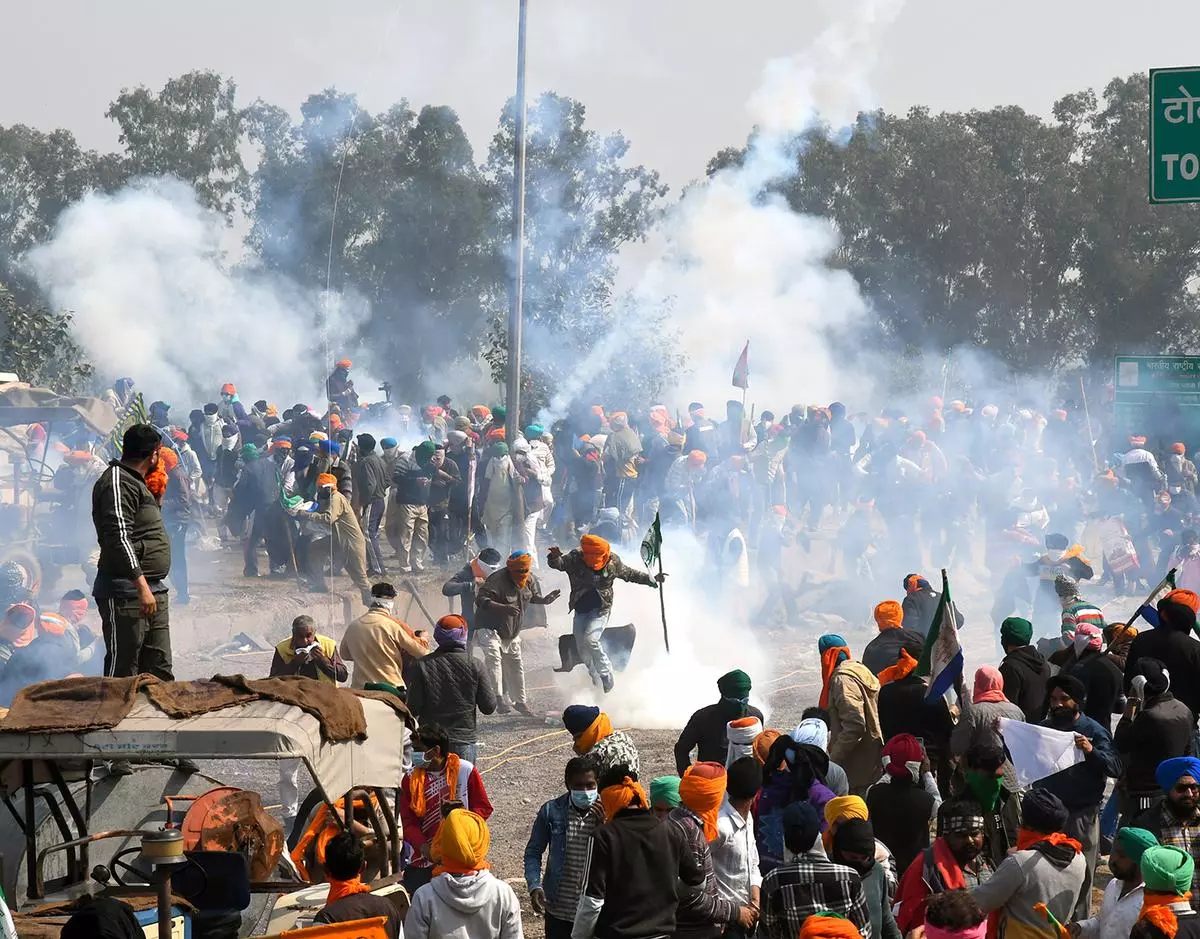
Police fire tear gas as farmers march to Delhi to seek the enactment of a law on minimum support price, at Shambhu Barrier in Punjab on February 14, 2024. | Photo Credit: SHASHI SHEKHAR KASHYAP
Farmer leader and chief of Sanyukt Samaj Morcha Balbir Singh Rajewal claimed that the State’s farmers are being punished for leading the year-long agitation against three controversial farm laws that were eventually withdrawn by the Modi government in November 2021. “They want to teach Punjab’s farmers a lesson. It is for this reason that the Centre did not procure last year’s 2 lakh tonnes of rice from the millers. The State godowns are brimming with food rations but the Centre has stopped the movement of wheat and rice from the State,” he said.
Grain beneath the skies
In several places the struggling farmers were compelled to offload their crops at drastically reduced prices at private mills, as the grain had begun to lose moisture under open skies in market warehouses for days, diminishing its weight and value.
“While the delayed lifting has pushed the paddy harvest and the next crop cycle, it will have a direct impact on the quality of paddy and its price,” said Jagjit Singh Dallewal, a prominent farmer leader, who has been campaigning for implementation of Swaminathan Commission report’s recommendations to ensure adequate prices for farmers’ produce. “It is going to cost the State exchequer dearly.”
Former Chief Minister and Jalandhar MP Charanjit Singh Channi has lambasted Mann, labelling him “a parrot caged by the AAP and the BJP”. Recalling the AAP’s election-eve promises, Channi told reporters: “Mann had promised to lift every grain of farmers’ produce and provide MSP. But today he is nowhere to be seen. The decline of Punjab’s farmer means the decline of Punjab.”
Many farm leaders allege a conspiracy aimed at facilitating corporate entry in the farm sector in a big way. They have questioned the radio silence of Modi and AAP chief Arvind Kejriwal. Joginder Singh Ugrahan, the president of Bharatiya Kisan Union (Ekta-UGRAHAN) said: “Both the Central and State governments are shirking their responsibilities under one pretext or another. Their aim seems to be to bring in private players, while the FCI remains absent from the scene. Meanwhile, State agencies tasked with procurement are bound by numerous unreasonable conditions.”
Due to widespread unemployment and farm distress, many young people in Punjab are migrating abroad, often risking their lives in the process, according to several studies. In one such study conducted by Kamaljeet Singh and Rakshinder Kaur of Punjabi University, Patiala, 79 per cent of visa aspirants come from rural backgrounds, with 70 per cent hailing from farming families. The study also found that to finance their children’s education abroad, many families are forced to sell land, liquidate other assets, or avail of loans. A 2022 report by Punjab Agricultural University in Ludhiana on farm suicides revealed that 9,291 farmers in six districts of the State took their own lives between 2000 and 2018. The report attributed 88 per cent of these suicides to the crushing burden of farm-related debts.
The children of Punjab
“I visited several grain markets between Chandigarh and Firozpur in the last week of October. By that time, only 15 per cent of the harvest had been procured, whereas at least 50 per cent should have been,” said Devinder Sharma. “In my conversations with farmers, many expressed deep concern, wondering if their children would have any future in Punjab.”
Though the Union Ministry of Chemicals and Fertilizers has refuted the allegations, many farm unions complain about the alleged shortage of diammonium phosphate in Punjab, which is likely to have an effect on the prospects of rabi crop. “Why are farmers standing in queues to get subsidised fertilizers being lathi-charged? It is the officials who are responsible for creating this mess,” said Sharma. Underscoring that Punjab is the agricultural powerhouse of the country, he added, “Instead of praising and supporting its farmers for their record production, they are being punished. This not only threatens the State’s agricultural future but also jeopardises India’s food security. We are already seeing the consequences of such mismanagement in neighbouring Pakistan.”
Meanwhile, SAD has threatened to launch an agitation if the AAP government fails to act swiftly to ensure the procurement and timely lifting of paddy from mandis. As political tensions and protests over the worsening farm crisis are expected to escalate, Sharma raised a pointed question: “Have you ever seen a corporate figure sitting at Jantar Mantar demanding loan waivers? Their debts worth Rs.15 lakh crore get written off without anyone batting an eye. Yet, poor farmers have to take to the streets just to secure the procurement of their crops and get their loans waived, only to be branded ‘Khalistanis’ and ‘militants’ in the process.”
Source - https://frontline.thehindu.com