Resistance to insecticides is complicating pest control, prompting experts to advocate for farmers in North America to use more integrated pest management strategies in their potato fields.
Resistance to insecticides is complicating pest control for potato growers, with experts warning that overuse, off-target exposure and pest resurgence are driving control failures.
Ian MacRae, an entomologist with the University of Minnesota’s Northwest Research and Outreach Center, is one of the experts watching the trend.
WHY IT MATTERS: Agronomists and farmers have noted for years that previous go-to chemical pesticides are providing lower control against pests like Colorado potato beetle.
Resistance arises through a combination of genetic and environmental factors, he noted. Some insects carry pre-existing genetic traits that make them less susceptible to insecticides. These traits are often rare in a population, but with repeated exposure to a chemical, resistant individuals survive and pass those traits on to future generations.
Those traits can come in a couple of forms. The insect might have metabolic resistance, in which the pest detoxifies the insecticide faster than a susceptible individual, or target-site resistance, in which the receptor sites affected by the pesticide are altered. Some pests also develop penetration resistance, which slows down absorption of the chemical, giving their detoxification systems more time to neutralize the toxin. Others exhibit behavioural resistance, actively avoiding treated areas or emerging later in the season when pesticide residues have faded.
In cases like the two-spotted spider mite, he noted, there has been a phenomenon called hormoliogsis, “where sub-lethal exposure to pesticides can actually increase reproduction rates.”
Potato beetles cast a wide net
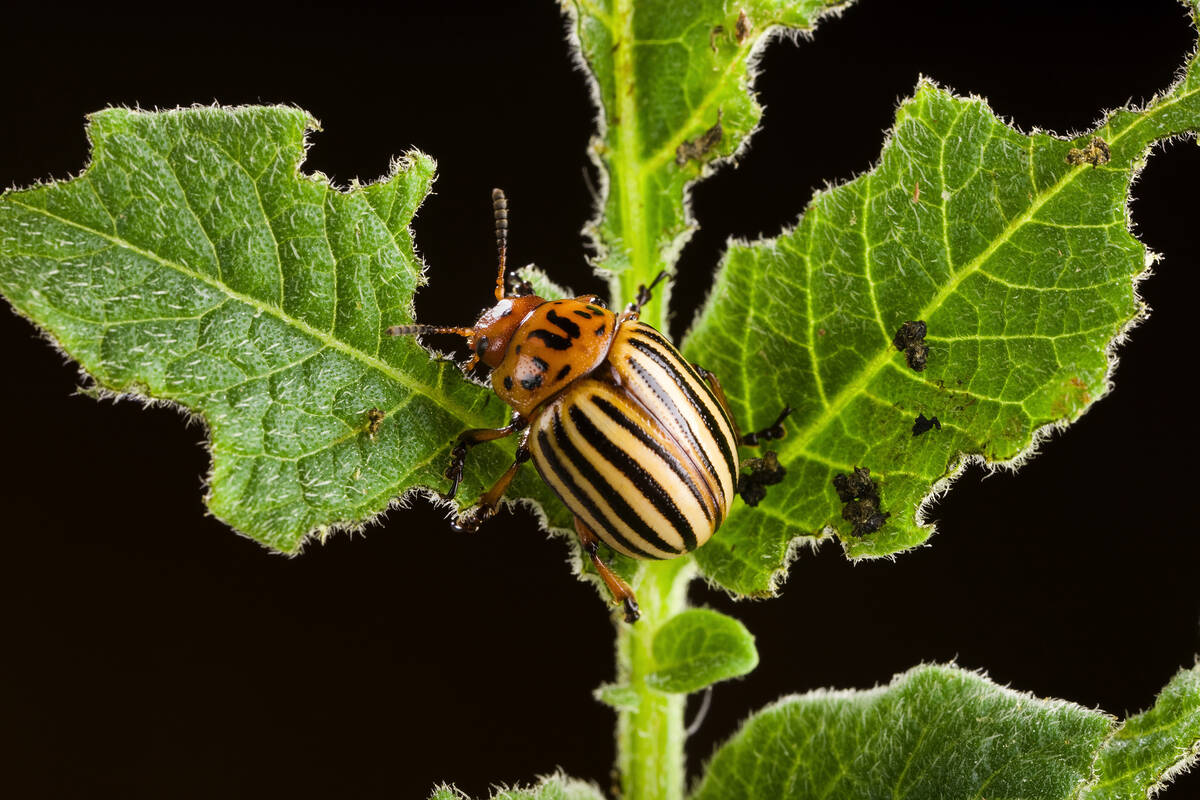
In Manitoba, spud growers will be well familiar with the increasingly complex problems of Colorado potato beetle control.
Experts have noted changes in behaviour and the insect’s life cycle that have kept more beetles out of the hot zone of a single pesticide pass, leaving more to survive. They are emerging later in the season, for example, avoiding at-plant applications of neonicotinoid insecticides, MacRae says.
“It used to be we’d have adults entering the field in the spring, maybe just a little bit, then they’d mate, have offspring with a big, heavy defoliator early in the season, those June, early July periods. And after mating and having eggs, the overwintering adults usually would just kind of die off. And so, you’d have this big peak of defoliation early in the season from the larva they eat, and then when they were finished growing, they’d drop to the ground, off the plant, burrow into the soil, and then they pupate down there and change into adults.”
This predictable pattern of emergence is now changing, with adult beetles, larvae and eggs appearing at the same time in July, overlapping in a way that makes control efforts more difficult, MacRae adds.
The delay in emergence has serious implications for pest control strategies. Typically, early-season neonicotinoid applications target overwintering beetles, but with later-emerging populations, the insecticide concentrations in plants are too low to be effective. This allows susceptible beetles to avoid exposure and survive, leading to an increase in resistant individuals.
“The later emergence of a large portion of population actually are susceptible to neonicotinoids. They’re not the resistant ones. The resistant ones come out and they don’t care. They’ll feed on it anyway, because they can detoxify basically a lot of their resistance,” MacRae says.
A limited toolbox
In 2023, roughly 70 per cent of all global insecticide sales came from just four modes of action, McRae noted,, increasing the risk that pests will continue to develop cross-resistance to multiple chemicals.
Cross-resistance occurs when an insect develops resistance to one insecticide but also becomes less susceptible to another, even if it has never been exposed to it. Growers who rely on rotation strategies could be affected by this, as resistance to one chemical could render an entire class of insecticides ineffective. Behavioural resistance is also playing a growing role, MacRae said.
“This is where… it allows the insect to escape or avoid the insecticide application.”
Newer insecticides have been developed to target specific life stages of pests, such as early instar larvae — but even these approaches are not foolproof, MacRae said. In Michigan, Wisconsin and Minnesota, Colorado potato beetles have exhibited behavioural resistance by remaining in diapause, a hibernation-like state, longer, emerging only after the insecticide residues in plants have diminished.
The economic challenges of insecticide resistance also cannot be ignored, MacRae said. The cost of developing a new insecticide is extraordinarily high.
“Back in 2011, when they did a large study, a consulting company looked at the cost of developing a molecule… that might have insecticide potential, it was a 10-year process, and it cost $250 million,” he said, adding that the cost now be well over $300 million.
Integrated pest management
There are steps growers can take to slow the development of resistance, according toMacRae. He recommends rotating modes of action whenever possible and avoiding back-to-back applications of the same class of insecticide across successive generations of a pest.
Reducing off-target applications can also help, as can targeting treatments in both space and time to ensure maximum effectiveness.
While not all application failures are due to resistance, it’s important to recognize the warning signs and adjust management strategies accordingly, MacRae says.
With resistance already widespread in several key pest species, growers are being urged to adopt integrated pest management practices that rely on a combination of cultural, biological, and chemical controls.
Without changes to current approaches, experts like MacRae warn that growers could soon face a future with fewer viable options for managing potato pests.
Source - https://www.manitobacooperator.ca