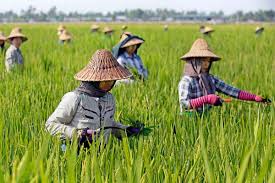
Myanmar's Agriculture and Rural Development Loan Project has disbursed over 247 billion kyats (about 117.61 million U.S. dollars) in financial assistance as of 2024, benefiting 5,816 farmers, the state-run Myanmar Radio and Television reported on Sunday.
The report said that the project not only benefits farmers but also strengthens the country's agricultural sector, Xinhua news agency reported.
The project, launched in July 2017, offers low-interest loans to support farmers in purchasing essential agricultural machinery, the report said. The repayment scheme includes three-year short-term and five-year long-term instalment options, it added.
Agriculture in Myanmar (also known as Burma) is the main industry in the country, accounting for 60 per cent of the GDP and employing some 65 per cent of the labour force. Burma was once Asia's largest exporter of rice, and rice remains the country's most crucial agricultural commodity.
Other main crops include pulses, beans, sesame, groundnuts, sugarcane, lumber, and fish. Moreover, livestock are raised as both a source of food and labour.
The primary method for rendering arable land is the slash-and-burn method (also known as "shifting cultivation" or "swiddening"). This involves setting fire to areas of primary forest or secondary forest to create fields where crops can be cultivated. After these fields are used for a time and the nutrients in the soil are used up, the land is abandoned and allowed to grow freely. Growth begins in the one to three years following the land's abandonment, and within 10 to 20 years it is once again able to hold an established secondary forest.
Sometimes, this arable land is converted into rice paddies, a common agricultural technique in southern and eastern Asia. In Burma, the paddies are flooded only occasionally by rivers, while a majority of the time farmers rely on the monsoon season for the necessary water. The paddies have an "impermeable subsoil", on top of which is a saturated layer of mud, and lastly around 4–6 inches of water.
Farmers in Myanmar raise livestock for both food and labour purposes. This includes cattle, water buffalo, goats, sheep, oxen, chickens, and pigs. Oxen and water buffalo are used as draft animals throughout the country, while most cattle are raised in the dryer northern regions. Goats are kept by farmers in pasture for their milk.
Farmers in Myanmar were affected by the outbreak of the H5N1 bird flu strand in Asia. Initially, the Mandalay and Sagaing regions of Myanmar were affected, and this resulted in the culling of several thousand chickens, quails and their eggs. However, as of 2006, the country's livestock officials announced a plan to fund the restocking of birds and feed for the affected poultry farms.
As of at least 2024, Myanmar has the largest amount of cattle herding in southeast Asia. Myanmar's domestic beef consumption is not high because of religious reasons and because of cattle's utility as a farm animal. The 2012 Major Commodity and Service Law prohibited the export of live cattle, although a lack of enforcement Myanmar meant that significant smuggling out of the country occurred. In 2017, Aung San Suu Kyi's government lifted the ban and began regulating cattle exports as a revenue-raising measure.
Source - https://www.thehansindia.com