CAP has steered Bulgarian agriculture toward greater resilience, but the sector continues to suffer from an absence of a comprehensive risk management strategy and limited research on internal and external risks, the report concludes.
Climate & adverse weather events
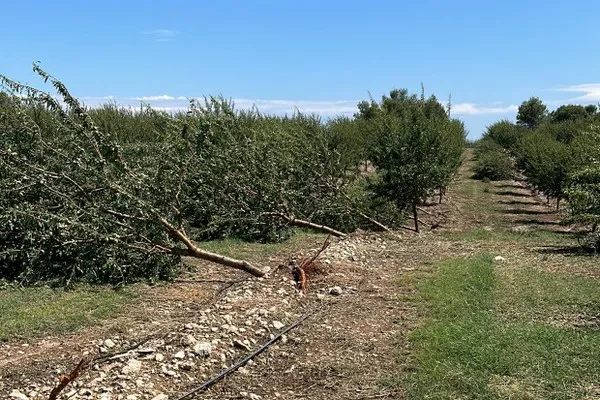
The report highlights how sensitive Bulgarian agri sector is to risks related to changing climate and adverse weather conditions, such as long droughts, heat waves, heavy rainfalls, floods, hails, and frost. Because of Bulgaria’s agro-climatic conditions, increased drought stress and a shortened active growing season have had negative impacts on both crops and grasslands, while also contributing to a higher incidence of plant and livestock diseases. According to the report, plant diseases and adverse climatic events have caused significant agricultural losses, resulting in approximately 347,000 failed hectares over the last decade. Wheat and oilseed crops are most affected, accounting for 50 percent and, respectively, 20 percent of the affected area. Drought and hailstorms accounted for 45 percent and 25 percent of the failed areas, respectively.
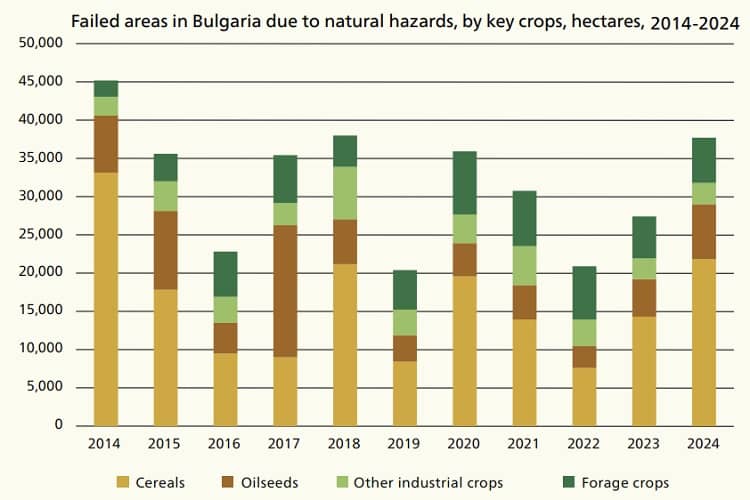
Vergroot afbeelding Graphic showing failed areas in Bulgaria due to natural hazards, by key crops, hectares, 2014-2024
Beeld: World Bank, based on data from the Ministry of Agriculture and Food of Bulgaria
Animal health risks
Authors point that Several widespread disease types (African swine fever, lumpy skin disease in cattle) had never been reported in Bulgaria until the last decade, when they hit the animal industry and caused production, economic, financial, ecological, and social losses. Most notable losses were recorded during the 2019-20 African swine fever outbreak, which affected multiple industrial farms. About one million animal deaths were estimated from 2019 to 2024 due to various diseases. Most recent economically significant challenges are related to avian influenza.
Losses
The World Bank estimates approximately 160 million euros of expected annual losses (4,4% of the total production value) only from yield volatility in portfolio of 6 key crops + cow’s milk. Some products are considered riskier than others - for instance, grain maize accounts for 20% of the portfolio’s value but contributes 38% of the expected losses. Based on a quantitative and qualitative analysis, The World Bank also developed a 2-layer financial strategy, combining different financial instruments to cover losses of various severity - Layer 1. Risk Retention for Frequent Events and Layer 2. Risk Transfer for Severe Events.
External shocks and macroeconomic factors
The recent supply chain disruptions and input price volatility caused by the war in the Middle East just follows a serries of external shocks that deeply affected Bulgarian agrifood sector. The World Bank highlights challenges starting from the covid-19 pandemic, and associated supply chain distortions, as well as the prolonged war in Ukraine, and current uncertainties about the multilateral trade system and relations. They lead to complex negative impacts for the farmers - rising prices for essential inputs such as feed, electricity, fuel, fertilizers, and others, along with heightened uncertainty in agricultural and commodity markets.
In addition, the report emphasizes structural issues that Bulgarian farmers were already facing prior the external shocks occurred, such as: decline of the working-age population and persistent de-population in rural areas, fragmentation of agricultural holdings, insufficient production diversification, technological modernization and innovation. Macroeconomic trends, such as inflation, reduced purchasing power of the population, price volatility, and others, further amplify these vulnerabilities, authors point.
Insurance and state aid
The World Bank highlights that insurance adoption remains limited due to mismatched premiums, low awareness, and a lack of reliable information and data systems. These issues are compounded by a weak insurance culture and limited risk perception among farmers, with ex-post disaster relief prevailing over proactive, market-oriented solutions. Coordinated effort is thus advised to improve data provision, build knowledge and capacity, develop effective risk management instruments, and raise awareness among all stakeholders about the necessity of insuring against the full spectrum of agricultural risks.
The core of Bulgaria’s agricultural insurance market is crop insurance covering losses from natural perils with only a minority of farmers, typically larger, more commercial operations, participate. According to the report, as of 2022, about 20 percent of Bulgaria’s arable land was insured against one or more perils. Major field crops (wheat, maize, sunflower) compose the bulk of the insured area, while perennial crops (fruits, vineyards) also see insurance uptake due to their high value and vulnerability to frost or hail. Livestock insurance remains negligible - in 2022, premiums were only about 0.05% of total non-life insurance premiums in Bulgaria.
The World Bank emphasized that unlike some countries experimenting with revenue insurance (covering price as well as yield risk) or index-based insurance (payouts based on weather indices or satellite data), Bulgaria currently does not offer these advanced products under its agricultural insurance system. The entire focus remains on traditional yield-based indemnity insurance for crops.
Until 2024, insurance subsidies were provided as national state aid, but starting from 2025 Bulgaria included a dedicated insurance premium support intervention in its CAP Strategic Plan for 2023–2027. The subsidy can now cover up to 70 percent of the eligible insurance premium cost, aligning with the maximum allowed by CAP rules.
Source - https://www.agroberichtenbuitenland.nl