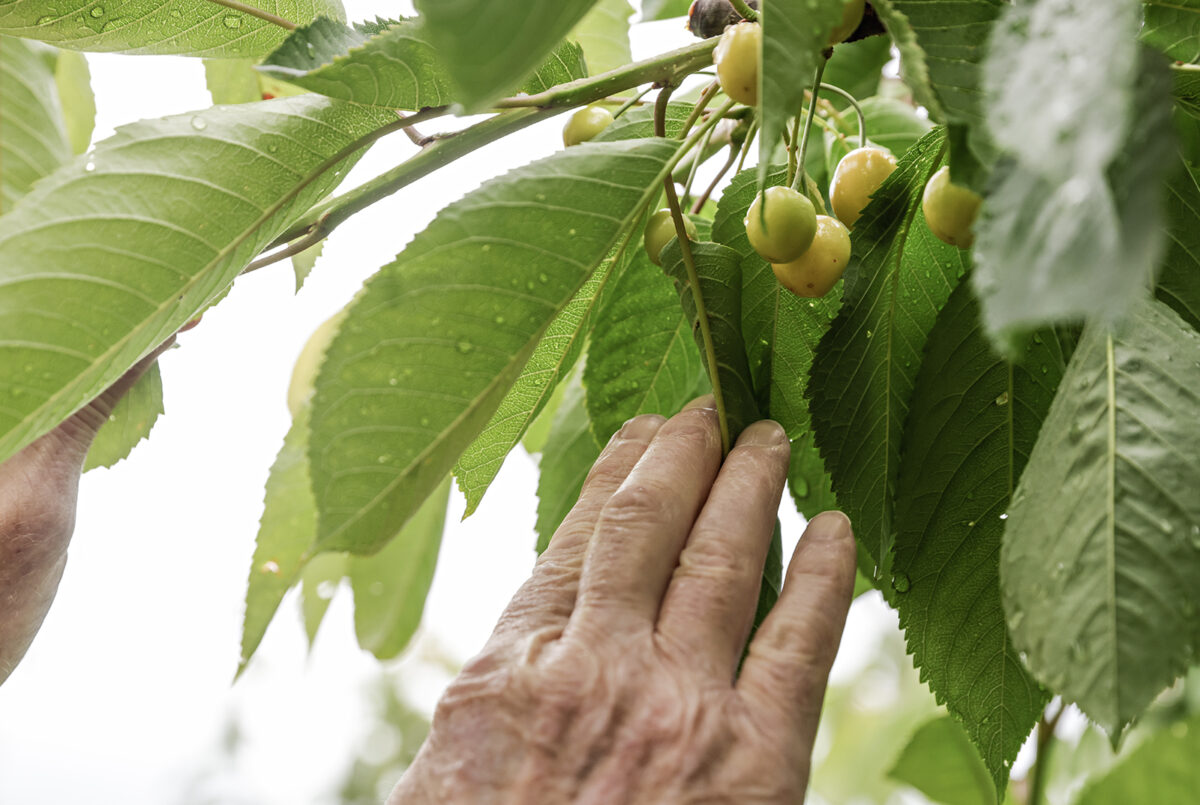
On January 13, Bruce Johnson woke up to fog and negative 13-degree temperatures at his 5-acre cherry orchard in Blue Bay on the east side of Flathead Lake, where the fruit trees absorb much of the landscape adjacent to MT Highway 35.
The negative temperatures persisted for three days as the Arctic front pushed the cool air down into the valley. But along the lake, Blue Bay was balmy compared to areas like Finley Point, which saw negative 21 degrees and Bigfork, which saw negative 25 degrees.
“That is not abnormally cold weather for Montana, but we had some warmer days before that while the trees were dormant,” Johnson said. “As it gets warmer and above freezing, it’s an abrupt change for them.”
The days prior to the Arctic front, temperatures were above freezing and the low-pressure weather system that swiftly moved in resulted in a dramatic temperature swing, dropping close to 60 degrees within a few days.
After the freeze, cherry farmers discovered black blotches on their trees – a sign that the flowers had frozen to death. The dead flowers meant no cherries would grow the following summer.
Johnson grows three varieties of cherry trees – Lapin, Skeena and Sweetheart – on his orchard south of Yellow Bay where most of the flowers on his trees died during the cold snap. But since Blue Bay’s temperatures didn’t drop as low as other areas on the east side of Flathead Lake, he’ll still see a few cherries this summer.
“The buds got whacked,” Johnson said.
In a normal year, Johnson’s trees produce about 50 pounds each, but he said this year he’ll be lucky if he can get 5 or 10 pounds.
Brian Campbell, the field representative for Monson Fruit Company based in Washington and a cherry farmer on Finley Point, said he won’t have a crop this year.
During a good season, the roughly 70-member Flathead Lake Cherry Growers cooperative produces 3 million pounds of fruit, about 80% of which is distributed nationally and internationally. But because of the mostly absent harvest this year, the cooperative won’t be operating, and the few cherries farmers see this year will be sold locally.
“It’s a 95% loss,” Campbell said.
In 1991, Campbell said a similar weather pattern caused a near-total crop loss when the east side of Flathead Lake saw negative 20 degrees at the end of December following mild conditions. But it wasn’t as bad as 1989 when temperatures dropped 60 degrees within hours, killing not only flowers, but most of the valley’s cherry trees.
“That temporarily wiped out the whole industry,” Campbell said. “There was state and federal disaster assistance to replant.”
While the loss of cherry flowers only impacts one harvest, the effects of tree death ripples over several years.
“That’s really hard because you’re talking about an investment,” Johnson said. “You’re losing five years of crops and putting an influx of money into planting.”
Some orchards lost trees following this year’s cold snap, but Johnson said most of those deaths were among “seniors” that weren’t as hardy as they once were along with young trees without fully developed roots.
“The good news is the trees are generally healthy,” Johnson said.
Lapin, Skeena and Sweetheart tree varieties typically tolerate Montana’s cold climate compared to other species in the Pacific Northwest that are meant for hotter temperatures. Some farmers still have decades-old Lambert trees on their properties, which were historically cold-tolerant but weren’t as lucrative because the cherries lose their firmness after a few days on a shipping truck.
According to Campbell, cherry buds become hardy in late fall when they’re capable of “supercooling,” which means the liquid can cool without solidifying. When ice forms in the shoots and bud scales, it pulls water out of their cells. This concentrates the remaining solution in the cells, lowering their freezing point to at least negative 6 degrees. Temperatures remaining below freezing allow this process to continue improving the bud’s hardiness, enabling them to withstand lower and lower temperatures at a rate of 4 degrees per day and can drop down as low as negative 30 degrees.
But if the temperature drops faster than 4 degrees per day – not giving them time to adjust – the flowers will perish.
Last January, the above-freezing temperatures prior to the cold front gave the flower buds an opportunity to thaw, and their hardiness returned to a baseline temperature of negative 6 degrees.
“If it goes above freezing, the trees have a chance to lose that much hardiness,” Campbell said. “The flower buds are the most susceptible part of the trees.”
Campbell said most of the Flathead’s cherry trees will recover and flower buds will start forming new flowers soon.
This year’s mostly absent cherry harvest adds another rough season for the industry, with recent years seeing hot weather and market lulls. Last year, there was an over-supply in the market in Washington and California, which drove down prices and previous hot summers resulted in a lower yield.
At the end of July and early August during the typical cherry harvest, cherry lovers will still see a few stands along the east side of Flathead Lake, but prices will likely be high due to the low supply.
“There will be some cherry stands,” Campbell said.
Source - https://flatheadbeacon.com