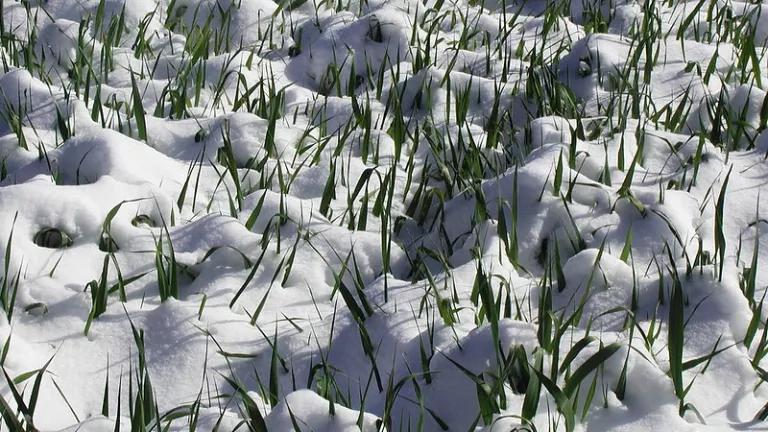
While many residents were safely tucked inside during the snowstorm that hit the Shenandoah Valley on Jan. 25, Mindy Lipinski of Revercomb Farms in Bridgewater was not.
At least a few times a day, she had to bundle up and go outside to check on her pigs, chickens, and rabbits, making sure they could reach their food and that their water wasn’t frozen solid.
“That first night and the next day were the most laborious,” Lipinski said. “We had to scoop off snow and bust ice. It was not a great day to be a farmer.”
After the winter storm left much of Virginia blanketed in snow and ice, a week of sub-freezing temperatures left some local livestock farmers working overtime to keep their animals warm and fed.
For Lipinski, the storm was preceded by an exhausting week of preparation.
Not only did she have the adult animals to worry about, but three sets of babies — chicks, pigs, and rabbits — had all been born within the past month. The situation required a lot of extra bedding, extra heat lamps, and additional time setting it all up. For at least an hour a day in the week before the storm, Lipinski was doing something to prepare, whether moving straw bales to insulate animal sheds or putting down new bedding in the chicken coop.
Then, when the storm hit, there was different work to do — breaking ice, clearing snow, and checking on the animals, all while struggling to walk on the ice-crusted snow.
The storm caused several larger poultry houses in Rockingham County to collapse, but Lipinski said no structures on her farm were damaged.
“Chores are taking two to three times as long,” Lipinski said. “You have to cautiously walk on the ice — it’s so compacted, it’s very slick. I had to clean all the troughs, they’re so full of compacted snow and ice.”
Lipinski’s husband, who has a plumbing shop and often does maintenance for the town of Dayton, gets bags of the town’s raked leaves every fall. The leaves get turned into warm bedding for animals’ enclosures.
Under a deep pile of leaves, animals can stay warmer even when temperatures outside are below freezing. A sow who had just given birth to piglets even built a “nest” out of her bedding to keep the babies warm, blocking the door with her back to protect them from the cold wind.
“Animals are made to go through these weather conditions,” Lipinski said. “When you give them a place to get out of the wind, they do remarkably well.”
Lipinski said she leans on practices used by farmers in colder climates when winters get harsh.
“I watch how other farmers keep their animals,” she said. “Deep bedding is a pretty common practice where this type of weather is more prevalent.”
Though Lipinski says most livestock can take care of themselves in weather like this, she had to prepare for the possibility of a power outage and its impact on the more fragile animals. Because of the high demand for her chickens, she had a “winter batch” of 80 chicks that needed to be kept warm with heat lamps.
“Just really, have duplicate infrastructure in place,” Lipinski said. “Things are going to happen. I made sure there was a contingency plan [for the chicks] to bring them inside if there was a power outage, I had tote boxes, a wood stove, plenty of dry wood.”
This is the harshest winter Lipinski can remember since she began farming in 2018, but she said it was no surprise that it took a lot of work.
“Farming is appealing to many people because it seems very natural,” Lipinski said. “But there are no days off. My entire family got sick, but it doesn’t matter if it’s sleeting, snowing, zero degrees, or if you have a fever. There’s no calling out. You have to be committed. It’s not just for you; it’s for the other living beings depending on you.”
Lipinski’s friend and fellow farmer Margaret Crick had to do even more, as she doesn’t live on her farm. Despite completely blocked roads on Sunday, Crick said she had to get from her home in Weyers Cave to her animals at Open Door Homestead in Fort Defiance, so she plowed the road to her farm using a skid steer.
“At 9:30 at night, we were pushing snow on the roads, trying to get home,” Crick said.
Originally from Pennsylvania, where this type of weather is more common, Crick said she knew what to do for winter but struggled with the Shenandoah Valley’s lack of infrastructure for snowstorms.
“Up there it’s constant, something you always live with,” she said. “Here, this happens occasionally. So they don’t always clear the roads well.”
Crick started preparing a week in advance, stockpiling food and de-icing fluid and making sure the animals had enough hay to bed down on. She delivered eggs and milk to customers on Saturday to ensure they had supplies when the storm hit.
“It’s not much different than what families have to do to prepare for a snowstorm, like stocking up on food,” Crick said. “It’s the same concept, just on a larger scale.”
Crick said that although the animals can often care for themselves, the constant battle of getting fresh water to them makes winter “not [her] favorite time of year.”
“It’s harder on your body, on your mental health, to go through doing these tasks. It takes ten times more energy on days like today to get basic tasks done,” Crick said. “But spring is coming.”
Even smaller farms took a lot of work to prepare for the storm. At Duck Butter Farm in Grottoes, Gage Staton is just beginning to expand his farm from providing meat to his own family to running a profitable operation.
“My goal here is that my kids don’t have to work for someone else if they don’t want to,” Staton said. “They can stay on the farm, and hopefully make a profit.”
Staton and his family began preparing for the storm three days before it struck, putting extra bedding in the animals’ shelters and making a wall of hay bales for his 19 cows, 16 calves and one bull to get out of the cold wind. He stocked up on feed for when the grass was covered with snow and dug out an old generator in case the power went out, which it didn’t.
The 92-acre Duck Butter Farm has fewer animals and less infrastructure than Revercomb, and there were no babies to worry about other than the calves. Most livestock, Staton said, know what to do in the cold.
“I’m just doing what I can to make them more comfortable,” Staton said, “But also knowing they’re livestock, and they can take care of themselves.”
But the biggest problem for Staton and his family was the animals’ water, which was constantly freezing. He had to strike a balance between making sure animals had enough water to drink and making sure there wasn’t too much left to freeze into ice. While he usually provides multiple water sources for the cows, he limited it to one trough during the icy weather to ensure it stayed ice-free.
“In 7-degree weather, you’re constantly playing ‘bust ice,’” he said. “I brought them up here for a close water source and to make sure they had ice busted. I had a week’s worth of hay in the barn structure and stacked some round bales on the fence line to give them a wind break.”
Farming is usually harder in winter anyway, but it generally gets above freezing during the day, Staton said. Then, the snow can melt, and water doesn’t freeze quite as often.
As a relatively new farmer who began in 2020, Staton has learned some of his winter preparation skills from other farmers in the area.
“I know a handful of other local farmers, I’ve learned from watching them prep,” he said. “I’m digging into the local community and getting advice from them.”
But Staton also offered a bit of his own advice to newer farmers.
“Do what you can for the animals, but remember they can take care of themselves if you give them what they need to take care of themselves,” he said. “It’s harder on us than it is on them.”
Source - https://www.dnronline.com