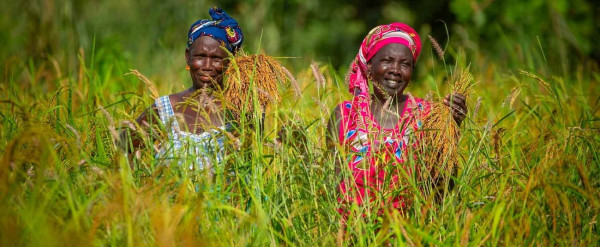
The Global Agriculture and Food Security Program (GAFSP) has announced the first allocation from its new private sector financing window to the African Development Bank Group (www.AfDB.org), providing $14 million in de-risking capital that aims to unlock $200 million from the private sector to enhance food security in low-income countries.
GAFSP provides financial and technical resources—including grants, blended concessional finance, technical assistance, and advisory services—in the world’s poorest countries to support projects across the agriculture value chain.
The new window, the Business Investment Financing Track, was launched in 2024 as GAFSP’s second-generation private sector financing window. It blends the program’s grants and concessional finance with financing from multilateral development banks to catalyze private sector financing for smallholder farmers, producer groups, agribusinesses, and start-ups.
This first allocation from the track will go towards the establishment of an Agro-Inputs Risk Sharing Facility -- a $200 million fund to be hosted by the Bank, with a $10 million tranche of derisking capital. An additional $4 million in grant resources will support technical assistance designed to catalyse up to $200 million in private-sector lending for small- and medium-sized agricultural companies in Ethiopia, Uganda, Tanzania, Malawi, and Zambia. The Agro-Inputs Risk Sharing Facility will work to incentivise local banks to extend credit to agro input suppliers
Smallholder farmers and early-stage agrifood businesses in fragile and low-income countries struggle to access credit, insurance, and investment capital due to perceived high risks, constraining their ability to meet rising food demand.
The Agro-Inputs Risk Sharing Facility, to be implemented by the African Trade&Investment Development Insurance -- a pan-African institution providing political risk and credit insurance to investors -- will address this gap by providing guarantees to financial institutions, a risk-sharing move to encourage commercial banks to lend to these underserved agribusinesses.
“This first allocation demonstrates the appetite for funders to work together in this new model to solve an age-old challenge of finance for smallholder farmers: risk,” said Natasha Hayward, Program Manager for the Global Agriculture and Food Security Program.
“By blending GAFSP donor funds with multilateral development and commercial finance, every Program dollar will leverage many more in private investment, multiplying the positive impact on food security and resilience to rising temperatures and unpredictable weather patterns.”
The financing will help expand access to certified seeds, organic fertilizers, soil enhancers, mechanisation, and other inputs that help agribusinesses to withstand extreme and prolonged heat, water scarcity and other impacts of extreme climates. More than 1.5 million smallholder farmers and 500 agro-dealers and cooperatives are expected to benefit.
“By targeting agro-input dealers and smallholder farmers, this facility intends to strengthen the entire value chain, from input supply to market access, building food systems able to withstand market shocks, including and especially environmental pressures. With the establishment of the Agro-inputs Risk Sharing Facility, we are planting the seeds of a more food-secure Africa,” said Philip Boahen, African Development Bank Coordinator of the GAFSP.
This debut allocation aligns with broad-based African commitments to transform food systems, including the Comprehensive Africa Agriculture Development Programme (https://apo-opa.co/4o51UOB) and the Kampala Declaration on Accelerating the Implementation of Africa’s Food Systems Transformation.
Source - https://www.zawya.com