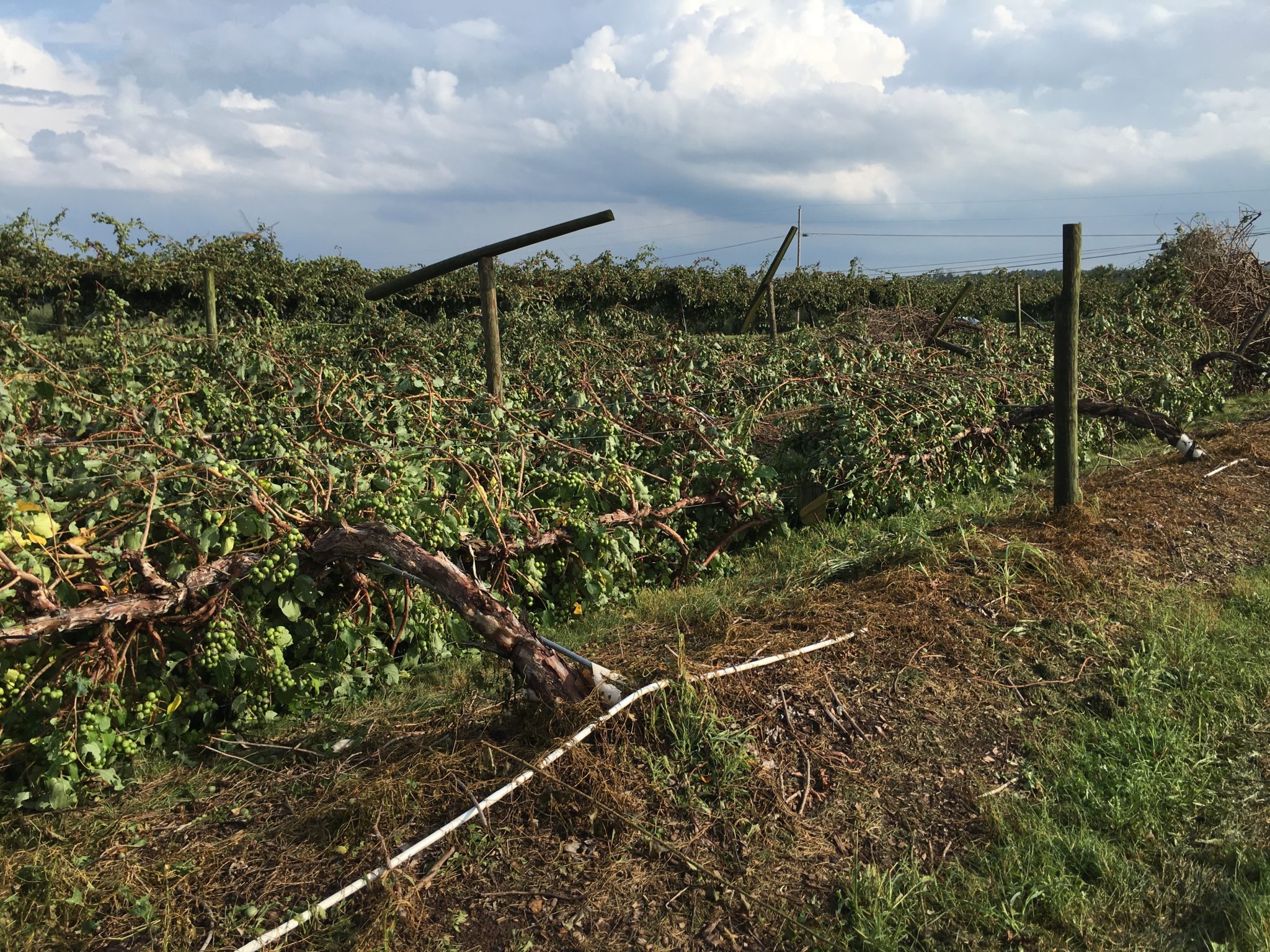
Bruno de Tastes walks up and down rows of manicured vines at his winery, scrunching green and golden leaves between his fingers as he goes.
"The leaves [are] … still quite cold and there's still plenty of moisture in the leaves," he said.
"It's not the water, it's the heat [that's having an impact on the grapes]."
The Little River Wines vineyard is in the Swan Valley, 30 kilometres north-east of Perth — one of the country's oldest and most celebrated wine-growing regions.
Its clay soil and proximity to the Swan River make it ideal for growing wine grapes.
But after WA's hottest summer on record, Mr de Tastes said the premier wine region's days could be numbered, if the heat continues.
"If it's just one day then the vine and the grapes can survive, but this year, it was five days in a row," he said.
"Not only five days in a row but week after week of 40-plus-degree days."
The Frenchman, from one of the world's most famed wine regions, has been growing in the Swan Valley for more than 30 years, the way his family has for generations.
"Traditionally in Bordeaux, we're not allowed to irrigate — that's a rule," he said.
"We put in irrigation when we established grape vines. But once they're established, we turn the irrigation off, so the root system tries to find the water."
Harvest lost in 40-degree heatwave
In January, the Swan Valley recorded consistently high temperatures, including eight days over 38 degrees Celsius.
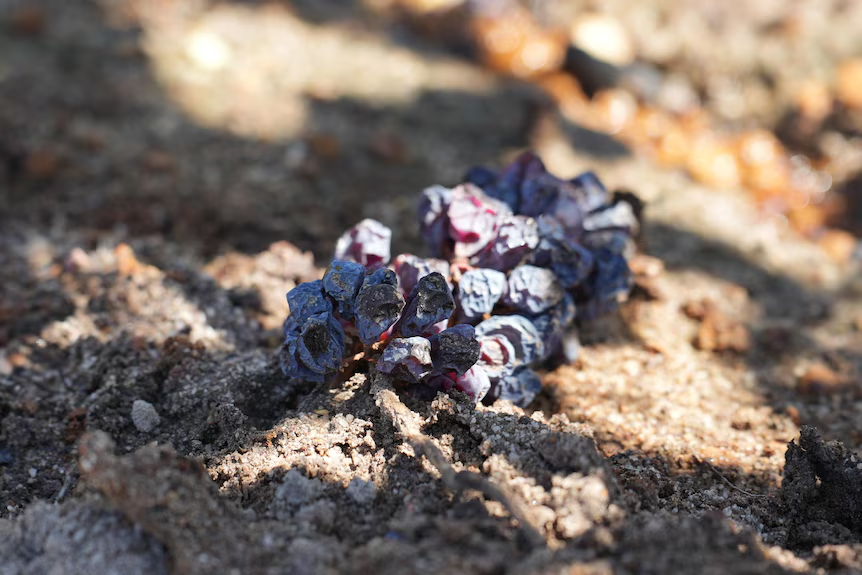
Then in February, when grapes should have been maturing, they shrivelled on the vine as the valley was hit with rolling 40C heatwaves.
At Little River there was no shiraz harvest, with the vineyard losing its entire crop, along with a portion of its viognier, petit verdot, Marsanne and chardonnay.
"That's about 6,000 bottles that we can produce from this vineyard, so it's a substantial loss," Mr de Tastes said.
"Calculate an average of $25 per [bottle] by 6,000, that's about the amount that we will lose.
"If it happened again in [20]24 and 25, 26, I don't think we can survive, but probably it won't, hopefully it won't."
On the other side of the valley, north of the Swan River, is Tyler's Vineyard.
When Donelle Tyler and her husband purchased the vineyard in 2012, it came established with mature, drought-hardy Spanish grenache.
Unlike Little River Wines, the vines grow in sand atop a clay pan and increasingly rely on irrigation to keep them alive, but were still impacted by the heat.
"Most of the vines are over 100 years old. Up until last year they weren't irrigated," Ms Tyler said.
"Our foliage and the grapes dried very quickly with this harsh heat, but we were worried because our canopy was becoming less and less.
"We were very fortunate that someone was selling part of their water allocation and had taken pity on us."
Earliest harvest in generations
Ms Tyler said the soil had dried following years of water mismanagement in the valley, forcing the couple to irrigate or risk losing their vines.
"That groundwater has dropped, and if that taproot from the vine is not getting enough water, the vines will just perish," she said.
"We spent a fortune on buying this licence.
"We would have lost the vines, there is no way our vines would have survived."
The vineyard lost about one quarter of its fruit, but Ms Tyler said it would have been more if they hadn't harvested during summer.
"It was a really early harvest, the earliest we've ever seen it in 27 years, but talking to a lot of generations, they've never seen it that early either," she said.
While growers in the Swan Valley faced rolling heatwaves, even those in cooler climates were impacted by snap heatwaves.
The Porongurups wine region at the foothills of the Stirling Range has an average summer temperature of 25C.
But wine grape growers Shelley and Barry Coade from Jingalla Wines lost about one quarter of their crop from three days of 38, 39 and 40C weather.
And they weren't alone.
One hundred kilometres further south, Denmark's Harewood Estate is one of the largest wine-making operations in the region, producing wine for several local vineyards, as well as its own label.
Owner James Kellie said this year's harvest yield was shaping up to be the worst he'd ever seen.
"It's certainly affected our growers who supply fruit from the more northern sub-regions of the Great Southern," he said.
"One grower produced 2 tonnes in a year when he potentially could have had a 15 and 20-tonne crop."
New approach needed
Since trade tariffs with China were imposed in 2020, domestic supply has risen but Mr Kellie said a poor harvest wouldn't translate to a price hike at the cellar door, and growers would lose out.
"The buck always stops with the grower. Unfortunately, they just won't get their returns," he said.
As global temperatures continue to rise, he said the onus would be on growers to find ways to combat the heat.
"We'll have to adopt varieties that are better suited to the hot conditions and practices in the vineyard, which are already employed by some of the bigger vineyards," Mr Kellie said.
"Spraying sunscreen or sunblock [and] putting shade cloth out over the fruit zone, several vineyards are using those tools, but they need to be employed more widely."
Source - https://www.abc.net.au