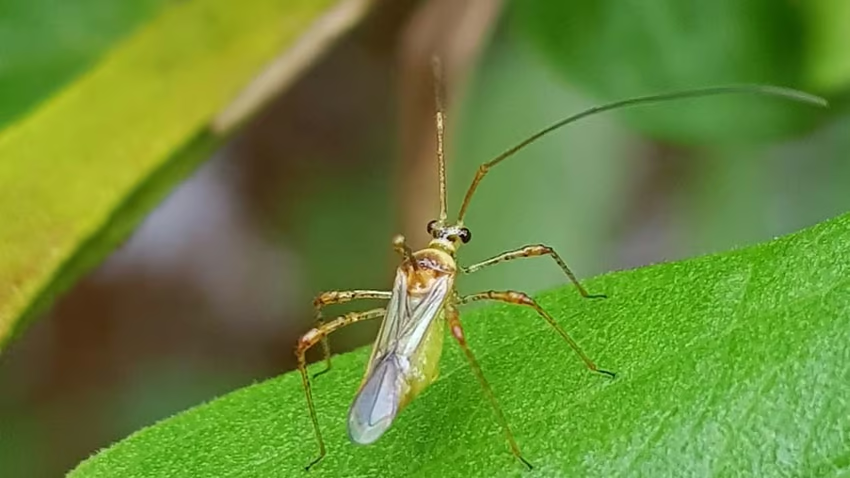
A year ago, the Tocklai Tea Research Institute (TTRI) in India's Assam state launched its biological attack against the tea mosquito bug (Helopeltis theivora), one of the worst enemies of the tea plant in this part of the world.
The tea mosquito bug is a major pest in tea plantations of India, sometimes causing economic losses to the tune of 25-50% as seen in many plantations in Assam and the Dooars region of West Bengal state in recent times. A study conducted by Tocklai found that the tea mosquito bug has developed enhanced levels of detoxifying enzymes, which is helping the pest create a defense against the commonly used insecticides in the tea gardens of India.
“Our study has revealed alarming levels of development of resistance by the tea mosquito bug towards thiamethoxam and deltamethrin, the two widely used insecticides in the plantations in India,” saidDirector of TTRI Dr. A. Babu.
According to Dr. Gautam Handique, another scientist from TTRI, tea estates from different regions of Assam have been reporting a reduction in the efficacy of pest control achieved through the application of these recommended insecticides recently, thereby establishing the tea mosquito bug as a persistent pest.
Dr. Babu further added that the tea industry simply cannot afford to take the tea mosquito bug lightly. “The pest is responsible for huge crop loss and our scientists are worried a lot by the gravity of the situation,” he said.
Scientists are continuously trying to find solutions to get rid of the tea mosquito bug. “We are also advising tea gardens to follow an upgraded, integrated approach to control the pests based on monitoring and early detection followed by spot application of insecticides, insecticide rotation with approved molecules, use of botanicals and microbial biopesticides, encouraging the build-up of natural enemies, and adopting other cultural methods of control,” said Dr. Babu.
Now, the world’s oldest tea research institute, TTRI, is about to add a lethal dose of chemicals (enzyme blockers) in its on-going chemical war against this mosquito-like insect, which feeds on the sap of the tender leaf of the tea plant.
"Recently, we have identified some synergists, which when added with insecticides, have proved effective in controlling the tea mosquito bug, which has otherwise built a detoxifying enzyme-based defense mechanism against the normal insecticides allowed to be used against this deadly pest in India," Dr. Somnath Roy, an entomologist at TTRI, told World Tea News.
Dr. Babu said that the authorities were in touch with the insecticide-producing companies so that these synergists could be mixed with the common pesticides for an effective control of the tea mosquito bug. “It will take time, but we believe this will work out,” he said.
Dr. Babu also said that the institute authorities were in touch with the Central Insecticides Board and Registration Committee to introduce new insecticides in the Plant Protection Code list, which could be effective against the bug.
Last year, Tocklai mass released multiple reduviid bugs, Sycanus collaris, in a few tea gardens to devour the tea mosquito bug and other tea pests as part of its biological attack under the integrated management of the tea pests. Reduviids are predatory in nature and were part of the tea ecosystem in earlier times, but with frequent use of pesticides in tea plantations, these insects are almost at the verge of vanishing from the tea ecosystem.
Tocklai has reared these insects under laboratory conditions for a couple of years and has made good use of these predators by releasing them in tea fields for pest control.
Apart from India, the tea mosquito bug has been a primary pest of the tea plant in many regions of the world, including Southeast Asia, Australia, and Africa. Studies show that Helopeltis theivora thrives on feeding on the sap of tender leaves, buds, and young shoots, which are an economically valuable harvest of the tea plant.
Pest attacks are common in tea plantations in India. Tea gardens, especially those located in tea-rich Eastern Assam, witnessed the worst attacks by pests in 2022, when several gardens faced huge losses. The use of pesticides was the only solution to control these bugs. “Insecticide applications to control this pest have to be used repeatedly, and failure of field control with insecticides is reported from many areas of Assam,” Dr. Handique said.
During the COVID-19 lockdown period, many gardens failed to use chemicals against the tea mosquito, and the loss was huge.
The use of chemical insecticides is widely recognized as a crucial element in the management strategy for Helopeltis theivora, and the Tea Board of India has allowed the use of only three categories of insecticides: organophosphates, pyrethroids, and neonicotinoids.
Dr. Dipankar Chakraborti, associate professor, Department of Genetics, University of Calcutta, a collaborator in the study, told World Tea News that insecticide tolerance in Helopeltis theivora is related to its genetics. Some resistant populations show genetic differences from susceptible ones, suggesting mutations in their DNA. However, some populations show tolerance without genetic differences, indicating environmental factors and changes in gene expression, which add to resistance.
“We have to continue our efforts to keep a check on these enemies of the tea plant,” said Dr. Chakraborti.
Source - https://www.worldteanews.com