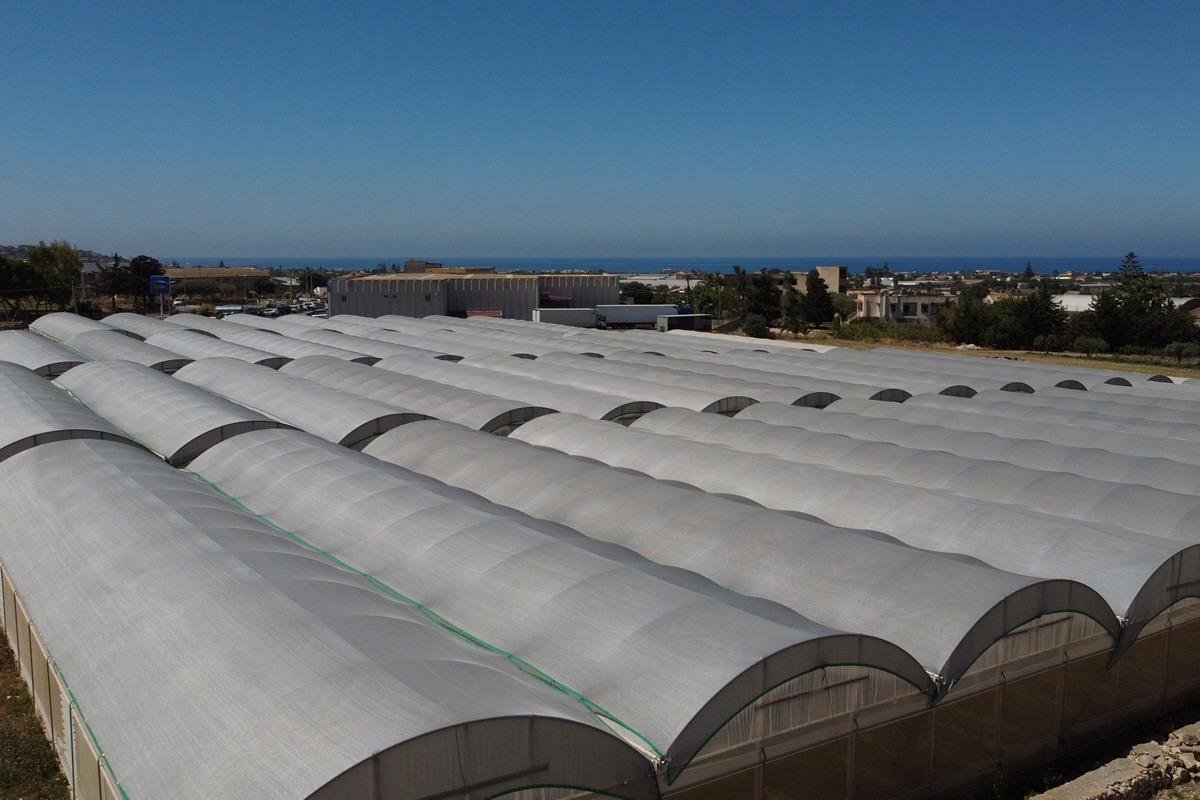
Climate change confirms itself as the number one problem for agriculture on a global level and Sicilian intensive greenhouse cultivation, despite its protected crops, makes no difference. This is what emerged from the following interview with Antonino Bonvento, the owner of a company that has had to adapt its cultivation methods with significant technical solutions.
"Our company was set up 60 years ago in Scicli (RG) by my father Vincenzo, and I have been running it for the past 20 years, during which I have updated it. It now boasts 5 hectares featuring technological facilities, plus a processing warehouse thanks to which the company has become a point of collection for other producers. We export mainly to Germany, Austria and Poland and our core business are cherry, plum and midi plum table tomatoes," explains the entrepreneur.
"Ten years ago, with the inexorable start of climate change, southern Sicily has had to adapt production processes to the new conditions. They were still not fully understood, but it already appeared certain that we needed to do something to protect crops during the warm periods with the maximum solar radiation. That is why we met with Agrintech, a company that produces reflective and shielded nets. By applying the nets on top of the films between April and late September, we can obtain a series of beneficial effects on the crops and production costs."
How it works
Reflective shields are new-generation shading nets that can effectively shield infra-reds, so they do not just reduce the light, but also the temperature, and they manage to increase the quantity of diffused light. The layers that make up Lumigrey (commercial brand of the net in question) undergo a surface treatment that makes them reflective.
The ability to limit Infrareds enables Lumigrey shields to control the temperatures under the cover. In addition, the light is partly reflected and partly dispersed, improving its diffusion in the environment underneath it.
"The fact that the net manages to regulate the temperature under the greenhouses leads to many advantages, starting with lower requirements during the fertigation stage. In addition, the humidity rate is higher in the summer, when conditions tend to be naturally drier. The temperature is 6-7°C lower, leading to improved working conditions for operators. From a qualitative point of view, fruits do not lose their color despite the high temperatures and there is no risk of scalding. Last but not least, the net protects and therefore prolongs the life of the plastic film."
When asked about his reasons for choosing Agrintech, Bonvento had no doubts: "there are many competing products on the market, but what makes Lumigrey stand out is the finishing, with a green strengthening strip on four sides that features a cord to fix the net to the greenhouse structure."
"We installed Agrintech nets multiple times over the past ten years. Managing the microclimate is very advantageous and economically valid for our crops, considering the benefits deriving from the saving of water resources, the energy used to lift the water and the technical means such as fertilizers and plant protection products. Management becomes more sustainable from an economic, environmental and working point of view."
Source - https://www.freshplaza.com