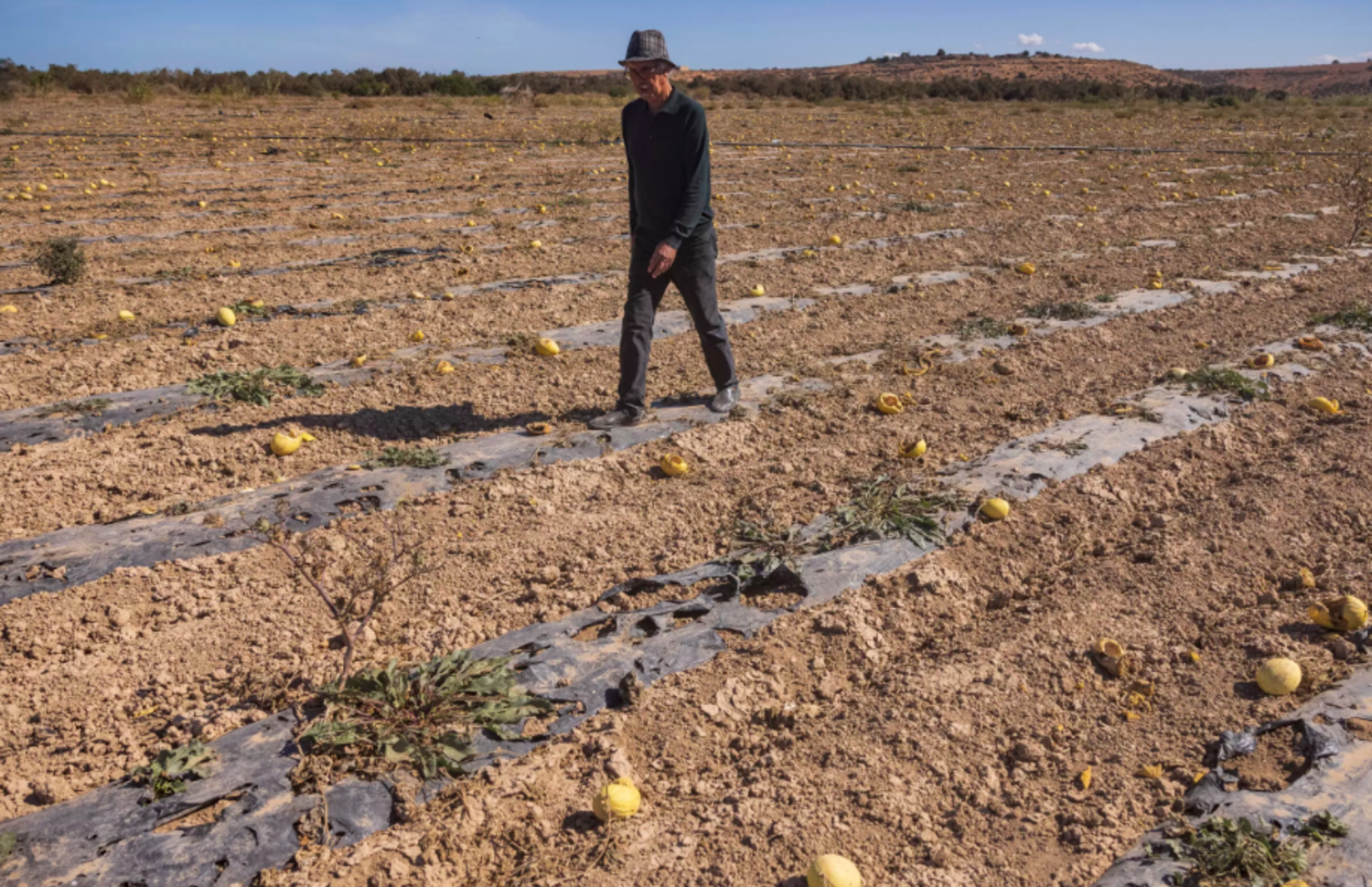
Morocco has become a hot spot for extreme weather-related events. The country regularly suffers from events such as floods and concurrent heatwaves and droughts that have caused severe water crises. As Morocco suffers another drought year in 2024, the agriculture sector is being hit particularly hard.
Using process-based crop growth models (CGMs), at Swiss Re we have been able to gain new insights into the challenges facing the sector. By quantifying the growth and development for non-irrigated wheat over the last eight decades, our simulations shed light on the impacts of weather on crop growth and crop yields in a changing climate. Beyond Morocco, similar insights can help insurers and the agricultural sector around the world understand, mitigate, and manage the impacts of a changing climate.
Insurance payouts during the last decade have helped to increase the resilience of the farmers by partially compensating the incurred losses. In this piece we also explore what measures could be taken to manage and mitigate a rapidly changing risk landscape, and ensure viable insurance.
An agricultural sector under pressure
Representing 10% of Morocco's GDP1, agriculture employs a substantial fraction of the country's labor force in rural areas. Cereal crop production dominates Morocco’s arable land, and it is heavily dependent on rainfall. More than 90% of the cultivated crops are grown under non-irrigated conditions2.
This season's drought reduced the seeded area of rainfed winter crops by almost a quarter compared to previous years3. The crops that did eventually seed and emerge suffered from water and heat stress.
Farmers' incomes and financial strength continue to be tested. Adding to a series of poor harvests, the 2023/2024 winter crop season coincided with commodity price shocks and rising inflation, driving increased prices of agricultural inputs such as fertilizers and energy.
Future climate projections are not optimistic, especially for high greenhouse gas emission scenarios4. Contemporary warming in the Mediterranean region has exceeded global average rates. In the near- to long-term, extreme events are expected to continue increasing water scarcity in the region, although with large uncertainties in the amplitude of the projected changes. The changing climate is also expected to shrink the zones suitable for specific crop cultivation.
The precarious nature of the Moroccan climate
Morocco is located at a transition climate zone between mid-latitude and tropical atmospheric circulation regimes. The country neighbors to the Mediterranean Sea in the north, the Atlantic in the west and the Sahara Desert in the south. Morocco's geographic location and complex topography composite a heterogeneous climate palette spanning from humid/semi-humid to arid/semi-arid regimes that exhibit strong seasonal and interannual variability.
Revealing a rapidly changing risk landscape for agriculture with crop growth simulations
Wheat dominates the country's crop production, grown on more than 3 million hectares of arable land, making it one of Morocco's major crops.
Using process-based crop growth models (CGMs) we have been able to quantify the growth and development for non-irrigated wheat over the last eight decades in Morocco. The simulations were run on an 'as-if' basis, for agricultural management practices that are representative of today’s situation.
For the 2023/2024 crop season, the CGM-based estimates show that all growth stages have been severely affected by the drought. In most growing areas the crop did not recover until the end of the season. This has resulted in more than 40% reduction (provisional estimate) in above ground biomass (AGB) compared to the average of the last ten years.
Although wheat yields in Morocco have been at low levels in past seasons (for example in the 1940s and 1970s), the simulations show that yield variability has now reached levels that are unprecedented in the historical period. Interestingly, in four out of the last five years, country-level wheat yield was below the long-term average.
Contemporary yield variability has increased by 40% compared to the 1990s. The increasing variability in recent years coincides with increasing variability in seasonal rainfall. This is in turn is driven by changes in absolute amounts of the number of dry days and the seasonal distribution of rainfall.
Changes in the length of the growing season also play a role. Our analysis reveals that growing has been advancing in response to warmer temperatures. For example, the time needed from seeding to the beginning of grain filling is now 2-3 weeks shorter compared with the middle of the 20th century. The acceleration of the crop season has direct consequences for the timing of the various growth stages and most importantly for the water availability at each stage.
How Morocco and the re/insurance sector are responding to the risks of a changing climate
The rapidly changing risk landscape indicates the need for immediate action on different fronts to mitigate and manage the risk landscape. Although the research in this blog is focused on the impact on the Moroccan market, there is relevance for markets around the world facing similar climate conditions.
The agricultural insurance sector in Morocco is the second largest in Africa (by generated premium income). Farmers are mainly covered with indemnity-based multi-peril crop insurance (MPCI) programs offered via a successful public-private partnership between the Ministries of Agriculture and Finance and the Moroccan Agricultural Mutual Insurance Company (MAMDA). Agriculture insurance premiums are heavily subsided by the Moroccan government, especially for smallholder farmers. In recent years, primary crop insurance products have been adjusted to better reflect the current environment. However, the changes may have already reached the high end of the economic sustainability limits for the farmers.
We also wanted to explore how re/insurers, farmers and policymakers can take measures to safeguard agriculture production in this new landscape. The Moroccan government has already taken many positive steps, and reform of crop insurance schemes could also help maintain the insurability of highly vulnerable areas. Morocco is not the first market to start the adaptation journey, and other countries have been already successfully adapting their insurance schemes to changing climate conditions.
Water governance
Improved and efficient water sector governance can continue strengthening resilience especially during dry seasons.
In recent years, the Moroccan government has taken encouraging measures to improve infrastructure and efficiency in water management. These measures include, for example, the construction of large dams to strengthen the country's water storage capacity, improved water basin interconnections and installation of control valves to reduce water loss through transportation and distribution. In the Green Morocco Plan, introduced in 2008 (succeded by the Generation Green 2020-2030 strategy in 2020), the government supported farmers to modernize irrigation and improve its efficiency by financing the installation of drip irrigation systems that can help to access groundwater withdrawals.
On-farm risk adaptation and mitigation strategies
Modernization and adoption of technological innovation at the field level are critical steps towards strengthening the resilience of agriculture to climate change. Adoption of new crop varieties has been slow in Morocco for example, with farmers in many cases still growing varieties that are more than 20 years old. Farmers should be supported to adopt new locally-breed varieties and whenever necessary even switch to alternative crop types that are suitable and approved for local climate and soil conditions.
Adaptation of modern non-conventional management practices could also help to better manage natural resources such as water and nutrients and partially mitigate severe climate impacts. For example, agroforestry can be an efficient management practice to limit soil degradation and partially compensate greenhouse gas emissions. Switching to direct seeding mulch-based cropping systems can improve soil fertility and drought tolerance. Although the list of strategies is non-exhaustive, farmer incentivization and education, as well as a clear prioritization road map would be critical elements for the transition to a more resilient agriculture.
Crop insurance scheme adaptation
The Moroccan crop landscape is heterogeneous, vulnerable to the increasing frequency and severity of drought. This may benefit from a more tailor-made approach, supporting food production, social resilience, and the economic sustainability of crop re/insurance.
Maintaining traditional indemnity-based scheme for stable production areas and offering a different type of crop insurance in highly vulnerable areas could be a solution for markets like Morocco. A well-structured, transparent parametric approach could also bring value. For instance, it can help to a) maintain the insurability of highly vulnerable areas, b) support the transition to crops that are well suited to local agro-ecological conditions and c) improve the loss adjustment process.
Source - https://www.swissre.com