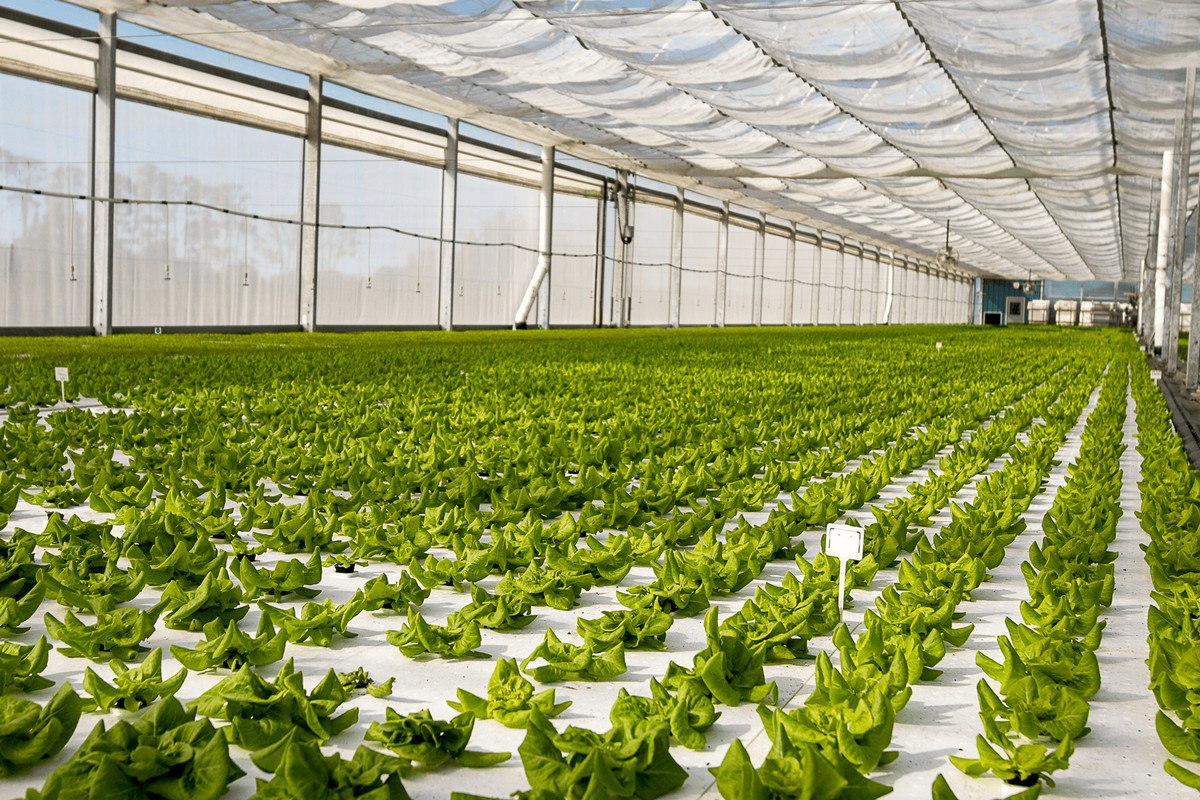
Sunswell Greens operates two greenhouse farms in South Florida, producing specialty lettuces and microgreens for retail and foodservice markets. The Lake Worth and Punta Gorda facilities each cover slightly more than two acres, with different hydroponic configurations: floating raft production in Lake Worth and nutrient film technique (NFT) in Punta Gorda.
According to Sarah Boone, Executive Vice President at Sunswell Greens, operating both systems allows the company to manage production across two facilities with distinct infrastructure and growing configurations.
Climate management in a hot, humid environment
Maintaining year-round production in South Florida requires managing temperature and humidity while balancing resource consumption and operating costs. Sunswell Greens combines natural sunlight with infrastructure designed to address the environmental conditions at each location.
The Lake Worth greenhouse features a retractable roof, while Punta Gorda uses an evaporative wet-wall cooling system supplied with recycled rainwater. Both facilities grow crops under natural Florida sunlight, reducing the need to rely on supplemental lighting as their primary source of illumination.
"We take advantage of Florida's climate benefits as much as possible to optimize both resource efficiency and unit economics," she explains.
The two cooling approaches address different aspects of greenhouse climate control. Retractable roofs can facilitate ventilation and heat removal when outdoor conditions permit, whereas evaporative wet-wall systems cool incoming air through water evaporation. In humid climates, evaporative cooling performance is influenced by ambient humidity, making system operation and ventilation management important considerations.
Controlled growing conditions and crop quality
The hydroponic systems provide different methods of delivering water and nutrients to plant roots. Floating raft systems support plants above a nutrient solution, while NFT systems circulate a shallow stream of nutrient solution through growing channels.
For Sunswell Greens, the controlled environment offers a means of managing crop inputs while reducing exposure to certain risks associated with open-field cultivation.
"Under these controlled conditions, we are able to consistently produce top quality crops." Sarah identifies runoff, animal waste, and severe weather among the risks that greenhouse production can help mitigate. Maintaining consistent output nevertheless depends on managing nutrients, propagation, crop development, and environmental conditions throughout the production cycle.
Water efficiency and integrated pest management
Water conservation is another component of the company's production strategy. Sunswell Greens reports using approximately 90% less water than field-grown crops. At Punta Gorda, recycled rainwater also contributes to the evaporative cooling process.
The reported savings highlight the potential resource-efficiency benefits of hydroponic greenhouse production, although comparisons depend on crop type, growing methods, and the boundaries used to calculate water consumption.
"Our pest management follows a tiered strategy that prioritises prevention, followed by biological controls and other interventions when necessary."
Coordinating production across two farms
Maintaining continuous production across two facilities requires coordination of propagation, crop scheduling, harvesting, and packing. Sunswell Greens relies on its operational team to maintain workflows across both locations, with staff able to provide additional support where needed.
She highlights the importance of the head grower's role in implementing consistent procedures, particularly in propagation and safety. These systems help support crop health across seasonal changes and provide a common operational framework for facilities using different hydroponic technologies.
"We are fortunate to have a wonderful operational team who do an excellent job of maintaining production across two farms, and who are always willing to jump in and help at both locations when extra hands are needed."
Retail distribution and future development
Sunswell Greens' regional distribution expanded with the launch of its Butterhead Lettuce at select Target stores in Alabama, Georgia, Florida, and North Carolina, announced earlier in the month. The launch adds a major retail network to the company's existing Southeastern market presence.
The company continues to work with distributors and retailers to evaluate potential product offerings. This process includes testing new lettuce varieties and blends to assess their suitability for customer requirements.
"Our product team is always collaborating with our distributors and retailers to test new varieties and blends for their customers."
Source - https://www.freshplaza.com