UC Riverside scientists have discovered a stealth molecular weapon that plants use to attack the cells of invading gray mold.
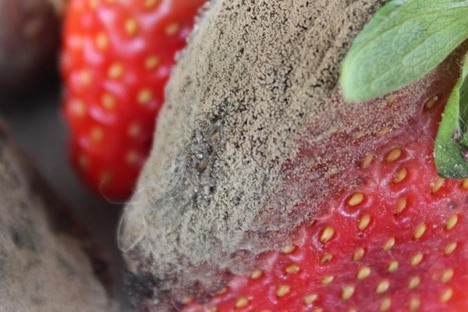
If you’ve ever seen a fuzzy piece of fruit in your fridge, you’ve seen gray mold. It is an aggressive fungus that infects more than 1,400 different plant species: almost all fruits, vegetables, and many flowers. It is the second most damaging fungus for food crops in the world, causing billions in annual crop losses.
A new paper in the journal Cell Host & Microbe describes how plants send tiny, innocuous-seeming lipid “bubbles” filled with RNA across enemy lines, into the cells of the aggressive mold. Once inside, different types of RNA come out to suppress the infectious cells that sucked them in.
“Plants are not just sitting there doing nothing. They are trying to protect themselves from the mold, and now we have a better idea how they’re doing that,” said Hailing Jin, Microbiology & Plant Pathology Department professor at UCR and lead author of the new paper.
Previously, Jin’s team discovered that plants are using the bubbles, technically called extracellular vesicles, to send small RNA molecules able to silence genes that make the mold virulent. Now, the team has learned these bubbles can also contain messenger RNA, or mRNA, molecules that attack important cellular processes, including the functions of organelles in mold cells.
“These mRNAs can encode some proteins that end up in the mitochondria of the mold cells. Those are the powerhouses of any cells because they generate energy,” Jin explained. “Once inside, they mess up the structure and function of the fungal mitochondria, which inhibits the growth and virulence of the fungus.”
It isn’t entirely clear why the fungus accepts the lipid bubbles. Jin theorizes they might just be hungry. “The fungus likely takes up the vesicles because they just want nutrients. They don’t know those RNAs are hidden in the vesicles,” she said.
The strategy is an efficient one for the plants, because one mRNA molecule can have an outsized effect on the fungus. “The beauty of delivering mRNA, instead of other forms of molecular weapons, is that one RNA can be translated into many copies of proteins. This amplifies the effect of the mRNA weapon,” Jin said.
Mold also uses these same lipid bubbles to deliver small, damaging RNAs into the plants they are infecting to suppress host immunity, an ability developed as part of a co-evolutionary arms race. Because RNAs are easily degraded, the bubbles provide excellent protection for transporting vulnerable cargo, for both plants and fungi.
“During infections, there are always a lot of communications and molecule exchanges where plants and fungi try to fight against each other,” Jin said. “Previously people looked at proteins being exchanged. Now, modern technology has enabled us to discover another important group of players in this battle.”
Going forward, the scientists are hoping to use this discovery to create innovative, eco-friendly fungicides. “RNA-based fungicides would not leave toxic residue in the environment and would not affect humans or animals. RNA is present in most food, and it is easily digested,” Jin said.
“There is a never-ending battle to control pests and pathogens. If we can deliver mRNA that interferes with mold cellular functions, we may be able to help plants more effectively fight in this battle.”
Source - https://www.hortidaily.com