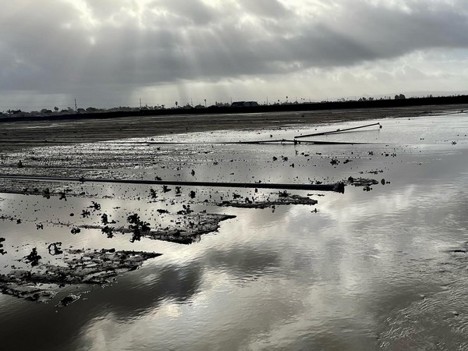
Governors of South Dakota, Iowa, Nebraska and Minnesota have declared emergencies in their states following massive rainfall and record breaking flooding. Anywhere from 10 inches to upwards of two feet of rain fell during the week of June 16-22, 2024, causing multiple rivers to crest well above previous records. Two lives have been lost and thousands of homes and businesses have sustained serious damage or been destroyed. Dams, bridges, levees, roads, railroads, culverts, fences and other infrastructure have failed, been destroyed or seriously compromised, and shelters have been opened for victims displaced from their homes.
The U.S. Geological Survey reported flooding broke records in at least 10 places after 8-10 inches of rain fell in just three days around Sioux Falls. The West Fork Vermillion River near Parker, South Dakota (with data back to 1962) was two feet higher than its previous record from 2019. Big Sioux River at Akron, Iowa (with data back to 1929) was 1.88 feet higher than its previous record in 2014.
NOAA and USGS data indicated more than a million gallons of water per second flowing through Rock River in northwest Iowa. Near Rock Valley Iowa, at 9:15 a.m. on June 22 the USGS gauge measured a streamflow of 153,000 cubic feet per second, more than twice the normal rate of the Mississippi River at Clinton, Iowa, and nearly three times the previous highest volume of water flow recorded at that location.
On June 25 and 26, Iowa Secretary of Agriculture Mike Naig met with farmers and agribusinesses in Lyon, Sioux, Dickinson, Palo Alto and Clay counties who were impacted by these devastating floods.
“He’s been trying to get his arms around the extent of the impact to crops, livestock, infrastructure, and businesses, so he can help to advocate for assistance and solutions,” said department Communications Director Don McDowell. “This recovery will take some time.”
“Our hearts go out to all the Iowans affected by this devastating flooding,” Secretary Naig stated in a press release. “We do not yet know the full picture of damage to homes, businesses, farms, crops, livestock, communities and public infrastructure, but we know that it is likely to be substantial and costly. Iowans are resilient and we will get through this together, but this recovery will certainly take some time and require considerable resources.”
Livestock mortalities from natural disasters are not a required reporting to the Iowa Department of Agriculture and Land Stewardship, McDowell said.
“We’re certainly aware of media reports and social media posts documenting these extremely unfortunate and difficult losses, but those numbers are not reported to or tracked [here.] Instead, we would direct farmers and producers to their local FSA office as USDA administers the LIP program and other disaster assistance.”
In Lincoln County, South Dakota, farmers, ranchers and residents took a blow. Emergency management director Harold Timmerman said that no estimate has been made yet on total number of homes affected.
The city of Canton has an “extreme amount” of damaged or destroyed homes, Timmerman said.
“Worthing and Lennox also had damage, and rural residences were affected adversely both from the flooding and from septic systems backing up,” he said.
Water had receded off of most roads by Tuesday, June 25.
“It’s getting a little better but we have a long ways to go to get everything fixed. We are working on the process now to make roads passable; some blacktop has been damaged, a lot of gravel roads need to be regraded, in some areas we need to fix the road base, add gravel or replace culverts. We’re also working towards a disaster declaration to get help for our townships and county roads from FEMA,” Timmerman said.
Area cattle producers had to try to move livestock before pastures flooded, and feed yards got extremely muddy. Some feed yards have had issues with lagoons filling up too fast.
“People are just trying to keep livestock safe and fed,” Timmerman said. “The DANR is helping folks with knowing where they can pump out their lagoons.”
Timmerman said he is aware of a large feeding operation in Turner County that is struggling with flooding on the Vermillion River.
“We are just trying to guide people through this as best we can,” he said.
Mark and Audrey Metzger and their family operate Brookdale Angus ranch near Lester, Iowa, just east of Sioux Falls. Many of their pastures are located on Mud creek, which runs into Rock River. Rock River is a tributary of the Sioux River which flows into the Missouri River at Sioux City, Iowa. Metzger said they measured 10.8 inches of rain leading up to the flooding.
“We are not as bad off as some people,” he said. “We had two miles of pasture fence washed out, the water literally picked up the fence and carried it out into the field intact.”
Rock Rapids and Rock Valley, Iowa, both downstream along the Rock River were “just devastated,” Metzger said. “The Rock River had a record high crest; they were rescuing people off roofs. It was the highest I’ve ever seen it at our place too, but we have no damage in our houses.”
Metzger’s pastures are littered with cornstalks but the cattle are safe.
“I just had a feeling it was going to get bad so I opened a couple of gates and they followed me through, otherwise I don’t know where they’d be,” he said. “We don’t think we lost anything. It could have been a lot worse, so many people literally lost everything. Our bottom pastures got hit the worst; it’s going to be a long time until we can graze them again.”
Last year, Metzger said they were almost begging for rain, now he’s hoping it quits.
“Maybe half an inch the middle of August, I’d be fine with that.”
Bill Kapperman, a crop insurance agent from Montrose, South Dakota, said that it will be at least a week until the full extent of the damage to fields can be assessed.
“The worst damage is in the area between Sioux Falls and Vermillion,” he said. “Some guys can’t even get to some of their fields so they don’t even know what they look like yet or if they’re still under water. The water it still working its way down the river.”
Fields have been damaged “one way or another,” Kapperman said. “If it was only under water for a day it might come back but it will be hurt. It’s just another kick to these guys. People down in the river bottoms are seeing a substantial amount of loss.”
The last three years have been dry for the area, so farmers have gone from dealing with one extreme to another.
“It’s part of the gig, you roll with the punches,” Kapperman said. “Sometimes they come more often than others. This is something that people are going to be feeling all year.”
Chris Carlson farms in southern Lincoln county. He said the damage is very area specific, with the northern part of the county being the worst.
“We might have lost three or four percent of our crop, but eight miles north of us it’s a full blown disaster. There’s a big flat area or upland ground that doesn’t drain. Between lack of tile and lack of surface drainage, fields are 70-80% gone. The Big Sioux and Vermillion river bottoms area 100% loss. Where we live the terrain is a little better, with more natural drainage, so our water made it to the Vermillion river faster than up north.”
Carlson said there were plenty of warnings, but “no one knew that Worthing, South Dakota would get upwards of 20 inches in spots. There’s nothing the government or anyone can do against mother nature when it’s happening.”
Carlson locked his cows up for two days to keep them out of flooding pastures.
“We lost an April born calf that got swept away in the current of the creek,” he said. “It rose too fast. But there haven’t been any catastrophic livestock losses that I’m aware of.”
In their “corn and bean country,” Carlson said, “Every pasture has a creek or river running through it.” He’s seen some neighbors’ fences that are a mess.
“Every wire of a five wire barb fence is covered in cornstalks. They are going to have a long summer.”
From several years of drought conditions to the current flooding, Carlson said it’s been a long time since the area has had a “normal” year.
“A lot of farmers in northern Lincoln county are not going to have fun meetings with their bankers this fall,” he said. “I run a corn planter for six of us; somebody in the group has had a crop loss due to drought the last three years. One farm has had losses on the crop insurance since 2019: flooding in 2019, hail the next year, drought in ’21, ’22 and ’23. This time they got lucky and missed the biggest rains.”
As a producer who feeds “every kernel of corn we raise and then some,” Carlson said that the loss of feed crops will affect area operators.
“North of us it’s an epic disaster.”
Jason Gannon had 18 inches of rain Thursday June 20 through Saturday, June 22. One road to their farm washed out, and his cattle yards are an “absolute mess.”
Gannon operates a small feedlot, and said that water backed up to the point that his retaining pond overflowed into the cattle yard.
“It’s just a mess,” he said. “We don’t have a choice, we just have to keep the concrete clean, and we bedded some cattle on the mounds.
He said that other people are worse off.
“We didn’t lose our house; 20 miles southeast of us at Rock Valley people are really in trouble. It’s going to be a long road for a lot of people to get to back to where they were.”
An 80 acre field lay completely under water with just the tops of fenceposts sticking up, Gannon said. He raises crops for feed, and says that he will be short on feed as a result of the flooding.
“Hopefully when the water goes down, if the crop was destroyed we can still plant some sorghum or millet,” he said.
He had just put up first cutting alfalfa on some lower lying ground along Beaver creek.
“We hauled the bales off last week. Now the whole thing is flooded. It lays along the railroad tracks. The railroad washed out, rock and railroad ties washed into the field. There’s definitely going to be a lot of stuff to pick up.”
Gannon heard of confinement barns that were without water and electricity.
“Guys can’t get feed to the hog barns because of the flooding and they can’t run their mills because the mill is under water,” he said. “I hate to complain; we could be so much worse off.”
Jason Johnke farms about 30 miles south of Sioux Falls, near Centerville.
“It’s been quite a week you could say. We had about 11 inches for the week in three different waves. There were a lot of 10-12 inch totals locally and the National Weather Service posted totals of close to 18″ in a couple of locations for the week.”
Thursday night the cows were split on either side of the creek in Johnke’s main pasture. Two cows that were separated from their calves swam across the flooded creek to get back to them.
“That night we got another four and a half inches of rain; by Friday morning we had to move the cows out,” he said. “We had to walk one set home through fields, one group we moved down the road a mile to a neighbor’s place, a third set we moved to a different spot with a corral.”
Now the pastures are full of mud and fences are washed out. Johnke will have to keep his cows locked in lots and on feed for a while.
“We won’t go back to grass for three to four weeks,” he said. “The grass needs to regrow and fences need to be repaired.”
Johnke has sufficient feed on hand.
“I usually have more cattle in the feedlot than cow/calf pairs, so we always have corn silage, but we will burn some hay. It’s definitely extra work for this time of year, and calf health is always better on grass versus in a drylot situation,” he said.
Losses were not as serious as Johnke observed in June of 2014.
“We had eight to 10 inches of rain in one night; that was the granddaddy of them all,” he said. “Water levels were close this time but higher after that storm. In 2014 we had some dead cows in trees that floated down the creek; it was horrible. That event was truly a flash flood, this was more of a wave. It rained and the water came up; we got more rain and it came up again. It was not one big blast, we had some time to get a plan together.”
“It’s the hand we got dealt so we deal with it,” said Chris Enger, who lives just south of Sioux Falls.
Enger was trying to track down a couple of calves that took off and got separated from the herd when he was moving them out of a flooded pasture.
“I know they’re alive, the corn is just getting tall,” he said. “My partner brings his horse down every day and we go scout for them. He roped one calf yesterday but the other two escaped.”
Getting around with four-wheelers doesn’t work after that much rain, Enger said. Gathering up cattle that blew through fences or that had to be moved out of flooded pastures has required a saddle horse and swimming.
“I’ve done more swimming in the last four days than in the 38 years prior,” he said.
For the most part, people have been understanding about cattle getting out.
“It’s the same story everyone else is dealing with,” Enger said. “Luckily there’s not a lot of livestock in our area. Everyone had cattle out in someone’s fields or yards. Two of my neighbor’s bulls were standing in my shop this morning.”
Enger has a couple of cows down from exhaustion, and his other cows have lost weight from the stress of the situation.
“I’m not sure they had eaten much in about three days,” he said.
He has cows locked in lots and trap pastures for the time being.
“I found the irony in it the other day, putting water tanks in the back of the pickup,” he said. “We’re throwing water tanks in all our trap pastures; we have too much water so we have to haul water. No one wants to be drylotting cows when there’s grass in June, but we have fences to fix, corn to spray and soybeans getting dirty. No one wants to hit a cow on the road.”
Enger feels they fared well, all things considered. His wife is from Rock Valley, Iowa.
“Those people lost everything,” he said. “My wife’s grandma had water up to the gutters on her garage. Her house was built in 1968, and the basement collapsed. It’s not salvageable. We’ve got some damp carpet in the basement but overall we consider ourselves fortunate.”
From June 17-21, Enger said they were approaching two feet of rainfall, if not more in localized spots. One of his neighbors had close to 20 inches of rain in a 36 hour span between Thursday night and Saturday morning. For perspective, he said, their average annual precipitation is around 26 inches of moisture. In the Worthing, Canton and Fairview areas, Enger said they had around 35 inches of precipitation already in 2024.
It’s a drastic contrast to the five and a half inches of moisture that fell all last growing season.
“We went from the best grass we’ve had in years, to pastures covered in mud and laid flat,” he said. “Such is life. God has a plan, we just have to follow and trust in it. I learned a long time ago that attitude and effort are the only thing you have control over at all times. If you keep those two in check, other things will fall into place in time.”
Source - https://www.tsln.com