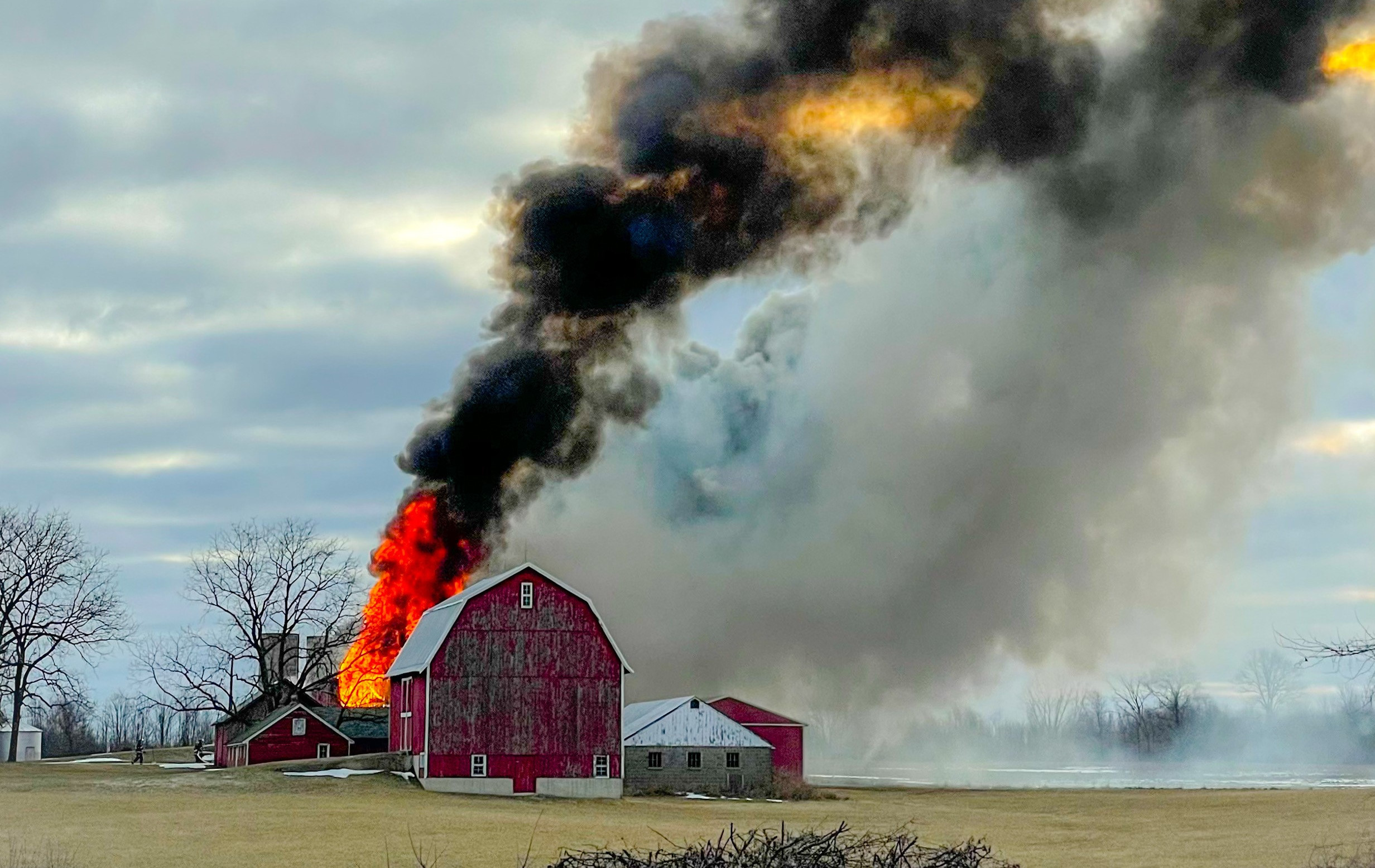
State lawmakers and agriculture officials are still assessing the full extent of the damage caused by the record-setting wildfires that ravaged the Texas Panhandle in late February, including the Smokehouse Creek fire, the largest in state history.
During a three-day series of hearings this week, officials were given a glimpse of the losses some Texas ranchers suffered from the disaster and how recovery won't come soon – if it ever fully comes at all.
"I hate that we have to consider and look at this. But I think it’s very important that the public understand the devastation of what happened. And literally millions, if not billions of dollars in [losses]," Andy Holloway, the Hemphill County Agent for the Texas A&M AgriLife Extension, told the Texas House Committee on the Panhandle Wildfires that convened in Pampa this week.
The five-member panel was created last month to investigate the causes and spread of the fires and the subsequent recovery efforts.
During the hearing, officials with the extension service told lawmakers that initial estimates reflect the fires caused at least $102 million in losses associated with ranching.
That figure is likely to grow as a full assessment isn't complete.
Holloway, a lifelong rancher who owned a cattle marketing company and ranching business for more than three decades, said Hemphill County lost about 7,000 mother cows. He called those mother cows "factories" because of the livestock they produce during calving season.
"We lost two animals and not just one because of the cash crop that the ranchers have. It’s the cash crop that was about to be born," he said.
Holloway added that neighboring Roberts County also lost around 7,000 cows, according to the county judge.
Those losses are expected to grow as cattle injured in the fast-moving blaze eventually die.
"What we’re finding … is with every day that goes by, our cows that they thought were sound and probably salvageable are not. And so, it goes on and on," Holloway said.
A long road ahead for ranchers
Replacing a herd won't be fast or easy because of the time it takes for a heifer to mature and become able to reproduce, said David Anderson, a professor and extension economist for livestock and food product marketing at Texas A&M University.
"If I add … a new heifer to my herd, if she had a calf this spring, that calf isn’t going to be beef production for two years," he said. "If I keep a heifer that was born this spring on my ranch, it’s two years before she’s old enough to have a calf of her own."
Replacing burned fence lines will also add to the price of recovery, as the cost of fencing materials remains high.
"If you went in and look for somebody that builds fences in that type of country, you’re going to be somewhere for three between $3 and $4 a foot to replace a fence," Anderson said. "There’s 5,280ft in a mile. So that that is $15,000 to $20,000 or so per mile of fence. That’s a big number."
Add feed and grass for the cattle that make it, and costs for ranchers continue to soar.
"Even if my cows survived, I got to go buy something for them to eat. And the grass will come back, but it may take a year. It may take a year and a half to have great usable amounts of grass come back," he said.
Though the situation is dire for several ranchers and their families, officials said the fire's effects on Texas’ beef industry won’t be as significant.
The annual slaughter of cattle, deer and heifers is close to 26 million a year, Anderson said.
"So [losing] thousands is really small number in the big picture," he said. "But I want to be careful saying that too, because I don’t want to minimize the losses. If it’s your ranch, I mean, that’s a disaster for those ranches that burned."
Is aid still available?
Through the challenges, the ranching and farming communities have banded together to offer assistance to their neighbors and others affected throughout the Panhandle.
The Texas & Southwestern Cattle Raisers Association said earlier this week that applications for financial assistance from the non-profit group's disaster relief fund are still being accepted.
"We activated the Disaster Relief Fund within 48 hours of cattle raisers being impacted by wildfires," Carl Ray Polk Jr., the association president, said in a statement. "We’ve received more than 1,300 donations that exceeded $1.3 million to date, with more donations still coming in."
There is no closing date for applications, although the agency recommends filing an application within 60 days of when the loss occurred. Applicants don't have to be a member of the group to qualify.
The Texas A&M AgriLife Extension Service also began operating donation sites across the affected area after the fire. Those operations have been turned over to county officials but are still operational, said Blair Fannin, the communications director for the extension service.
Fannin said some of the sites will soon operate by appointment and urged those in need of supplies to contact their local AgriLife Extension offices.
"These appointments do not mean that we’re slowing up distribution of these resources," he said. "These are available to all of these ranchers and producers that need them. We will give out and distribute all supplies. We are not going to maintain an inventory of the resources."
Source - https://www.houstonpublicmedia.org