Farmers would get financial help when extreme weather hurts their business under a bill unanimously passed by the Senate agriculture and appropriations committees.
S.60 aims to set up a fund to provide grants to farmers when floods, fires, freezes and more damage crops, harm livestock or otherwise hurt bottom lines. Legislators were considering a starting pool of $7.5 million for the 2026 fiscal year, though the version of the bill on the Senate floor leaves the price tag to be determined.
“We need to make sure we are taking care of our local farms and food systems,” said the bill’s lead sponsor, Sen. Ruth Hardy, D-Addison, in a phone call.
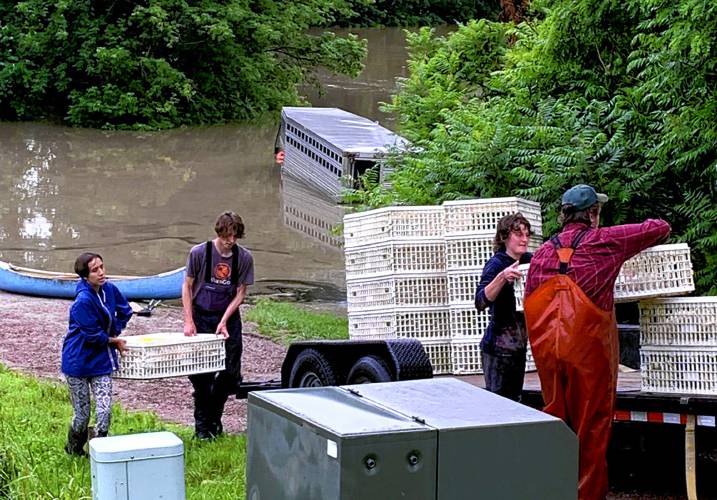
The idea for the fund began after organizations representing farmers came together in the wake of extreme weather events in 2023, including a devastating late spring freeze and catastrophic flooding in the summer.
“99% of our farm was under water, wiping out about $200,000 worth of crops,” said Andy Jones of Intervale Community Farm in Burlington, testifying before the Senate Committee on Agriculture in late February.
A review board would make the final call, with a turnaround coming at most 30 days from officials receiving an “administratively complete application,” under ideal circumstances.
Concerns floated around the Senate agriculture committee last month that the bill may discourage some farms from applying for or purchasing crop or flood insurance because they could rely on the fund instead. Mary White, vice president of the Vermont Farm Bureau, told legislators that officials could curb the issue by requiring farms to show they had applied for insurance.
Freezes, droughts and barn collapses are among other more local events that may impact a community’s ability to produce food. Vermont’s topography often means flash flooding is contained to only some areas, meaning the state or county as a whole doesn’t reach the federal bar for a disaster declaration and the aid that comes with it.
The fund is partially modeled after the Business Emergency Gap Assistance Program, under the state’s commerce agency, designed to help businesses recover after the floods in 2023. Farmers have business models far more susceptible to extreme weather events than most businesses, leading to requests for a separate fund. Months after those 2023 floods, agricultural businesses applying to that emergency fund had hardly received payments, Community News Service revealed at the time.
Farmer advocacy groups were asking for a starting amount of $20 million but weren’t tied to that number. The bill’s supporters suggest the fund could grow during years without many extreme weather events and be used when needed.
Gov. Phil Scott’s budget has some money appropriated for a recovery fund through the Vermont Economic Development Authority, and the money could be used to start the fund, Tebbets told legislators in a Feb. 27 meeting. “That could be a nice little nest egg of $2 million to get going,” Tebbets said.
Many tree fruit growers advocated for the bill, citing the spring 2023 freeze that severely damaged crops. A bill last session, H.813, aimed to create a Tree Fruit Farmer Assistance Program, starting with a “placeholder” amount of $10 million. The bill passed the House agriculture committee but stalled in the appropriations one.
“For a minute we had hope, but just when we were able to project our losses and there was talk of relief … the July floods happened, and we were, metaphorically, swept away with them,” Linda Friedman of Wellwood Orchards in Springfield said via email.
The review board for the proposed program would be made up of state officials, farming organizations and farmers who have received assistance and oversee how the funds are used, including perspectives from farmers and experts around the state.
“This bill is about food security, supporting farmers that have taken on this risk for society and supporting our rural community,” said Sam Smith, farm business director at the Intervale Center, in February testimony to senators. The center leases land along the Winooski River to the Intervale Community Farm and others.
“Farmers across the state are really working hard to be the smart business managers they need to be to adapt, but we need to support them on this level, as a state,” Smith said.
The Senate bill was being read on the floor March 19. In the House, legislators introduced a nearly identical bill, H.229, in February. Among the differences between them is coverage for foresters, too. That bill hasn’t left committee.
While large farming operations may qualify for assistance programs like federal crop insurance, small and medium farms often have no safety net, according to the Northeast Organic Farming Association.
“It’s geared towards the bigger row crops in some of the other states,” Secretary of Agriculture Anson Tebbetts told senators in a February meeting, referring to crop insurance. “Those insurance programs available through the USDA are not really at the scale of Vermont.”
The fund would help farms recover losses or reimburse them for unexpected costs after severe weather. Those could include wages, wiped-out income from destroyed crops or livestock or repairs to roads and equipment. It would cover up to 50% of uninsured or uncovered losses, up to $150,000 per year for any one farm, after officials verify numbers and weather incidents in each application.
Source - https://www.vnews.com