NEWS
855
of 1225
News
23.06.2016

USA - Winds, storms damage corn crop

While the region's corn crop was off to a good start, strong winds and storms last week damaged some fields in western Kentucky. "There were quite a few acres damaged in Marshall County, and about 20,000 acres in Christian County," said Chad Lee, University of Kentucky extension agronomist. "And the rest of the counties have reported spottiness. Some fields are pretty bad, while others aren't. It was a unique weather event." According to Lee, things had been going pretty well. "Part of the problem was you had corn that was growing at a quick pace, which means it had plenty of moisture and nutrients and everything else," Lee said. "The storms broke over some plants at the node (joints on the stalk). With the fields so wet with rain, the wind literally blew the root out of the field, so plants were laying with their roots out of the ground. That's not normal at all." The corn that was snapped at the node is not going to recover. "If they had to get a crop in, they'd have to replant," Lee said. "But it's so late, it's pretty difficult for the corn to do very well. Probably, their best bet ... is just crop insurance." In Calloway County, "There were a handful of fields that received some damage, and one or two that I would say were severe," said Matt Chadwick, county extension agent. "Now a lot of that has stood back up. We do have some early planted corn that has kind of entered the reproduction state of tassling, which is pretty early, so the next two or three weeks' temperatures and the amount of water we get will be very crucial to determine our corn crop for this year." According to the most recent USDA Crop Progress and Condition report, 73 percent of the state's corn crop is rated good or excellent, as is 84 percent of the state's wheat crop. "Most producers have the majority of their winter wheat harvested," said Chadwick. "And, a lot of them already have their second crop beans planted back behind their wheat." The crop report indicates 83 percent of the state's tobacco has been set. "There was a lot of tobacco set in the last two weeks, probably close to 60 percent of our entire crop," Chadwick said. "So we're probably running over 90 percent (total), pushing 100 percent." Chadwick said. According to Trent Murdock, Graves County extension agent, there will likely be a yield loss to the corn crop in some fields. "It's very site specific, and management system specific," Murdock said. "Some fields have the potential for more wind damage with open land with no wind breaks." Murdock estimates almost all of the county's corn is planted, and most farmers in his area are close to being done harvesting wheat. "I've seen some very, very good yields in Graves County," he said. "Overall, the wheat crop has been pretty darn good. I think most of the people I've talked with are pretty satisfied with what they've gotten." A lot of tobacco is looking pretty good right now, too, according to Murdock. As always, everything is weather-dependent. "If you could tell the weatherman to order up just about an inch (of rain) a week, that'd be phenomenal," he said. Source - http://www.kentuckynewera.com

22.06.2016

USA - Rain takes a bite out of Washington cherry crop

A light but stellar Washington cherry crop has been damaged by heavy rain, and while some fruit was ruined overall industry losses may not be as large as first thought. What previously was estimated as a crop of 18.3 million, 20-pound boxes now is probably a 17-million-box crop, said B.J. Thurlby, president of Northwest Cherry Growers, the industry promotional organization. A total of 7.3 million boxes had been shipped from the start of the season, May 18, through June 20. Virtually all were picked before the June 18 rain, Thurlby said. “It wasn’t a horrible rain storm. It could have been worse. It stayed cool and the wind blew,” he said. Wind helps dry cherries and cool weather afterward reduces crop-ruining cracking. Two weeks of cool weather before the rain is pushing the production peak of 500,000-plus boxes per day out to the Fourth of July, he said. The Fourth is a traditional marketing target, and there still will be plenty of fruit for the Fourth with promotions and ad-prices remaining in place, Thurlby said. Heavy rain struck throughout Central Washington from Oregon to Canada. Picking mostly ceased through Monday as growers and packers analyzed how much fruit could be salvaged. “Cracks in the stembel are legal to pack if they are small and heal,” said Norm Gutzwiler, a Wenatchee grower. “If prices are right, it can be sorted and make money for the grower. If not, they go to the processor (for brining) or you leave them on the tree,” Gutzwiler said. It’s a matter of economics when it comes to high-tech packing house sorting and if prices are too low growers shouldn’t be picking, he said. “Frankly, prices will have to go higher than they are,” Gutzwiler said, adding production and marketing will be in limbo a few days. Gutzwiler, Thurlby and others said fruit size and quality had been exceptional until the rain. Damage ranges up to 45 percent but will clean up in a week and later fruit will mature with no damage, said Roger Pepperl, marketing director at Stemilt Growers LLC in Wenatchee, the nation’s largest sweet cherry producer. “We are extremely optimistic with good fruit size, lots of Skeenas (variety) coming on with great flavor and good demand,” Pepperl said. Fourth of July cherries will be “awesome” and Stemilt will offer a special Kyle’s Pick brand, named for Stemilt co-owner Kyle Mathison, with high sugars and firmness and large size, he said. Thurlby said two large Skeena growers in the Basin lost 20 percent. Skeena, a Canadian variety, is more susceptible to cracking. Wenatchee’s Stemilt Hill orchards sustained up to 40 percent damage and a larger grower in the Okanogan about 5 percent, he said. Rain was less in The Dalles, Ore., said Brenda Thomas, president of Orchard View Farms Inc., Oregon’s largest cherry grower. Damage is manageable with the company’s new high-tech cherry sorter a huge help, she said. Normal 10 percent cullage has risen to 20 to 30 percent, she said. The crop is later than Washington’s with about two-thirds to go, she said. Dave Taber, a grower in Oroville on the Canadian border, said multiple prior rains over several days already stressed cherries in the Okanogan. He said he probably lost 25 percent of his crop and estimated Rainiers in the area at 10 to 60 percent split, Skeena up to 40 percent, Lapin looking better at 15 percent and Sweetheart at 15 to 30, depending on location and crop load. Lighter crops with large fruit took the heaviest damage, Taber said. “We’re trying to figure out the amount of damage and work our way through it. We will be packing. We will go forward,” said Harold Schell, director of field services at Chelan Fruit Cooperative, adding that the season is over for some. Andy Handley, an East Wenatchee grower, said he lost about a third of this crop. More than 50 percent of his largest, nicest Sweethearts in one, five-acre block are split, making it an insurance claim, while across the street a heavier set of smaller Sweethearts are only 10 percent split. The larger, more mature fruit “just couldn’t take five hours of rain,” he said. As soon as the rain was done, he was blowing cherries dry with airblast sprayers but the “big stuff was already gone,” he said. “Demand is very high because Bing volume is very low. I’d love to harvest this block if I could but it would double my harvest cost,” Handley said, looking at the cracked fruit in the lost block. “If we bring in 35 percent splits, the shed asks us to stop. It’s not economical for them or us. Packouts need to be 80 percent or better for us to make it. The 70 percent range is only breakeven,” he said. Two weeks of cool weather, before the rain and after June 4-7 high heat, really saved the cherry crop, Handley said. He said he paid $7 per bucket, up from $4, to keep pickers through his Bing for his Rainier, he said. Labor was tight but now is better, Handley and others said. Source -  http://www.capitalpress.com/

22.06.2016

USA - Farmers facing replant decisions

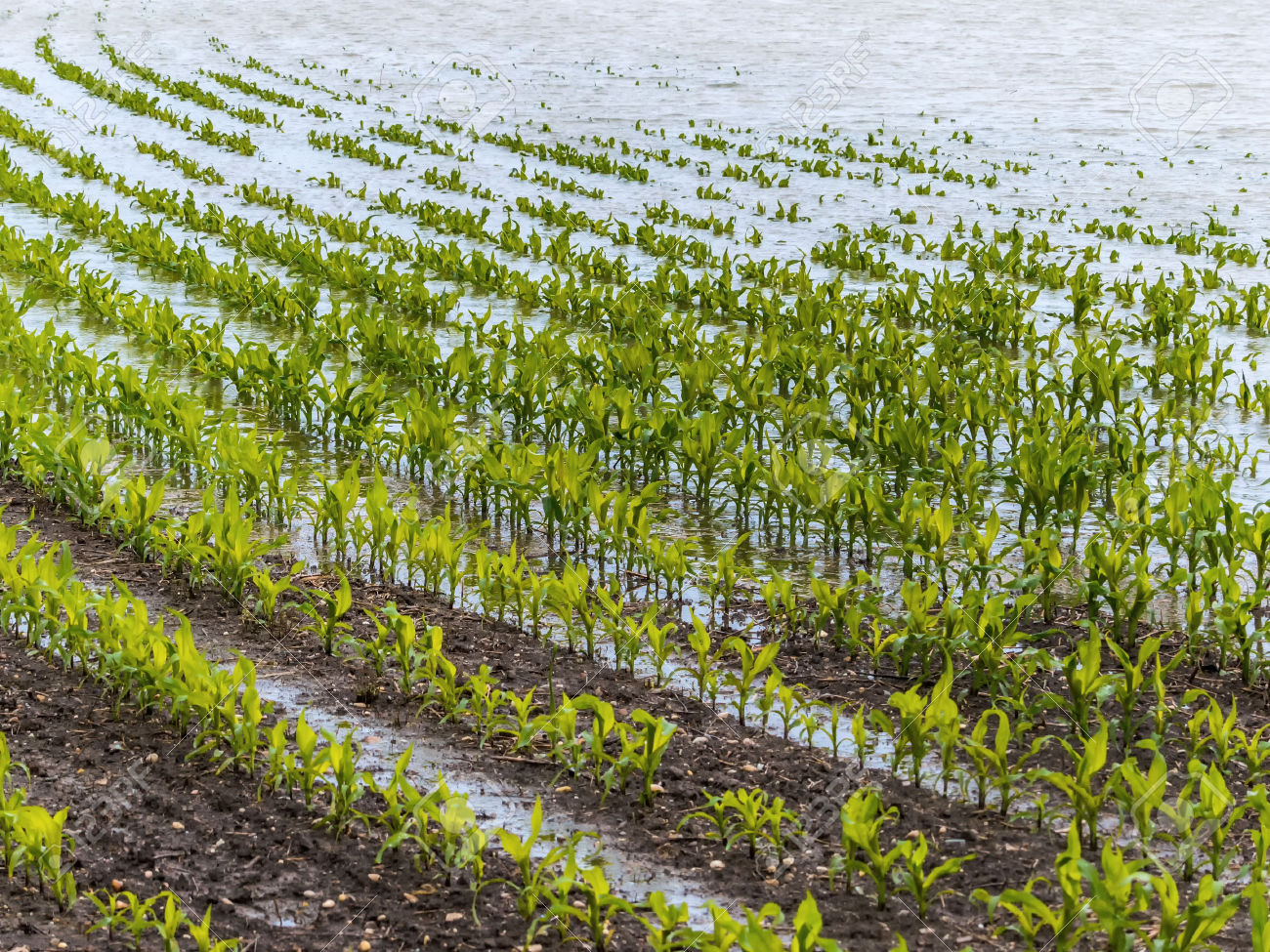
Following the heavy rains and severe storms in many areas of the Upper Midwest from June 9 to 15, farm operators are now facing difficult decisions with regards to replanting crops. Many locations in southern Minnesota and northern Iowa received several inches of rainfall during that period, which led to considerable standing water and drown-out damage in numerous fields. In addition, there was hail damage in some areas that damaged crops, which could also result in replant decisions, especially with soybeans. Most producers will likely not be replanting corn at this late date, except for livestock producers who can utilize the corn as silage or high-moisture corn. Based on university research, corn planted in southern Minnesota during the period of June 5-10 has only about 50-60 percent of the expected yield potential, compared to corn planted in late April to early May. Corn planted later in June has even less yield potential. Soybean yield potential is also reduced with planting after June 1, but not as severely as corn. Early varieties of soybeans planted in mid-June in southern Minnesota have a realistic yield expectation of 30-40 bushels per acre, compared to normal yields of 50 bushels per acre or higher. By late June or early July, the soybean yield expectations drop to 20-30 bushels per acre. The yield potential of late-planted soybeans is highly variable, and is very dependent on favorable weather conditions in August and early September, as well as having a later-than-normal first frost date. It is best to consult with an agronomist or seed representative before finalizing crop replant decisions. University research has shown that corn stands can be reduced up 50 percent with only a 20 percent reduction in yield potential, provided that the stand reductions are fairly uniform. Similarly, soybean stands can be reduced by up to one-third, with only a 10 percent or less loss of yield potential. It should be noted that there is a lot of variation in these results in actual field conditions due to gaps between plants in the row, and the health of the remaining plants in the field. Unfortunately, drown-out damage usually affects only a portion of the field, and that area is usually a total loss. Another factor affecting replant decisions is Federal Crop Insurance, which allows producers some compensation for replanting following crop losses from heavy rains, hail or other natural causes. To qualify for replant compensation, farmers must have a loss area of at least 20 acres, or 20 percent of the total acres in an insured farm unit, whichever is less. The crop insurance replant provision can only be exercised once on the same crop acres. Some farm operators may have already used the replant option following poor emergence in May, and thus could not use the replant provision again in June, following the excessive rainfall. A majority of farmers in the Upper Midwest insure their corn and soybeans with a Federal Crop Insurance policy enterprise units, which group all acres of a given crop in a county together for calculating potential crop loss and insurance indemnity payments. By comparison, a crop insurance policy with optional units insures crops down to individual sections within a township. The reason more farmers choose enterprise units is to get higher insurance coverage levels at a lower premium cost. However, many times producers fare much better with optional units, as far as potential crop insurance indemnity payments, when dealing with more localized crop losses resulting from heavy rains or hail. Crop producers in the Upper Midwest who are facing either prevented planting or crop replant situations should contact their crop insurance agent for more details on the prevented planting and replant options with various crop insurance policies. The USDA Risk Management Agency (RMA) has some very good crop insurance information and fact sheets available on the agency’s website. Source - http://cornandsoybeandigest.com

22.06.2016

USA - Cotton Subsidies: Gifts that Keep On Giving

The United States Department of Agriculture has just awarded cotton producers “one-time only” payments that cover “cotton ginning costs” based on their 2015 production. Anyone with experience in policy history, an attribute most farmers possess, knows that temporary subsidies have a strong tendency to become permanent in one form or another. It is therefore valuable to consider the background and implications of this new program. The new cotton ginning cost subsidies grew out of cotton industry dissatisfaction with the subsidies to which they have had access for the last couple of years compared to cotton policy history. Before the price spikes of about a decade ago, for about 70 years cotton farms had traditionally relied on government payments for half or more of their annual revenues. As a part of the settlement of a WTO dispute, the 2014 Farm Bill offered cotton farmers a new, heavily subsidized county-based revenue insurance program (named STAX) to replace long-standing price-based subsidies. But despite an 80% subsidy on the insurance premiums, most cotton farms (accounting for about 70% of aggregate cotton acreage) have chosen not to sign up for STAX. Simply put, despite the heavy subsidy, STAX has failed to satisfy the subsidy habits of the cotton industry. Most cotton farms and acreage continue to participate in the heavily subsidized farm-by-farm crop insurance program, but despite premium subsidy costs of $450 million per year, an average of $54 per acre, that subsidy has also been insufficient to relieve political pressure from cotton producers for transfer of federal funds. Earlier this year, the USDA rejected industry calls for payments based on cotton seed production and that too stimulated further industry demands that the government find some way to increase subsidies. As with many US farm commodities, cotton prices have been lower than in the recent past. Prior to 2008, government payments would have made up much of the difference in cotton revenue while indemnities from subsidized revenue insurance would have aided those farms with larger revenue declines that were linked to poor yields on their own farms. Farmers, and their bankers, had confidence that, thanks to American taxpayers, cotton revenue shortfalls would be modest. Under the current programs, cotton farms receive only some of the government payments that they had come to expect in previous decades. USDA finally acquiesced to repeated requests from the cotton industry. The new subsidy will transfer about $300 million or roughly $43 per acre, to cotton farms. If the program turns out to be, and was really expected to be, a one-time windfall benefit, the consequences of the new subsidy would be limited to a transfer from the American taxpayers to farms owned and operated by a relatively small group of wealthy individuals and families. That is business as usual in Washington. But, where this program has potential to do more economic damage is precisely the precedent it sets for further subsidies and the incentives created by those expectations. So how does the new subsidy fit into the cotton subsidy fabric? Subsidized individual crop insurance continues to be popular and STAX may yet be popular in years when farmers anticipate indemnities. But, now, when revenues decline, farmers, their bankers, and other firms involved with cotton input supplies or cotton marketing, can anticipate that Congress or the USDA will find some rationale for a creative way to top up the revenue of this politically connected and astute industry. (The current and several previous chairs of the House Agricultural Committee represent districts where cotton is, or has been, king.) Despite its WTO pledge to reduce cotton subsidies that create production and trade distortions, apparently the US government cannot resist, perhaps especially in election years, the desire to provide income supplements. The implications are clear. Even though the new cotton subsidy payments made in any year may be based on prior year production, the payments are being built into industry revenue expectations, which keeps cotton production higher than it would otherwise be. And, as usual, such production responses imply lower cotton prices and related distortions created by choosing crops in response to government subsidies rather than market signals. Source - http://www.insidesources.com/

22.06.2016

Canada - Excess rain challenges Manitoba edible bean crop

Extensive rainfall in some areas of Manitoba is causing problems for edible bean crops. The Red River Valley area saw three to four inches of rain throughout the week, some areas seeing four inches all in one rainfall, said Dennis Lange, development specialist for pulses with Manitoba Agriculture. “The beans went in as everyone thought, but we’ve had some heavy rains down here … There have been reports of edible bean fields being under water,” Lange said. “Early estimates are five to 10 percent loss right now but until the water goes down we don’t know for sure.” Areas further north in Manitoba didn’t suffer as badly from the rain, but Lange said he still expects to see more loss than last year. “It’s a little early in the season to see that amount of loss … we’ll have a better idea in the second week of July how many acres of dry beans we have planted and the loss we will see,” Lange said. Last year, 128,000 acres of edible beans were planted. This year’s crops were projected to be about 100,000 to 120,000 acres, slightly down from last year, Lange said. Source - http://www.producer.com

22.06.2016

India - BJP slams Cong, NCP co-ops for holding crop claims

The BJP has criticised the Congress-NCP-controlled district cooperative banks for not honouring crop insurance claims of farmers. The move is being seen by many as another attempt to get control of the cooperative sector that is still largely controlled by the Congress and the NCP. The NCP hit back saying it is a political move with malafide intentions. State cooperation minister Chandrakant Patil on Tuesday said there are complaints that many district cooperative banks are not disbursing crop insurance money, resulting in difficulties for the farmers who are already in distress. “The state government will take action against all such banks that have not released crop insurance claim amounts,” Patil said. Sources in the government confirmed that the government is considering to issue notices to three district cooperative banks directing them to comply the Reserve Bank of India (RBI) rules. They are Beed, Osmanabad and Jalna — all controlled by NCP heavyweights. Senior NCP leader and leader of Opposition Dhananjay Munde controls the Beed district cooperative bank, Osmanabad bank is being controlled by former NCP MP Padmsingh Patil, while former education minister Rajesh Tope has control of the Jalna district cooperative bank. Sources said around Rs 800 crore are pending with the Beed bank, while Jalna has to pay around Rs 480 crore against crop insurance claim amounts to the farmers. The cooperation minister warned all such banks to start releasing the amount immediately or face action. However, Tope has refuted the claim and said it is a political move. “It’s propaganda. What has been said about Jalna bank is false. This also shows malafide intentions of the government,” Tope said. Source - http://www.hindustantimes.com

21.06.2016

US announces US$300 million in payments for cotton producers

US cotton producers will receive one-off payments totalling US$300 million, the US Department of Agriculture announced two weeks ago. The payments will be made under the Cotton Ginning Cost Share Program. Cotton “ginning” is the process by which cotton fiber is separated from the seed. Farmers will receive a one-time payment based on their 2015 cotton acreage, multiplied by 40 percent of the average ginning cost for each production region. The payments will be made to producers who meet certain requirements, including an adjusted gross income limit of US$900,000 and a requirement to be actively farming. The payments will be capped at US$40,000 per producer. The support provided will also be 60 percent higher than the amount farmers received through the Cotton Transition Assistance Program, a scheme that was meant to provide limited support to producers while direct payments were being phased out under the 2014 US Farm Bill. “The Cotton Ginning Cost Share program will offer meaningful, timely, and targeted assistance to cotton growers to help with their anticipated ginning costs and to facilitate marketing," said US Agriculture Secretary Tom Vilsack. Cotton prices down from 2011 peak US cotton farmers benefit from subsidised insurance under the Stacked Income Protection Plan (STAX), which has provided such insurance to producers of upland cotton from 2015 onwards. Cotton producers are also eligible for marketing assistance loans and crop insurance coverage under the 2014 Farm Bill, even though they were excluded from two new schemes that were introduced for other agricultural producers at that time, the Agriculture Risk Coverage (ARC) and Price Loss Coverage (PLC). Cotton producers have this year urged Vilsack to reclassify cottonseed as an oilseed under the Farm Bill in a bid to increase the level of support they receive – although the Agriculture Secretary has argued he does not have the authority to do so. The industry nonetheless extended a cautious welcome to the announcement of the new one-off scheme. Mike Tate, the chairman of the American Cotton Producers, said that producers “appreciate Secretary Vilsack’s efforts in providing marketing assistance to a commodity that is suffering a serious decline in market revenue.” Heavily-subsidised foreign competition was among the factors suppressing prices, Tate said. Although cotton prices have fallen dramatically since peaking at US$2 per pound in 2011, they have returned to levels that are close to historical averages for the previous decade, with prices today back at around 63 cents per pound. The decline in prices since 2011 has been linked to several factors, including global oversupply of cotton as a result of government stockpiling, increased market competition with polyester, and falling oil prices, which have decreased the price for oil-based raw materials used in making polyester. Trade-distorting effects? Since the announcement was made, some US trading partners have been more critical of the new payments. Brazil questioned the impact of the payments on the cotton market during a meeting of the WTO’s Committee on Agriculture last week. Trade officials said that Brasilia’s first assessment of the new payment scheme “seems to indicate that this is a new trade distortive domestic support measure with potential impacts to international cotton prices.” In 2014, the US and Brazil reached an agreement over a dispute filed by Brazil in 2002 over cotton subsidies in the US. (See Bridges Weekly, 2 October 2014) The WTO’s Appellate Body confirmed in 2005 that certain US cotton support payments, including direct payments and export credit programmes, were trade-distorting and prohibited under global trade rules. Some experts also warned that the new programme could have implications for farmers’ planting decisions by altering their expectations of government support in years ahead. “Every farmer will expect that this supposedly one-time payment will be continued,” said Terry Townsend, an international cotton industry consultant, in comments emailed to Bridges. The US recently submitted a report to the WTO indicating that the country’s farm subsidies overall increased to US$14 billion in 2013, including US$573 million in support for cotton, which was reported as highly trade-distorting “amber box” support. (See Bridges Weekly, 2 June 2016) Trade negotiations continue At the global trade body’s tenth ministerial conference last December in Nairobi, Kenya, ministers adopted a decision on cotton which acknowledged efforts made by some countries to reform their policies, and restated the objective of reducing trade-distorting support, but without taking any concrete steps to do so. The outcome fell short of long-standing demands from West African cotton exporting countries Benin, Burkina Faso, Chad, and Mali – collectively known as the Cotton Four (C-4) – for restrictions on permitted levels of trade-distorting domestic support. Trade negotiators from the majority of WTO member countries see domestic agricultural support overall as a priority for the trade body’s next ministerial conference, in December 2017, while officials have noted that large data gaps in reporting their farm subsidies are hampering efforts to do so. Source - http://www.ictsd.org

21.06.2016

Switzerland - Rotting strawberries

The persistent rain causes the strawberries to rot in the field and the wet weather promotes the multiplication of the pest Drosophila suzukii. This season the strawberries have been struggling with worms. Furthermore the frosty nights in April have damaged a significant share of the flowers, which led to misshapen strawberries. And now the heavy rain is a new factor. Hagen Thoss of the expert organization Obst am Strickhof states: “It should be the time that the yield is at its optimum, but many farmers already report a decrease in harvest.” And the shorter shelf life due to the wet weather is a problem. “The fruit is less popular with customers during this weather,” continues Thoss. Mild winter, wet weather The pest Drosophila suzukii worries the farmers. The fear is that the mild winter and the wet weather will increases the pest this year, which also threatens other harvests. The cherries will be ripe soon, followed by raspberries and blackberries - all fruit varieties, which are threatened by the fruit fly including the grape. “Our raspberry field is directly next to the strawberry field,” says farmer Tobias Martin of Martin Agro in the north Switzerland. “And we see that there are a lot of fruit flies in the strawberries.” It is unclear if it is the Drosophila suzukii variety. Source - http://www.freshplaza.com

21.06.2016

USA - Trust the ag lender, crop insurance cuts would most harm family farms

This is the time of year when farmers are meeting with their lenders to renew farm operating loans for 2016. The past few years have been challenging for producers as commodity prices have fallen, input costs have risen, and severe weather has damaged or destroyed entire crops.  With the downturn in the ag economy, multiple years of lost revenue and less than favorable forecasts for 2016, many producers are facing the tough question: can I afford to continue farming? Without access to capital, the answer to this question is a resounding no. I’ve worked in the ag finance business in Texas for more than 30 years and have seen highs and lows in the farm sector. Though those in agriculture have always faced risks, those risks have escalated over the past two decades. Volatility has become the norm rather than an infrequent event. In the last five years farmers have experienced a multi-year drought, hail storms in October, late spring freezes, and too much rain literally drowning their crops. Prices for farm commodities have dropped drastically to below the costs of production as foreign subsidies and market-manipulating policies have drastically risen. As a way to mitigate these risks and make access to capital possible, Congress selected crop insurance as the primary risk management tool for farmers in the last farm bill. The modern crop insurance system in place today replaced ad hoc disaster relief programs ensuring farmers would have some protection against natural disasters. Congress designed crop insurance to be affordable to the farmer, yet accountable, requiring producers to pay premiums for the insurance coverage on their crops and shoulder a portion of losses through deductibles. Source - http://southwestfarmpress.com

21.06.2016

USA - Severe weather causes damage in rural Phelps, Buffalo Counties

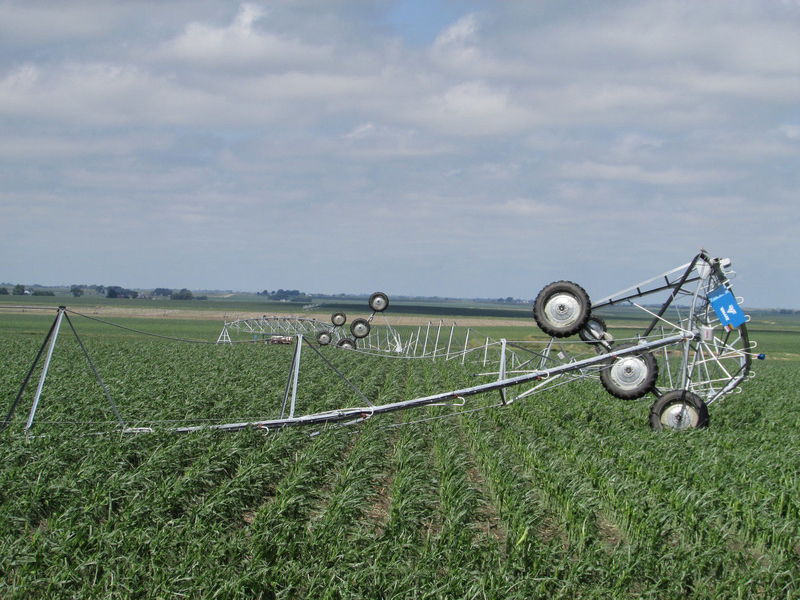
A severe thunderstorm that blew through Hub Territory Friday night caused some tree damage in Buffalo County and significant damage to farm land, equipment and buildings in Phelps County. Phelps County Emergency Management Director Justin Norris said the storm hit Phelps County hardest between 738 and 743 roads, and roads A and G where 3½ inches of rain, high winds and hail were reported. Norris said crops were shredded and there were areas where there were snapped poles, causing power to be out sometime between 8:30-11:30 p.m. or midnight. He said he also received reports of damage to pivots and buildings where roofs came off. Phelps County Extension Educator Todd Whitney said he had heard that two irrigation companies in Holdrege had received 50 requests each to repair or replace pivots. “A lot of producers have had 10 or 14 pivots that had damage to them,” he said. David Hoferer, design manager at Central Valley Irrigation in Holdrege, said it has received phone calls to repair or replace 58 pivots. He said over half that number will be total replacements. “It seems like we got deja vu all over again,” Hoferer said. “In the summer of 2014 is when we had 200 plus pivots go over in that wind storm. It seems like Father’s Day weekend is doomsday for us, it seems like something always happens.” Hoferer said the company won’t get out to make the repairs and replacements until insurance goes through for the farmers. Kirk Edgren, a farmer north of Bertrand, said he lost six pivots, which he said will probably need to be replaced. He also had damage to buildings and crops. His shop building doors blew in and part of the roof blew off; he had hail damage to two of his mobile homes; his grain bin walls were pushed in; and the end and back walls of his barn blew out. There was hail damage to what he estimated was 60 percent of his corn and soybeans. He said it is too late to replant, but the crops may survive. Edgren said he guessed that the hail that damaged his property was somewhere between pea to marble-sized, but he didn’t know for sure because he couldn’t see well enough through the wind and rain. He said he has insurance for his pivots and crops. “It’s kind of what you sign up for,” he said of being a farmer. Whitney said he and a group from the USDA were to look at crops this morning to see the extent of the damage. Whitney said though he has “seen some pictures from farmers that look really severe. There was an area where it shredded not only the leaves but some of the stalks.” Whitney said he hopes some of the crops will be able to recover. In Buffalo County, the greatest damage was done to trees in the Riverdale area, said Buffalo County Emergency Management Director Darrin Lewis. He said there was also a lightning strike that hit a home in that area and law enforcement arranged for the home’s occupant to stay with her son in Elm Creek because she was without power for a while. Source - http://www.kearneyhub.com/

21.06.2016

Canada - Farmer not optimistic about insurance for flood-damaged crops

Ray Piper has been farming for more than 30 years, and has seen his share of floods. He's also made his share of crop insurance claims, a process he's not optimistic about after last week's deluge. "History has a way of repeating itself," Piper said in an interview with media at his washed out canola field north of Dawson Creek June 17. Piper grows canola, wheat, barley and fescue on around 3,500 acres that have been in his family for 100 years. Flood waters washed away at least one of his fields along 219 Road, which he said does not properly drain due to design issues. He lost around $100,000 in crops during the 2011 floods, and said he received little crop insurance. This time, he expects his losses will be higher. "The rain started and within about a day it started to flood in this valley. There's a delayed reaction, but when the water comes, she comes hard." He said his biggest concern is the 219 Road, which he said prevented 200 acres of canola from draining. "I won't go broke farming, but it hurts a lot," he said of the crop losses. "It's really frustrating. You put your crop in and do your best, then the government builds a dam, essentially, is what it is." He said crop insurance pays on a farm-wide basis, instead of field by field, which means his claims typically don't pay out. According to the ministry of agriculture, around $1.7 million in crop indemnities were paid out after the 2011 flood. Source - http://www.dawsoncreekmirror.ca

21.06.2016

India - Reliance, Bajaj Allianz, ICICI Lombard to insure crops in Haryana[:ru]U

To protect farmers from vagaries of weather, the Haryana Government has awarded contracts to three general insurance companies, namely Reliance General Insurance, Bajaj Allianz General Insurance and ICICI Lombard to provide crop insurance coverage to the farming community in the current kharif season under Pradhan Mantri Fasal Bima Yojna (PMFBY). The state government has initiated the process and soon a notification will be issued for the implementation of the scheme. For the current kharif season, the state government has notified four crops, namely cotton, paddy, bajra and maize. As per the scheme, the sum assured for paddy crop has been fixed at Rs 62,500 per hectare, cotton (Rs 60,000), bajra (Rs 27,500) and maize (Rs 25,000 per hectare). For the effective implementation of the scheme, the state has been divided into three clusters and each insurance company has been assigned a particular cluster. According to the state government, Cluster-1 comprises Panchkula, Kurukshetra, Faridabad, Kaithal, Sirsa, Bhiwani and Rewari. Under Cluster-2, Ambala, Karnal, Sonepat, Hisar, Jind, Mohindergarh, Gurgaon has been designated. Further, Yamunanagar, Panipat, Palwal, Rohtak, Fatehabad, Jhajjar, Mewat will come under Cluster-3. The scheme is open both for loanee and non-loanee farmers with July 31 as the last date for the deposit of the premium. In case of loanee farmers, it is mandatory for the banks to bring them under the ambit of PMFBY. If the banks fail to do so, then in case there is crop loss to a loanee farmer who is not insured, the bank will have to make good the losses. The premium paid by farmers would be reduced to 2% of the insured value for the more rain-dependent kharif crop and 1.5% for the rabi season, compared with 3.5-8% under the previous schemes. Source - http://www.tribuneindia.com

20.06.2016

Global Parametrics to bring third-party capital to disaster risk transfer

The world of disaster risk transfer and financing for the developing world and development communities is getting increasingly interesting and relevant to the ILS world, with the latest news being the imminent launch of Global Parametrics, a parametric risk transfer provider backed by a third-party capitalised risk fund. Global Parametrics is going to be unique in a number of ways, as it will target selling only parametric risk transfer and index insurance coverage to organisations which are largely unprotected today, as it aims to focus its products on areas that can help to reduce the protection gap and help to address under-insurance of poor, and vulnerable people in developing countries. The mandate of Global Parametrics will be to offer parametric protection, backed by strong science and risk modelling, selling protection to the likes of NGOs, development banks, microfinance providers and even municipalities, while sharing the risk with third-party investors via an investment fund structure known as the Natural Disaster Fund (NDF). Global Parametrics has been funded for launch by the German government’s Climate Insurance Fund, run by KfW. Although the mandate for Global Parametrics is to seek to be an independent going concern within a few years. The UK government’s Department for International Development has also supported the creation of this venture and is committed to its future success Global Parametrics is a little different, as it targets becoming a sustainable, profit-making venture, while looking to help increase penetration of insurance coverage for weather, catastrophes and natural disasters, by targeting clients and populations that currently do not have this type of protection. At the World Humanitarian Summit in Istanbul on May 23, Baroness Verma, the UK’s Parliamentary Under Secretary of State for International Development, revealed the initiative saying that the UK, alongside Germany and partners, was planning “to develop a transformational parametric insurance venture, Global Parametrics, and a Natural Disaster Fund.” The developing world sees significant inward capital flows and investment, from organisations working in the region, those providing financing, humanitarian assistance, infrastructure and other investments. A large amount of this capital and often the poor, and vulnerable beneficiaries are at risk from severe weather or natural catastrophe events, but do not have any protection or financing that specifically targets these exposures. Global Parametrics will offer derivative risk transfer products to enable these organisations to better protect their financing and operations against the impacts of catastrophic weather or natural disaster events. Using parametric triggers, based on weather indices or natural disaster variables, the coverage provided by Global Parametrics will be quick to respond and payout when disaster strikes, which is vital in developing markets and for the development community operating there to assist the local population. The Chief Sponsor of Global Parametrics is Jerry Skees, of GlobalAgRisk and formerly the University of Kentucky, an experienced science and modelling focused weather, climate and disaster risk professional who has worked on agricultural insurance, weather-index insurance and derivative type programs for over three decades. Among those joining Skees in the venture is Bernard Van der Stichele, previously managing ILS investments and analytics at AQR Capital Management and the Ontario Teachers’ Pension Plan (OTPP), who will serve as the Chief Technology Officer for Global Parametrics. In the near future, the CEO will be announced. Sitting behind Global Parametrics will be the Natural Disaster Fund (NDF) fund, capitalised by public financing as well as by third-party capital providers, which could include ILS investors, funds and even other traditional insurance or reinsurance companies. With limited funds in the NDF at launch, Global Parametrics will quickly turn to the traditional reinsurance and ILS markets to co-share risk with it; thus welcoming the market in to participate in these offerings in low and middle-income countries. Recognising that the ILS fund business model can bring significant efficiency, Global Parametrics aims to be capitalised by this fund for its underwriting activities, with investors in the fund sharing in the returns of the pool of risk. And the company wants to be completely capital agnostic, meaning that as it builds its client base and the portfolio held in the Natural Disaster Fund (NDF) grows, third-party investors and ILS fund managers could all allocate some capital to it in future, as way to access the returns of developing market insurance business. As Global Parametrics scales up, the types of risk that it could bring to investors via the Natural Disaster Fund (NDF) could prove extremely attractive to investors already in the ILS space. These parametric, developing and emerging market weather and catastrophe risks would offer a unique opportunity for accessing diversifying risks, or new perils, something the ILS market is currently only beginning to see in very small volumes. The Natural Disaster Fund (NDF) will sit between the capital and re/insurance markets and the buyers of protection, with Global Parametrics acting as a modelling, structuring and insurance provider, in this way smoothing and making more efficient the transfer of risks from developing market clients to the ultimate risk bearing insurance and reinsurance or capital and ILS markets. By using a fund structure, which allows capital providers to participate and share in the risk adjusted returns, while Global Parametrics uses an efficient model as a type of modelling, structuring and insuring entity, the overall model could prove efficient, helping to lower the cost of risk capital and ultimately protection. For investors in the Natural Disaster Fund (NDF) the business model will also enable them to get their capital significantly closer to sources of risk which would previously have been very difficult, or almost impossible to access. By bundling or packaging risk into the fund structure, Global Parametrics can also take advantage of the diversifying nature of risks from across the developing markets of the world which as it scales will also increase its efficiency, ultimately helping to reduce the costs of natural disaster coverage it provides. Global Parametrics and the Natural Disaster Fund (NDF) will look to work alongside NGOs and development organisations, to help protect against weather and disaster risks such as drought, to provide insurance protection for lenders, to help and support resiliency projects and also for hedging risks associated with renewable energy. All of this will be undertaken on a global basis, ensuring the globally diversified Natural Disaster Fund (NDF) can in time pass on the benefits of diversification through the fund to Global Parametrics’ clients. The ultimate goal and the reason the likes of DFID and KfW are backing Global Parametrics and the Natural Disaster Fund (NDF) is for poor and vulnerable people in developing countries to be able to rely on rapidly disbursed funding when disasters or severe weather events occur, providing continuity, just in time financing and even pre-event financing using triggers based on forecasts. Global Parametrics is a fascinating initiative that answers many of the questions asked of re/insurance when it seeks to tap into developing markets. The business model, being agnostic as to form, capital and structure, has enabled something highly efficient to be created and structured, which in time should become a compelling source of disaster risk transfer and financing to support development, resilience and ultimately increase the insurance penetration of poorer regions of the world. As a start-up venture, looking to bring efficient risk capital to areas of the world that third-party ILS capital has yet to meaningfully reach, Global Parametrics will need the time to demonstrate if their business model can provide the catalyst for spurring insurance markets as investments in low and middle-income countries as intended. Source - http://www.artemis.bm

20.06.2016

Canada - Seeding complete in Saskatchewan, crops look good

Spring seeding is virtually complete in Saskatchewan, with 99.5 per cent of intended acres in the ground as of June 13, according to the latest weekly report from Saskatchewan Agriculture. Most is in the good-to-excellent quality category. There were only a few fields of oats and flax, as well as some greenfeed and silage, still to be seeded, said the report. The five-year (2011-15) average for this time of year is 94 per cent seeded. Warm temperatures “resulted in excellent crop growth,” the report said. Overall, 60 percent of fall cereals, 75 percent of spring cereals and 73 percent of oilseeds were at their normal stages of development for this time of year. The majority of the crops were in good-to-excellent condition. Much of the province got rain during the week, with the southeastern, southwestern and east-central regions recording the greatest amounts. Areas in the drier northwest also received much-needed rain this week. Topsoil moisture on cropland was rated as four percent surplus, 85 percent adequate, nine percent short and two percent very short. Hay land and pasture topsoil moisture was rated as two percent surplus, 80 percent adequate, 14 percent short and four percent very short. Windy conditions hampered weed spraying in many areas of the province. Cutworms and disease are causing crop damage in some areas. Producers are busy controlling weeds and insects and getting prepared for haying. Source - http://www.producer.com

20.06.2016

Mexico - Pasture lands in MX - insured against drought via satellites

Back in January this year a small group of my team together with our local partner ProAgro hit the road to the mexican countryside to visit cattle farmers on-site. We had the great opportunity to meet with them and discuss the impact of drought risk on their production. They explained to us how frequent and how severe this can be – they are experiencing substantial losses almost every second or third year. As we left the fields, it was clear to us, how much an effective solution to drought risk is needed. When such events strike, cattle producers are forced to reduce their herd size and buy supplementary fodder. The reason for this is that their beef production is heavily dependent on the availability of natural grassland. If there is little or no rain across the year, there is not enough grass for their herds to graze. This, in turn, means farmers have to incur the extra cost to purchase supplementary fodder to maintain their herds. Given the fact that these are small subsistence farmers, the additional cost is rather a stretch to their finances. Aiming to offer a sustainable risk mitigation solution to these farmers, we, Swiss Re's Agriculture Reinsurance team and ProAgro (Protección Agropecuaria Compañía de Seguros, S.A.) managed to successfully develop and pilot a new satellite based index product. Since the beginning of June cattle producers in Puebla state, Mexico, are insured against drought. The product is designed on the basis of the Normalized Difference Vegetative Index (NDVI), which is an indicator of vegetation growth conditions based on satellite imagery. In essence, the greener the grass is the higher the NDVI value. Insurance payouts are made if during the insurance period the actual measured NDVI on a given pixel grid falls below a predefined threshold of the historical one. In practice, the triggers are set at a level to reflect the onset of pasture production losses due to drought. As part of the Mexican government's macro-level catastrophe CADENA program, the product is 100% subsidized. That's a huge incentive for low income farmers who can now benefit from having an appropriate and cost-effective mechanism in place when next drought strikes. That's how much we can achieve when we partner with innovative insurers and allocate joint efforts to close the protection gap. Source - https://openminds.swissre.com

20.06.2016

Turkey - Insurance as innovative tool for humanitarian assistance

I am attending the first World Humanitarian Summit in Istanbul. This is a flagship event organized by the United Nations and a number of heads of state are joining UN Secretary General Ban Ki-Moon to discuss the way forward. Total humanitarian assistance has increased dramatically from USD 18 billion in 2012 to USD 28 billion in 2015 – the highest ever recorded. With this increase comes a massive funding gap as needs for humanitarian assistance are increasing even more. Consequently, the humanitarian funding mechanism needs to be fundamentally redesigned. And insurance can play a meaningful role in there – for example by providing coverage against natural disasters! Natural catastrophes are increasing in frequency and severity. The consequences are especially severe in vulnerable low-income countries, which are both the worst hit and the least prepared. Innovative financial instruments such as parametric insurance or catastrophe bonds exist to protect these countries against humanitarian crises caused by natural catastrophes and to preserve hard-won development gains – even in the face of floods, earthquakes, adverse weather and other setbacks. Natural catastrophes and (soon) even the outbreak of epidemic diseases are insurable risks. The re/insurance and capital markets are prepared to and have the financial means to absorb these risks. Governments and humanitarian actors can transfer these risks to the private sector, which has the benefit of converting a highly volatile financing requirement into a more stable budget item and of leveraging available funds. This leverage can be as high as 30 times (USD 1 million of premium could result in USD 30 million payout in case of major catastrophe). Doing this allows the global community to move away from reactive post-event funding towards proactive funding strategies. Humanitarian actors and governments could tap into the technical expertise of re/insurers to develop objective and politically acceptable ‘triggers’ for the early and quick release of funding. A paradigm shift in humanitarian financing for natural catastrophes towards risk transfer solutions requires the willingness and ability from the side of governments and humanitarian actors to take control of their disaster risk financing. Humanitarian actors can both promote and sponsor insurance schemes as well as securing funds for their own operations through insurance mechanisms. Humanitarian actors can increase the efficiency of their funding mechanisms by reserving traditional humanitarian funding for non-insurable risks, particularly for conflict-related settings and slow, onset disasters, while transferring insurable risks, such as natural catastrophes, extreme weather and potentially epidemic outbreaks to the private sector. Insurance does not only provide the funding for recovery after an event but also puts a price tag on risks by analyzing the underlying exposure and vulnerability. This process informs decision makers of their overall preparedness, allows for improved contingency planning and targeted investment in risk reduction measures. Source - https://openminds.swissre.com

855
of 1225