NEWS
898
of 1224
News
06.01.2016

India - Farmers stage protest, demand crop insurance amount

Members of Uttar Karnataka Negilayogi Raith Sangha staged a dharna in front of the deputy commissioner's office here on Monday urging the government to disburse crop insurance compensation, and initiate immediate measures to solve Kalasa-Banduri Nala Project. Making teaching staff working in agriculture universities to stay compulsorily for some months in rural areas to promote agriculture was another major demand of the protesters. Farmer leaders Shivanagouda Patil, Veerupaksha Hosur, Nagappa Mommigattai, Pundalik Jeerigawad, Rayappa Walikar, Iranna Baliger, Pundalik Mangoji, Mallikarjun Marigouda, and others led the protest. In a memorandum submitted to the government through the deputy commissioner, the agitators said, North Karnataka had been reeling under either drought or deluge for the last four years. Farmers who had been suffering crop loss continuously for this reason were taking extreme steps of committing suicide. Though the farmers were undergoing such a severe hardship, neither the State government nor the Central government bothered to address the farmers' problems. The farmers urged the government to disburse ` 7.42 crore crop insurance compensation amount already released by the agencies concerned. The arrears of sugarcane growers should be released by the factories, and price of sugarcane should be fixed at ` 3,000 per tonne from this year. The government should also fix a scientific price for cotton, paddy, soyabean, groundnut, tur and greengram, they demanded. They said, the farmers had been fighting for the implementation of the Kalasa-Banduri Nala Project since last four-five months. However, the Union and State governments had turned a blind eye towards the issue. The Centre, as well the State government, should take measures to implement the Kalasa-Banduri project at the earliest to help the farmers of the four districts. They said, the basic purpose of setting up of agriculture universities across the State would be served only when the teaching staff of these varsities regularly interact and give timely tips for improving the farm yield. This could be achieved only by making agriculture universities teachers and scientists spend four months in a year mandatorily in villages. The said, the government should take immediate measures to level all farm land across the state as it would help farmers to conserve rain water and get good yield. Source - sahilonline.org
05.01.2016

Uganda - Gov't to use drones to enhance food security

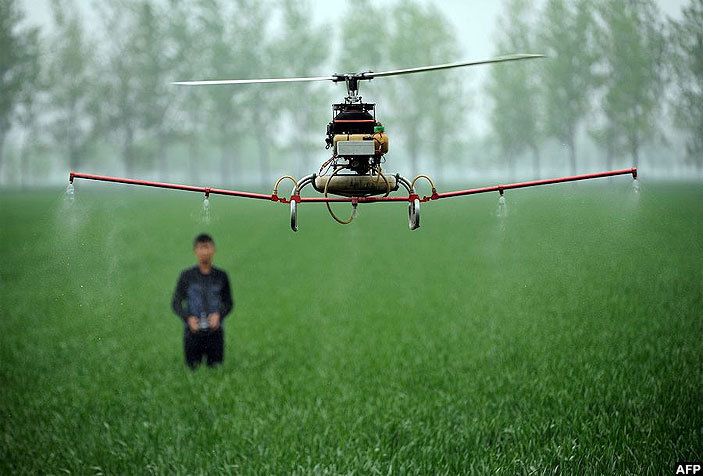
They are more associated with spying, but unmanned aerial vehicles (UAVs or drones), will soon be deployed in Uganda to help farmers increase agricultural output and enhance food security. ___________________________________ A drone is operated using a remote control and flies using propellers. It can be fitted with a knapsack in case the operator is interested in spraying crops. “Drone technology is trending in surveillance, but it can be used in agriculture,” said Okasai Opolot, a director in the Ministry of Agriculture. He added that drone technology is versatile. Opolot cited spraying as one of the activities where drone technology could be used to cover more than two villages in a day. He added that this could help farmers in Teso sub-region where pests have been affecting oranges. [caption id="attachment_110859" align="aligncenter" width="519"] A man controlling a drone to spray pesticides on a farm in Bozhou, central China’s Anhui province[/caption] According to the agriculture ministry, Teso is known to have more than five million orange trees and an estimated 1.5 million trees of mangoes. He pointed out that discussions are taking place within the Government to introduce the technology in the agricultural sector. “A drone goes for about $6,000 (sh20m) and could be more effective than hand pumps when it comes to dealing with pests affecting oranges,” he said. However, initiatives outside the Government are moving faster than the Government to work with drone technology in agriculture. Opolot cited Equator — a seed company — that has been spraying using drones in the production of seeds. Opolot pointed out that a Chinese company investing in seed technology in Uganda will set up a demonstration using drone technology at Kikyusa in Luwero district. He said the International Potato Centre (CIP) and the UN Food and Agriculture Organisations (FAO) are in advanced stages of making trials on spraying potatoes with the technology in the districts that constitute the former Kigezi region in southwestern Uganda. Apart from Uganda, Tanzania will benefit from the initiative by the International Potato Centre and FAO. The drone trials will be implemented in partnership with the National Bureau of Statistics. In September, the International Water Management Institute (IWMI) carried out trials in Sri Lanka using an eBee drone equipped with a near-infrared sensor; the trials showed how this can give farmers early warning of problems anywhere in their fields. “Using near-infrared, you can identify stress in a plant 10 days before it becomes visible to the eye,” says Salman Siddiqui, the head of IWMI’s GIS remote sensing and data unit. “A plant is stressed by either water or fertiliser shortage, or because it is being attacked by a pest. Photosynthetic activity decreases and this affects the chlorophyll. That is what the near-infrared sensor can detect, but our human eye cannot see it until it is in more advanced stages.” That 10-day warning could prevent large-scale crop losses. Siddiqui says: “If a crop is being attacked by insects, the whole area can be affected, not just one farmer. With UAVs, if you can figure this out before it spreads, you can save the whole area. Accurate data is crucial for effective agricultural policy-making, but a report by the World Bank this year highlighted how patchy that data is for much of sub-Saharan Africa. “Donors and governments look at statistics, and in some places smallholder plots are so small we do not have precise statistics on their crops,” says Dieudonné Harahagazwe, a senior CIP scientist based in Nairobi. “With sweet potatoes, for example, policy-makers might say it is not an important crop because there are just small, scattered plots. Or the statistics cannot tell the difference between potato and sweet potato. This is important, because farmers lose out if the statistics are not accurate.” This was confirmed by CIP’s initial trials using drones to map fields in Uganda. According to its research in the Kumi district of eastern Uganda, official statistics underestimated the planting of sweet potato by a staggering 50%. Such a disparity between what is in the books and what is in the fields can make a crop less visible to policy-makers, which means smallholders might not gain access to the relevant extension services such as training, seeds or micro-insurance. With a drone in the sky for half an hour, you can probably say exactly where groups of animals are. In a separate interview, Edward Opolot, the head of Aijar, a private company, said the drone technology is used in monitoring water stress in crops and that this helps empower farmers to intervene and cut losses. The drones can provide more accurate, up-to-date information on crops being grown in different places as well as data on crop output in a failed season as well as a bumper harvest. The drone technology has excited researchers. Opolot said demonstrating how drones might be used in these situations is necessary. “I am convinced that this technology will add value to work in the agriculture sector,” he said, adding that modernisation of the agriculture sector comes with accurate data and support from machines such as drones. Source - newvision.co.ug

05.01.2016

USA - Apple losses reached $85 million

A recent report from the state Department of Agriculture estimates that Central Washington apple growers lost at least $85 million, which is less than 5 percent of the state’s $2 billion industry. Raspberry growers in Western Washington lost $14 million, dryland wheat farmers lost $212 million, and hay growers around Ellensburg lost $11 million. In May, the agency estimated the drought could cost $1.2 billion in lost harvests, including $243 million from Yakima Basin junior irrigators. It’s unclear at this point whether total losses will reach that level, and a more detailed accounting is expected later this year. Washington’s agricultural industry makes up about 15 percent of the state’s economy and the total harvest has been valued at over 
$10 billion in recent years. The report is based on commodities where data was already available, a survey of about 450 growers, and a detailed look at the impacts to the Kittitas Reclamation District, which has junior rights and ran out of water the first week of August. Source - freshplaza.com

05.01.2016

FAO releases latest global El Niño report

Recent droughts, floods, hurricanes, tsunamis and other hazards experienced around the world have had a huge impact on agriculture; interrupting market access, trade and food supply, reduce income, deplete savings and erode livelihoods. The FAO monitors the evolution of hazards and provides early indications and warnings on possible impacts on agriculture and food security. One such phenomenon is the periodic occurrence of El Niño. FAOGIEWS communicates developments during the gestation period and issues alerts and warnings if and when necessary. The objective of this study is to enhance our understanding of the El Niño phenomenon using FAO’s Agricultural Stress Index System (ASIS). FAO-ASIS, developed with the support of EU/FAO Improved Global Governance for Hunger Reduction Programme, is based on remote sensing data that highlights anomalous vegetation growth and potential drought in arable land during a given cropping season. This study is carried out under the auspices of the new FAO Strategic Framework, for the Strategic Objective 5 “Increase the resilience of livelihoods to threats and crises”, Major Area of Work on Natural Hazards. The study outcomes are expected to enhance further discussions on our understanding of the El Nino Phenomenon and add to the growing literature. This would in turn improve effective early warning capabilities of FAO and partners to issue and trigger timely disaster risk reduction measures. Source - freshplaza.com

05.01.2016

USA - Texas blizzard kills 15,000 cows

A freak blizzard killed at least 15,000 dairy cows in the US state of Texas and for almost two days kept farmers from milking some of those that survived, officials said Monday. The brutal winter storm dumped heavy snow on the northern part of Texas on December 26. Farmers have not yet fully assessed the damage. "They're still trying to dig out, but at least it stopped snowing," Kirsten Voinis, a spokeswoman for the Texas Association of Dairymen, told AFP. Texas ranchers typically let their cows graze in pastures rather keeping them locked up in barns. The storm hit too suddenly for them to get their cows inside. The association estimates that the storm killed about ten percent of mature dairy cows in the region. It does not yet have an estimate as to how many calves and heifers were killed. Safely disposing of the carcasses will be a major challenge. "We usually send them to rendering, but we're not sure if rendering will be able to handle a number this big," Voinis said. "We're trying to figure out if there's wintering capacity, or if we do have to bury them. That opens up other issues... water quality and how it impacts your land." Many of the surviving cows will also likely give less milk for months to come. They are typically milked twice a day, but the bad roads and blowing snow meant farm workers were unable to get some cows into their barns to be milked for as much as two days. "When a dairy cow goes that long without being milked, her milk supply starts to dry up," Darren Turley, executive director of the Texas Association of Dairymen, said in a statement. "That means the dairy cows in this region will give less milk for months to come. Less milk going to market will be felt by consumers, as well as by dairy farmers." Source - dailymail.co.uk

05.01.2016

India - Rescue farmers from debt trap

The Centre and the states should formulate suitable agricultural policies and implement them in earnest to rescue farmers from the debt trap and to save their lives, according to Dr. Y. Sivaji, the former member of the Rajya Sabha. He made the plea in a representation to Union Finance Minister Arun Jaitley in New Delhi on Monday as a part of the pre-budget consultations being conducted by the Minister. Sivaji, an agricultural expert who resides here, has been participating in pre-budget consultations for several years. Noting with regret the suicide of 5,650 farmers across the country in 2014, as confirmed by the National Crime Records Bureau, Sivaji said the farmers were forced to take the extreme step as they had fallen into the debt trap and there was no way out for them. "Agriculture in the country is a gamble with monsoon, and the input costs are soaring all the time. Droughts and floods ravage the crops and there is no relief for the farmers," he complained. The states were washing their hands off by announcing ex-gratia payments to the families of farmers who ended their lives and little was being done to address the problems afflicting the sector. Suggestions Stating that the minimum support prices announced by the Centre for various crops were highly unrealistic, he suggested that the states should announce the MSPs and they should be entrusted with the responsibility of ensuring the payment of MSP. Further, the crop insurance policies should be reformulated to see that each farmer who loses crop gets the insurance on an individual basis and not on the basis of crop loss in a particular area. Further, he suggested, the National Rural Employment Guarantee Scheme should be implemented in such a way that the farm operations do not get affected for want of labour. The village panchayats should be involved in the exercise. He pleaded that economic liberalisation should be extended to the farm sector and farmers should be allowed to sell their produce anywhere in the country or abroad. He impressed upon the Union Finance Minister the need for urgent action to address the issues. Source - thehindubusinessline.com

05.01.2016

Australia - Hail storm damages $6 million worth of cotton in southern Queensland

A hail storm on Christmas Eve is estimated to have written off about $6 million worth of cotton in southern Queensland. St George agronomist John Mulholland said the storm looked to have damaged about 1,200 hectares of crop across nine farms. He said the thumb-sized hail had torn through the cotton at a delicate stage of production. "A lot of it was in the peak flowering range and up to 23 nodes, the oldest of it I suppose," he said. "It just tore it to shreds. I know one bloke had all of his [cotton crop] written off, so that is not the greatest Christmas present." Mr Mulholland said most of the growers he had been in contact with had crop insurance. "It never seems to be as good as growing a crop yourself," he said. "But at least they will be able to plant another crop behind it, if they can get on the country and possibly plant a few mungbeans or sorghum. "Mungbeans are reasonably quick and they are a good price at the moment and as far as inputs go, fertiliser and things, there is not a lot of work to do coming straight in behind the cotton ... so they are probably a good option." Mr Mulholland said the storm also had delivered some handy rainfall. "I have heard of anything from about 21mm in the irrigation area up to 120mm up towards the border near Mungindi," he said. "So there is quite a varied total but it is a great start. If we can get another follow-up in the next couple of weeks it would be even better." Source - abc.net.au

04.01.2016

Floods, Drought, and Deals: 20 Biggest Ag Stories of 2015

From January, when California producers found themselves under a state of emergency to drought, to December, when Midwest farmers scrambled to protect their grain from flooding, it has been a wild year in weather and more for ag. Here are the 20 most notable news events of 2015. Deals and near-deals.From Syngenta to RCIS, John Deere to DowDuPont, 2015 proved to be a year of consolidation in machinery, seed, crop insurance and more. Argentina reopens for business. President Maurcio Macri has slashed export taxes on corn, wheat, and soybeans and devalued the peso, all of which is making Argentine crops newly available—and affordable—on a global scale. Rain, rain and more rain in the Midwest. A wet spring and early summer turned parts of the eastern Corn Belt into federal disaster areas and brought some serious variability later in the growing season.As 2015 came to a close, Midwestern farmers found themselves fighting Mother Nature again, as flooding threatened grain, livestock, roads, and more. Interest rate uptick. After nearly a decade, the Federal Reserve finally raised interest rates in late 2015, boosting the dollar and unsettling farmers worried about the cost to borrow money. Avian influenza. An outbreak of deadly avian flu this year was devastating to poultry producers and their flocks, resulting in the deaths of more than 48 million birds, including chicken and poultry. Hardest hit? Minnesota and Iowa, where the economic losses hit $650 million and $1.2 billion, respectively. COOL. After years of political and international skirmishes, country-of-origin labeling (COOL) was determined to violate American trade agreements with Mexico and Canada. Thanks to Canadian and Mexican threats of $1 billion retaliatory tariffs on U.S. goods, Congress finally repealed the law in December. Farm bill elections. The rollout of the 2014 farm bill meant lots of decisions for producers this year as they evaluated which commodity programs would make the most sense for their operation for the next five years. The big winner in the Corn Belt? ARC-county, which promised the highest payments for corn and soybean farmers. Clean Water Rule. Previously known as Waters of the U.S., this controversial rule regulates what types of activities need a permit due to the impact on streams, wetlands, and other bodies of water. The law is currently stuck in legal and political limbo after a federal appeals court in October stopped the implementation of the rule and some in Congress attempted—unsuccessfully—to defund it. Renewable Fuel Standard. After months and months of delay, EPA finally released the Renewable Fuel Standard for 2014, 2015, and 2016, bringing some certainty to ethanol producers and corn growers. The big winner? Biodiesel. Water quality issues. Des Moines Water Works’ decision to sue a handful of rural Iowa counties over agricultural runoff brought new attention to water quality and nutrient management issues. Staggering losses in the cattle industry. In the last two months of the year, feedyards have lost more than $500 per head, which adds up to losses of $2 billion in equity in the industry in just two months. Falling milk prices. After record highs in 2014, milk prices this year have declined 30%. That means that milk prices are at, near, or below break-even levels, depending on the farm. Will prices rebound?Maybe. California dairy farmers now want to join the Federal Milk Marketing Order system, which could eventually translate into lower prices for everyone. Warm weather. According to NOAA, 2015 could prove to be the hottest year on record.  Drought in California. Thanks to a historic drought, 2015 started with new scrutiny on water usage as Gov. Jerry Brown declared a state of emergency. From almond tree growers to cattle producers, many found themselves fighting for access to water for crops and more. Trans Pacific Partnership. The full text of this massive international trade deal was just released this fall, so months of debate in Congress are likely ahead. But agriculture does appear to be one of the winners in the proposed deal, with plenty of growth potential for American ag exports. Grain storage. Two years of big crops plus low prices for corn, soybeans and wheat means farmers are storing tremendous amounts of grain in the hope of getting better prices. Will their gamble pay off?  Crop insurance. It’s now the cornerstone of agricultural risk management, thanks to changes in the farm bill. But with federal budgets tight, the program—and the various subsidies provided—got unexpectedly trimmed in Congress this week. While those $3 billion in proposed cuts were restored, the situation illustrates the challenges facing crop insurance in the world beyond ag. West Coast port labor deal. At this time last year, produce was rotting on West Coast ports, thanks to a months-long labor dispute. In February, federal mediators finally got dockworkers and shippers to reach an agreement, avoiding a port shutdown that would have drained the U.S. economy of $2 billion a day. Wildfires in the Pacific Northwest. While California growers dealt with drought, ranchers in the Pacific Northwest were fighting devastating wildfires that burned 1.6 million acres in Oregon, Idaho and Washington. El Nino. This weather pattern can bring everything from rain to South America to warm winters to the U.S., which obviously affect crop production, commodity prices, and more. The 2015 El Nino was expected to be one of the strongest in three decades.  Source - http://www.agweb.com

04.01.2016

Nepal - Farmer helpline being launched in 25 districts

The government has launched a mobile phone service named Kisan Sim to educate and inform farmers about the weather, agricultural extension service, crop insurance and other matters in a bid to boost productivity and cut losses from climate hazards. Free mobile sim cards with a Rs100 balance will be distributed to 5,500 farmers in 25 districts under the Agriculture Management Information System project. “We have signed an agreement with Nepal Telecom to provide this service,” said Shyam Kishore Sah, spokesperson of the Ministry of Agricultural Development. This first ever farmer helpline in Nepal provides high quality and supporting information to farmers, enabling them to make more informed decisions when preparing the ground, planting, managing pests and harvesting, he said. The climate and weather news is integrated in the phone-based agricultural information that will advise and support smallholder farmers. Those who have Android smartphones should download the application Hamro Krishi which will enable them to get information offline. “Farmers will get early warning information about drought, rainfall and rising temperature through regular SMS so that they can act accordingly,” said Sah. “The major objective of the project is to keep farmers abreast of climatic behaviour and protect them from distress.” Besides, farmers can ask questions through the mobile service about when to apply fertilizer and weed. They can also ask about pest attacks on crops and protection measures, he said. Contact numbers of agriculture offices and crop insurers in the district, toll free numbers, audio notices and success stories related to the agriculture sector will be provided to farmers. “This technology has been particularly developed to bridge the knowledge gap in rural areas,” Sah said. The service will not provide information about crop prices and market access, but such programmes can be integrated in the service in the years ahead, he added. According to the ministry, the District Agriculture Office will form a committee to select farmers’ groups for the services. Piloted in Banke, the project is being implemented in three phases. In the first phase, it will cover eight districts—Dhankuta, Sunsari, Siraha, Kavre, Bara, Rupandehi, Banke and Jumla. In the second phase, the project will be implemented in Sankhuwasabha, Jhapa, Morang, Saptari, Mahottari, Chitwan, Surkhet and Kailali; and in the third phase, it will be extended to nine districts—Darchula, Doti, Rukum, Dang, Mustang, Kaski, Palpa, Dhading and Dolakha. The Agriculture Manage-ment Information System is one of the four components of a pilot programme on Climate Resilience funded by the World Bank and implemented by the ministry. Nepal’s farm sector employs 66 percent of the population and accounts for 33 percent to the GDP, but it is highly exposed and vulnerable to extreme climate events and impacts of climate change. Agricultural production is constrained by frequent natural disasters like flood, drought, landslide, intense rain, hailstorm and cold and heat wave. According to the ministry’s statistics, 61,000 hectares of paddy fields were abandoned last summer due to poor rainfall and drought in many central Tarai districts. Likewise, crop failure has been reported on 1 percent of the country’s paddy fields. The Food and Agriculture Organization (FAO) of the United Nations has projected that climatic conditions in Nepal will worsen, and that there may be even more frequent occurrences of climate-related extremes and negative impacts on food production. “However, by adopting the right measures, it is possible to adapt effectively to the challenges posed by climate change. Such measures require a comprehensive approach that includes strengthening the capacities of institutions and delivering need-based services to farming communities,” the FAO said. Source - kathmandupost.ekantipur.com

04.01.2016

Australia - Farmers fight back from $50m storm damage bill

DESPITE a $50 million damage bill, the region's farmers have welcomed recent rainfalls which have gone some way to setting them up for a positive season. A fierce storm which tore through parts of the Darling Downs on Christmas Eve flattened crops and destroyed millions of dollars worth of infrastructure. AgForce grains president Wayne Newton said insurance assessors and farmers had conservatively estimated the bill to be more than $50m. But there is a glimmer of good news for some farmers, Mr Newton said, with soaking rains putting some producers in good stead to plant a late summer crop and try to recoup some of the losses. "The storm hit in mid-growing season and its far comment that a lot of the crops were looking quite good despite a dryer growing season," he said. "This one (the storm) came out of the blue and it certainly is a bit of a kick in the guts. "But most of the growers in that area, they're pretty resilient." Mr Newtown said the storm cell was about 10-15km wide when it tore through the area southeast of Cecil Plains to the western side of Bowenville, to Peranga north to Bell and into the foothills of the Bunya Mountains. Source - thechronicle.com.au

04.01.2016

USA - USDA Extends Deadline To Increase Protections For Forage Crop Losses

USDA Colorado Farm Service Agency (FSA) Executive Director, Leland Swenson announced that the deadline for producers to obtain or modify higher levels of coverage through the Noninsured Crop Disaster Assistance Program (NAP) to protect against poor forage crop quality because of drought or other natural disasters where the forage is intended for mechanical harvest has been extended to Nov. 13, 2015. “For some 2016 forage crops, the application deadline for NAP occurred before information became available to measure losses due to quality that could influence loss payments or continuous coverage was purchased and at that time producers were not aware of the crop quality options, so we extended the deadline so that producers have more time to decide what type of modified coverage works best for their operation,” said Swenson. The Noninsured Crop Disaster Assistance Program protects agricultural crops for which crop insurance is not available from losses due to natural disasters, such as drought, freeze, hail, excessive moisture, excessive wind or hurricanes. The program offers basic coverage at 55 percent of the average market price for crop losses exceeding 50 percent of expected production, and higher levels of coverage, up to 65 percent of expected production at 100 percent of the average market price. Higher coverage is not available on grazing crops. However, the extension does not afford producers the opportunity to purchase basic 50/55 NAP coverage. Producers interested in adjusting their NAP coverage must submit the appropriate paperwork to their local FSA county office before the Nov. 13 deadline. The protections provided by this program were made possible by the 2014 Farm Bill, which builds on historic economic gains in rural America over the past five years, while achieving meaningful reform and billions of dollars in savings for the taxpayer. Since enactment, USDA has made significant progress to implement each provision of this critical legislation, including providing disaster relief to farmers and ranchers; strengthening risk management tools; expanding access to rural credit; funding critical research; establishing innovative public-private conservation partnerships; developing new markets for rural-made products; and investing in infrastructure, housing and community facilities to help improve quality of life in rural America. Source - http://kticradio.com

04.01.2016

India - Odisha notifies six crops for agri insurance during Rabi season

Odisha has notified six crops to be covered under the National Agricultural Insurance Scheme (NAIS) during Rabi 2015-16 season after reports of substantial crop loss in the preceding Kharif season because of drought conditions. The crops to be insured under the scheme, otherwise known as Rashtriya Krishi Bima Yojana, are paddy, groundnut , mustard , potato, black gram and green gram. The loanee farmers growing the notified crops in the notified defined area and availing loans from financial institutions are compulsorily covered under the NAIS while it is optional for non-loanee farmers. In Odisha, the Agriculture Insurance Company of India Limited (AICIL) is the implementing agency for the scheme. The unit area for crop insurance will be gram panchayat for paddy and block for groundnut, mustard, potato, black gram and green gram. The premium subsidy for small and marginal farmers (having land holding of two hectares or less) will be 10 per cent of the total premium for Rabi 2015-16 which will equally be shared by the Centre and the state government. "The state government is encouraging non paddy crops to compensate the loss sustained by the farmers due to the wide spread drought situation. They are stressing on sowing of pulses", said Dasarathi Singh, deputy general manager, AICIL. As per reports, 1.34 million hectares of crop area have been affected in 215 blocks across 26 districts having a sustained crop loss of 33 per cent and above. Recently, the state government has submitted an additional memorandum amounting to Rs 2,199.06 crore to the Government of India for management of drought. However, the actual volume of crop loss will be ascertained after the crop cutting is over on the basis of which the state government will submit the final memorandum, if required. In Rabi 2014-15, as many as 1,17,582 farmers were covered with a sum assured of Rs 480 crore. Odisha has directed the banks to extend normal agricultural finance for Rabi crops during 2015-16 depending on the irrigation potential. The banks are asked to extend loans to the tune of Rs 4,500 crore in the ensuing Rabi season. Source - business-standard.com

04.01.2016

USA - Not all North Dakota Farmers Embracing New Type of Crop Insurance

Officials think education could increase interest in a new type of crop insurance that also might give farmers who diversify a boost. Whole farm crop insurance became available in North Dakota this past growing season. No policies were sold, but officials in the state Department of Agriculture think more producers might find it useful as they learn more about it. “I think this is a wonderful tool,” said Agriculture Commissioner Doug Goehring, adding that producers may not have had time to look at the program as they have been scrutinizing the new Farm Bill and trying to understand Agriculture Risk Coverage and Price Loss Coverage, along with changes in multi-peril coverage. “Everybody had their plate full to learn all that,” he told The Bismarck Tribune. Now, whole farm crop insurance will be offered nationwide for the 2016 growing season and officials, including those at the Agriculture Department, are hosting training sessions for insurance agents. This insurance is different in that it offers revenue protection for the whole farm to producers who are raising at least three commodities, which can include livestock. The U.S. Department of Agriculture Risk Management Agency said the purpose of the insurance is to encourage diversification. Premiums are discounted the more diversified a producer is. There are 50 commodities produced in North Dakota, 40 of which are plant based, which makes the state a prime candidate for the insurance coverage. In many cases, when it comes to specialty crops or organic crops, there is little to no insurance protection, Goehring said. Those with livestock and specialty crops, like dry beans, peas and lentils, can loop those commodities in with coverage for standard crops, such as corn and soybeans. The whole farm insurance works by insuring revenue rather than yield. “Before, we were always insuring units or bushels,” Goehring said, though whole farm can be used in conjunction with multi-peril coverage at a discounted premium. Wade Haselen, an agent with Cottingham Insurance in Washburn, said it is more about risk. “In my area, I think we’re too diverse in the crops we grow,” he said. “It will never be popular in my area. No one wants to take that risk.” Though RMA says whole farm insurance is for diversified producers, Haselen said there gets to be a problem when considering late and early season crops. If a farmer’s early season crops do better than their late season ones, they are paid nothing on their late season loss. Most insure crop by crop, instead. With prices down, many of his clients are choosing to stay with what they have been doing, according to Haselen. As markets continue to slip, affecting the bottom line, or if expenses go up unexpectedly, whole farm coverage kicks in. Goehring said some things, such as depreciation, also may not work against farmers with this product because it is based on five-year average revenue reported on the Schedule F tax form. Farm size doesn’t matter, and a producer using whole farm may have smaller operations, such as 40 acres of specialty crops. There’s also a market readiness feature, covering the cost for those who process their crops to be sold at farmers markets, according to Goehring. “It isn’t going to be for every farmer, but it will work for quite a few if they choose to use it,” he said. North Dakota’s neighbors to the west have been buying into the program. Montana had 58 policies in 2015, Washington had 571, Idaho had 132 and Oregon had 98. The policy was particularly popular with apple growers and other orchards, and education was driven by insurance companies who saw the benefit it could offer their clients. Source - insurancejournal.com

04.01.2016

India - State subsidy for banana crop insurance premium

Banana growers of the district have been advised to insure their crops with State Government’s premium subsidy so as to get compensation in case of crop loss due to natural calamity. National Agricultural Insurance Company, a Central Government organisation, has introduced an insurance scheme to bail out banana growers in case of natural calamities. The State Government, on its part, extends a ‘helping hand’ by offering subsidy for the premium to this insurance scheme. Under the National Agricultural Insurance Scheme, compensation is calculated based on loss of yield. Firka-level yield assessed from ten experiments in different villages in a firka is compared with the average of last five years. If the yield is lesser than the average, then the lesser percentage is determined as ‘compensation percentage’ to the sum insured. Premium for banana crop has been fixed as 5.50 per cent for this 2015 - 2016 rabi season and hence the State Government offers 55 per cent subsidy to small and marginal farmers and 50 per cent subsidy to other farmers. If the farmer wants to insure his banana crop for Rs. 1 lakh, the total premium amount is Rs. 5,500. After deducting the State Government’s subsidy, the beneficiary farmer will have to pay Rs. 2,475 in case of small and marginal farmer and Rs. 2,750 in case of other farmers. A farmer can insure his banana crop up to a maximum of Rs. 2,68,549 for one acre. “Banana crop insurance is compulsory for farmers, who have availed crop loan from banks and cooperative credit societies and on voluntary basis for non loanee farmers in notified firkas only,” Deputy Director of Horticulture, Tirunelveli, T.C. Kannan said. In Tirunelveli District, Tirunelveli, Madhavakurichi, Naranammalpuram, Melapattam, Sivanthipatti, Munnirpallam, Karisalkulam, Pazankottai, Kurukkalpatti, Sernthamangalam, Kadayanallur, Aykudi, Kalluurani, Surandai, Paimpozhil, Ilaththur, Tenkasi, Keezhapavoor, Alangulam, Uthumalai, Senkottai, Vasudevanallur, Venkadampatti, Alvarkuruchi, Mukkudal, Puduppatti, Pappakudi, Cheranmahaevi, Melaseval, Ambasamudram, Singampatti, Kalakkad, Ervadi, Nanguneri, Poolam, Moolaikkaraipatti, Viyanaryanam, Radhapuram, Thisaiyanvilai, Samuugarengapuram, Vallioor, Panagudi, Pazhavur and Levinjipuram firkas have been classified as ‘notified firkas’ for banana crop for the current rabi season. A non-loanee farmer in a notified firka can pay the premium in commercial banks and cooperative credit societies, in which he holds the account after filling the details in the prescribed application form. Applicaion forms and more clarifications can be obtained from Block Assistant Director of Horticulture concerned. “The banana growers should utilize the opportunity and enrol their names before January 15 so that they can get adequate compensation in case of crop loss due to natural calamities,” Mr. Kannan said. Source - www.thehindu.com

31.12.2015

Australia - Farm damage at $50 million and counting, one week after powerful storm hits Queensland's Darling Downs

The powerful storm that hit the Darling Downs last week has caused at least $50 million of damage to crops and farm infrastructure. AgForce grains president Wayne Newton was among a group of advocates and government figures who inspected damaged properties yesterday and he said the damage was even more extensive than first thought. He said "several hundred" properties were affected when the 'super cell' struck the night before Christmas Eve and 75 cotton farms were being assessed. "It's quite startling, the amount of damage to both cotton crops and sorghum crops and a few corn crops," he said. "The cotton and the sorghum, in some parts of the storm, have literally been mown down. "You'd swear you'd driven over it with a mulching machine and just shredded the whole crop." Mr Newton said the storm had hit a tract of agricultural land from a point south of Cecil Plains, then headed north east to Bowenville and then continuing further north. However, the impact was felt much further afield, with homes damaged in Stanthorpe. Mr Newton is a grower himself and was among those whose crops were damaged. "This is absolutely the worst I have ever seen, the level of the damage. "I've had hail hit both my own cotton and sorghum and cotton over the years and it has certainly done plenty of harm, but in this case it is quite spectacular. "On top of that, there are a number of overhead irrigators, central pivots and lateral moves that have been tossed over. "[Farmers] will be up for considerable expense to have them reinstated and of course there is considerable damage to sheds and houses." Mr Newton said work had been continuing to get power reinstated to some locations, and some property were still without electricity. He said many growers will be covered by insurance, but given the scale of damage, it could be some time before insurance companies are able to assess all damage. Source - abc.net.au

31.12.2015

India - The village learning to live in harmony with snow leopards

In the high altitude treeless expanses of Kibber, Himachal Pradesh, India, snow leopards use boulders and ridgelines to stalk blue sheep and Himalayan ibex. But they also feast on yak calves and horse foals, much to the chagrin of villagers. These animals fetch a pretty penny, and the compensation paid by the state was so measly that livestock owners didn’t even bother to file claims. Had nothing been done to resolve the problem, people’s hostility to snow leopards could have turned volatile. After studying the situation, scientists at Nature Conservation Foundation (NCF), Karnataka, came up with a couple of ideas. Since livestock overran the pastures, wild ungulates were too few to sustain snow leopards. If people’s losses were to be reduced, the population of wild prey animals had to increase. In 2001, NCF entered an agreement with the residents of Kibber to set aside part of their pastures where livestock would not be allowed to graze. To make up for the loss of grazing land, the foundation paid £290 (Indian rupees 20,000) per year to lease 500 hectares (1,235 acres) of pastures. At least on this parcel of land, blue sheep and ibex don’t have to compete with domestic animals. A year later, the foundation started a livestock insurance program so villagers could be reimbursed for their losses. Villagers decided how much annual premium they would pay for each kind of animal. Once premiums are collected every year, the foundation donates one and half times that amount to create the capital. There was one rule: the total insurance to be paid in a year could be no more than 60% of the capital. When a snow leopard killed a calf or foal, a two-member team inspects the carcass to make sure the owner isn’t gaming the system. If the case is deemed genuine, the affected person receives the insured amount. Although the sum may not be the full market value of the animal, it meets the expectations of people. In addition, a shift to growing high-value green pea crops, rather than traditional barley, has required additional manpower. As a consequence villagers have cut back on the size of their herds of sheep and goats. With fewer animals to compete with, and a dedicated grazing area, blue sheep numbers tripled within three years. Snow leopards responded by attacking fewer domestic animals. In 2004, the village increased the reserve to 1,500 hectares (3,700 acres). Increasing wild herbivore numbers brought another kind of problem: damage to crops. NCF hired a couple of farmers to shoo away the animals when they ventured close to the fields. Although this method is successful in other villages, the guards in Kibber weren’t too eager to do the job. Next year, the conservationists plan to hire more energetic candidates and also test temporary solar electric fences at the critical times in the growing season. Anticipating changes and putting mechanisms in place to benefit wildlife without any cost to villagers is a vital part of the snow leopard conservation, and not just in India – it’s being trialled in other snow leopard countries as well. Source - theguardian.com

898
of 1224