NEWS
904
of 1224
News
11.12.2015

Azerbaijan - Shortcomings of agricultural insurance highlighted

Agriculture sector, which is the main source of income for more than 40 percent of Azerbaijani population living in rural areas, should reconsider the advantages of the agricultural insurance for its further development. Experts believe one of the causes of underdevelopment of agricultural insurance in Azerbaijan is the lack of awareness of farmers on insurance and its capacities. Another factor is lack of necessary data. Head of the State Insurance Supervision Service under the Azerbaijani Finance Ministry Namig Khalilov said the sphere of insurance is not sufficiently developed in the country. Azerbaijan’s insurance companies are not ready to engage in agricultural insurance because of lack of necessary infrastructure, Khalilov said at a panel discussion on improvement of mechanisms for agricultural insurance. The statistical data is necessary to determine the degree of risk both by regions and by product, while it is necessary to train experts, he noted, saying that the international experience in this field should be applied in Azerbaijan. The international experience shows that financial mechanisms are needed for the sustainable development of the agricultural sector, one of which is insurance sphere that can protect the interests of agricultural producers, he noted. “First, this sector has a great potential to increase its share in the GDP. Second, with the development of the agricultural sector the solution of social problems in the countryside can be achieved: the population will be able to earn more, the problem of unemployment and food security would be solved,” he stressed. Azerbaijan is preparing the relevant legislation for the mass use of agricultural insurance in the country. Currently, the government subsidizes agricultural insurance, but the coverage is still insufficient. The share of public financing of premiums in agricultural insurance was increased from 25 to 50 percent in the law on assistance and agricultural development in Azerbaijan, approved in 2007. The agricultural insurance is also one of the riskiest tools. UThe list of crops, insured by the state budget, includes wheat, barley, maize, sunflower, potatoes, sugar beets and vegetables. The average tariff for agricultural insurance in Azerbaijan is about 1,500 manat (about $1,427) per year (five percent per hectare), and this despite the fact that the average profit per hectare is approximately 25,000 manat (about $23,778) per year. The state budget annually envisages the amount to cover the cost of 50 percent of the insurance contract with the farmers, but, unfortunately, it is never used entirely at all. To address the data problem, the Agriculture Ministry aims to create electronic database for insurers. Insurers to gain access to agriculture e-base The Agriculture Ministry has allocated 4.8 million manat (about $4.6 million) to the creation of “e-Agriculture” in 2015, said Rahim Novruzov, chief consultant at the financial and accounting department of the Ministry. Using the system, insurance companies will get access to the database of the agricultural sector and will be able to use it to predict risks, which will ultimately lead to increase of interest to the agricultural insurance. He also noted that work on creation of this system is carried out in all regions of the country, and the system will include all the necessary information about the sector in each region separately, including the amount and types of products grown by farmers for several years. Agricultural insurance benefits low Meanwhile, a low level of budget implementation in the framework of preferential insurance of risks in agriculture is observed in Azerbaijan, Novruzov added. Despite the fact that the state budget provided about 7.5 million manat (about $7.1 million) for these purposes in 2007-2015, the funds is being developed at around 40,000-60,000 manat (about $38,000-57,000) per year. “One of the reasons for this is lack of awareness in the sphere,” Novruzov added. Farmers have a little interest in agricultural insurance due to the low level of services provided by insurance companies, he noted. Source - http://www.azernews.az
11.12.2015

Kyrgyzstan issues 3.5 billion soms to back farmers

The Kyrgyz Finance Ministry has allocated concessional loans in the amount of 3.5 billion soms (over $48.3 million) for farmers since early 2015 in the framework of the Financing Agriculture-3 Project. Roughly 9,143 farmers were able to benefit from the loans issued under the project during the January-October 2015. Of the total amount some 2.794 billion soms were issue for livestock farmers, 369.440 million soms for tribal and agricultural cooperatives and 347.123 million soms for crop production. As many as 6 banks are involved in implementation of the Financing Agriculture-3 Project. Kyrgyzstan's agriculture production is quite competitive within the framework of its integration with the EEU. The country’s joining the EEU is expected to favorably affect the development of agriculture production, improving technologies and trade relationships. Kyrgyzstan is a mountainous agricultural country and agriculture is a leading sector of Kyrgyzstan's economy, accounting for approximately 24 percent of the country's GDP. Besides, about 64 percent of the country's population is living in rural areas and 14 percent of all people are working in the agriculture sphere. For comparison, this figure in developed countries amount only to 1-3 percent. Thus, Kyrgyzstan's agriculture has not only economic but also social and political importance. Source - http://www.azernews.az
11.12.2015

Kenya - High charges dampen crop insurance uptake

Farmers in areas with high risk of drought and pest infestation recorded low uptake of crop insurance cover over the last one year, citing high charges on premiums, according to new research findings. Scanty information on production levels and a measure of severity of Weather in the areas also compounded the woes of small-holder farmers in maize-producing regions. Egerton University research arm, Tegemeo Institute of Agricultural Policy and Development said complexity in how new index-based weather insurance works has made crop insurance unattractive. “Farmers confidence in crop cover has been eroded since majority are not sure whether they are liable to compensation,” said Tegemeo Institute researcher, Erick Mukandi. While index-based insurance is used to compensate farmers in the event of loss, compensation is awarded against a shared risk, making it complicated for smallholder farmers. A draft index-based insurance draft policy published in June indicates that a policy holder and insurer will enter a contract that should use an index that is easily observable and measurable and the value of which is objectively and independently verifiable. “This is to build trust that the pay-out correctly reflects the experience and resulting contractual benefit,” reads the draft in part. It also spells out that reporting and capital requirements of insurers should reflect unique risks and nature of the products. Farmers are still exposed to vagaries of weather, with climate change predicted to significantly lower production of coffee and tea. Source - http://www.mediamaxnetwork.co.ke

11.12.2015

USA - Drone use in ag increasing, but lack of FAA rules slowing technology

The use of drones in commercial agricultural is beginning to rapidly increase. But the Federal Aviation Administration’s lack of permanent rules for unmanned aerial vehicles is slowing development of the technology, Ron Looney, chief pilot of Empire Unmanned told a couple hundred people at the Idaho-Eastern Oregon Seed Association’s winter meeting Dec. 2. Empire Unmanned in January became the first company in the United States to receive an FAA exemption to fly UAVs for commercial agricultural uses. The Idaho business used drones to image 10,584 acres in 84 fields for 39 customers in 2015, Looney said. Those customers included farmers and researchers and the crops imaged included wheat, onions, alfalfa, sugar beets, corn and grapes. The company charges about $4 an acre, with a 150-acre minimum. “We started out slow and are getting bigger all the time,” Looney told Capital Press. “We think it’s going to be a big deal.” For now, Looney said, the main benefit of drones in agriculture is providing farmers a quick assessment of crop health. This allows a farmer to make replanting decisions quickly, estimate yields, monitor nitrogen update, and see where a crop is stressed or where there are weed or disease issues. “It also helps with insurance claims so you can show your insurance company exactly where the crop damage is,” he said. But Looney and North Idaho farmer Robert Blair, vice president of agriculture for Measure LLC, a commercial drone company, said the FAA’s lack of permanent rules for UAVs is hindering further development of the technology for farming purposes. Any legal commercial drone use right now is being done under an FAA exemption. If any farmer or rancher uses a drone as part of their operation, they are no longer a hobbyist and need an FAA exemption. They also have to have a commercial pilot’s license. A drone can only be flown within line of sight, which is about half a mile, Looney said, and they can’t be flown within 500 feet of a non-participant. “That’s a pretty good restriction,” he said. “The restrictions from FAA are also restricting the development of the technology.” The FAA this year released proposed rules on drone use for public comment and permanent rules could be in place next year, said Blair, an early pioneer of drone use on farms. Once the FAA has permanent rules in place, he said, “you will see more research being done and we will see more use of this technology.” “I am excited about the technology,” Blair said. “Farmers are going to benefit from (UAVs).” Right now, drone use in agriculture is pretty much limited to assessing crop condition, he said, but using UAVs to apply chemicals will happen eventually. “That application part is going to take some time but it is the natural evolution on the agricultural side of things,” Blair said. “In my lifetime, you will probably see crop duster sized UAVs.” Source - http://www.capitalpress.com

11.12.2015

USA - Crop insurance a key component of many farmers’ finances

Last year U.S. farmers spent roughly $3.8 billion on crop insurance premiums. With the 2014 Farm Bill ending direct payments, crop insurance has become the main tool remaining to help farmers manage risk and live to fight another day when Mother Nature and other forces deal them a tough hand. Steve Terjeson is executive vice president and chief lending officer of Citizens Bank, headquartered in Corvallis. He grew up in Eastern Oregon, where crop insurance is a matter of course. “With the rainfall and soils in the Willamette Valley you can usually produce a pretty good crop,” Terjeson said. “This year was a good example of a fairly down year; there was some light grass seed yield that we saw. In other years it might be wheat that’s down.” Last year U.S. farmers spent roughly $3.8 billion on crop insurance premiums. Those policies protected 128 different types of crops planted on 295 million acres valued at more than $129 billion. “The evolution to crop insurance has effectively moved risk management away from the public sector, funded exclusively by taxpayer dollars, toward the private sector, where farmers and crop insurance companies help shoulder part of the cost of natural disasters,” Northwest Farmers Union President Kent Wright said in a recent opinion piece published in the Capital Press. “This takes taxpayers off the hook for the entire bill when disaster strikes and is good for farmers who must always keep their risk management plan in mind, and good for rural America because farmers are the engines that generate economic activity.” Terjeson revisits the subject of crop insurance in annual reviews with clients. “Is it worth buying that insurance?” he asks. “Are you well-diversified or are you depending on one crop? Each farmer’s a little bit different.” The degree to which a farm is affected by crop failures, markets and the economy may be foretold in their balance sheet, said Brian Field, founder and president of Harvest Capital in Canby, Oregon. Source - http://www.capitalpress.com

10.12.2015

Australia - Volatile weather expected to hit farmers hard next year

With adverse weather conditions across Australia predicted to continue well into 2016 by the Bureau of Meteorology (BOM), a weather and commodities expert predicts poor crop harvests and poor incomes for farming communities as a result, including impacts on Gympie's rural industries. Nationally recognised commodities expert and media commentator Jonathan Barratt says, "Record-breaking heatwaves in South Australia through to torrential rains in north-west NSW have paid a toll on grower incomes - and will continue to do so next year. The major complaint by growers this year was there was simply not enough rain throughout the growing and 'filling' period. When it did come, it came at the wrong time. Losses on the farm affects the whole rural economy and flows on to consumers buying groceries in supermarkets." BOM predicts this year's El Nino - expected to continue into autumn next year - is likely to bring lower rainfall across northern Queensland, drier conditions across Australia's southeast, and above-average rainfall in Western Australia's inland. The strength of this El Nino could rank it as a 'top three' event in 50 years*. "If the forecast is correct, soil moisture profiles leading into next year's season will be low. The reliance on in-crop rain is more critical than ever should summer rains fall short of providing substantial moisture. Now more than ever, it is critical for growers to hedge adverse weather risk," says Jonathan who is CEO of CelsiusPro, an award-winning provider of weather certificates and Australia's first provider of parametric weather cover. "As Federal and State Government policy is looking to shift the risk growers have on production and income from them towards the insurance market, it is important for growers to keep abreast of their options to hedge that risk." Unlike weather insurance, weather certificates pay out immediately without the need to make claims. In 2015 alone, there has been a 170 per cent increase in issued weather certificates by CelsiusPro, and 45 per cent of growers with weather certificates have had pay outs as a result of adverse weather. "Weather certificates help transfer risks associated with adverse weather away from the farmer and local community and onto financial organisations that can absorb it. The weather forecasted by the Bureau of Meteorology will have an effect on subsoil moisture profiles for the next season." CelsiusPro's weather certificates are determined with growers, who provide grid references for their property, and are then provided - by CelsiusPro - 25 years of five-by-five kilometer gridded data - from its partner, the Bureau of Meteorology - which shows the rain events over the area.  From this data, CelsiusPro works with the grower to arrive at a structure that works for them. "One of the most popular hedges I use to combat dry periods is a Dry Season Certificate that pays per mm below a trigger. For example, in Skipton NW Victoria, the average rainfall during the growing period is 151mm. On a total sum insured of $100,000 CelsiusPro have designed weather certificates that start from $3000 upwards." Weather certificates allow farmers whose businesses are vulnerable to volatile weather conditions to price up a policy at their farm gate.  The data explores weather patterns, extreme heat, rain deficiencies or periods of heavy rain and correlations between them. CelsiusPro, awarded the ANZIF Insurance Award for Innovation in 2014, also uses parametric products to analyse trends around hurricanes, floods, cyclones and earthquakes. "Farmers can have all this information at their fingertips to see the triggers in conditions which will determine how much insurance they will need to purchase for the season, and can change their policy depending on their needs.  We're not just about providing the data, we're about making sure the right insurance policy is behind the predictions so that our customers are in the best position should they become exposed to vulnerability," Jonathan says. Source - http://www.gympietimes.com.au

10.12.2015

Canada - Researcher decries loss of PFRA

The elimination of the Prairie Farm Rehabilitation Agency by the Harper government has stripped western farmers of their best tool for coping with droughts and other climate change challenges, says Dave Sauchyn, a researcher at the University of Regina. The folding of the PFRA into Agriculture Canada’s bureaucracy removed the extension workers from the field at the time when the farmers need information on adapting their operations to the risks of higher temperatures and less precipitation that accompanies climate change, Sauchyn told the Food Security and Climate Change Conference. In public meetings with researchers across the Prairies, “farmers told us they needed help in adapting to climate change,” he said. “They need someone to improve their understanding of risk of hotter, drier summers. “We need a co-ordinating agency to provide them with the expertise to provide the technical information they require,” he added. “The PFRA had been able to fill that role.” The Harper government withdrew from the PFRA community pastures, turning them over to the provinces or private groups, and eliminated the extension personnel who could have helped, he said. The PFRA was created in 1935 to help farmers recover from a prolonged drought that devastated western farming. It provided trees for shelterbelts and training in agriculture practices and water management to farmers so they could better cope with future dry spells. Measurements of the South Saskatchewan River back to 1108 have found dry years are far more common than wet ones in Western Canada, he said. Alberta and Saskatchewan are especially dependent on water from the snowmelt in the Rocky Mountains. “Irrigated land is consistent in output while the areas dependent on natural precipitation are erratic in output. There is a clear connection between water and yields.” Average? The idea of an average year for western farmers “is a strange concept in Western Canada because almost every year there is too much or too little precipitation,” he said. “In the future, the range between wet and dry years will become even more extreme. The wet years will be wetter and dry years drier.” With the help of PFRA, Prairie farmers restored the region’s agriculture capability while adapting to dryland farming, he said. Crop yields have risen by 228 per cent since the 1930s. Research in recent years has shown the Prairie growing season is three weeks longer because of climate change. At the same time, water supplies in midsummer are lower when precipitation is needed to keep the crop growing. To prepare for climate change, the West needs to introduce adaptive planning from communities on up to make the region more resilient to extreme weather. That means “involving the right people with clear responsibilities and leadership to the communities informed.” The plans need to include measures to keep local businesses and services functioning. While individuals “can prepare to some extent for water scarcity and excess water, there is a definite need for watershed and regional proactive planning, involving multiple agencies and orders of government.” Clear need There is also a clear need “for programs for sharing information and providing financial support for innovative adaptation practices and increasing awareness and motivation.” He recommended that watershed groups be “recognized as among the best-equipped groups to test out and implement local changes and adaptations, and to contribute to emergency preparedness plans and actions. Their activities should be supported and capacity enhanced.” The organizations need to be kept informed on provincial and federal programs. Without government and university extension programs, “technical knowledge gap is now considered to be a significant problem when implementing or testing out new adaptation practices.” Source - http://www.manitobacooperator.ca/

10.12.2015

India - Rs. 1.81 crore welfare aid distributed

Collector K. Nanthakumar distributed welfare assistance to the tune of Rs. 1.81 crore to 228 beneficiaries at a mass contact programme organised at M. Nedunkulam in Paramakudi block on Wednesday. Addressing the gathering, the Collector said that agriculture activities had gained momentum as the district was receiving good rains this northeast monsoon season. He urged the farmers to join crop insurance scheme so as to offset losses suffered on account of floods. He said that the mass contact programmes were organised every month to provide immediate solutions to grievances of the public and the district administration was taking action against all genuine petitions. Issues which could not be resolved during the programme were referred to the departments concerned for action, he said. People from M. Nedunkulam, Valandai and Madandai, coming under the Valandai revenue village, attended the programme. The Collector also distributed marriage assistance of Rs. 60.14 lakh to 97 poor women and other welfare assistance for Rs. 1.04 crore to 96 other beneficiaries under ‘Pudhu Vazhvu’ scheme. Source - http://www.thehindu.com

10.12.2015

Bolivia - Winds damage banana plantations

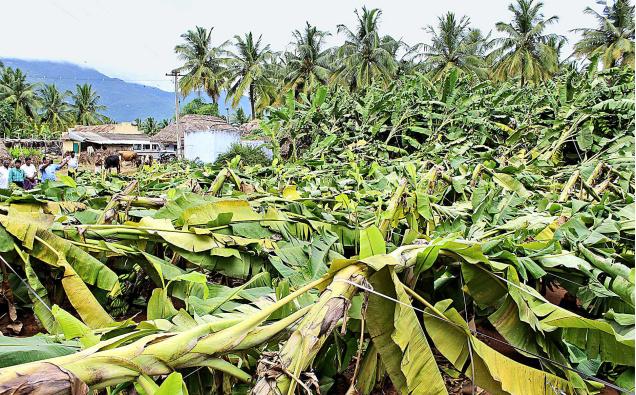
37 hectares of banana crops were affected by strong winds early Sunday in the municipality of Entre Ríos, in the Tropic of Cochabamba, reported the head of the Civil Defence in the area, Luis Gallo. According to images broadcast by Radio Fides Chapare to report on the damage caused by the weather, the roofs of five houses and other wooden infrastructure were destroyed. Unions in Isarzama and Independencia were the most affected, as five hectares of corn and bananas were damaged. The Civil Defence and the Risk Management Unit of the Municipality of Entre Ríos visited the area to check for damage and make a report on the aid that will be required. According to the report of Radio Fides Chapare, the strong winds uprooted banana plantations and even caused cracks in the walls of brick houses. Over the weekend, the SENAMHI issued a weather alert for thunderstorms in the tropics. Source - http://www.freshplaza.com

10.12.2015

USA - Crop insurance debate always in season

The crop insurance season for 2015 ends this week. If a farmer's planting of the 2015 crop was delayed or it didn't meet the guaranteed yield, an indemnity payment may be coming. But crop insurance for the future has occupied many discussions in the halls of Congress over the past several weeks, and likely will for days to come, well after it is over for this cropping season. When the House and Senate approved a two-year budget deal in early November, it eliminated a $3 billion guarantee for  crop insurance sought by the agriculture committees to keep crop insurance companies afloat in times of crop failures for farmers and severe financial stress for the companies that pay out indemnity payments. When House and Senate Agriculture committee leaders learned of the cut they told their party leaders that the ag committee members would withhold their votes for the budget deal, which could threaten its passage. In turn the House and Senate leadership agreed to restore the cuts, and that occurred Thursday. The crop insurance funds were restored and attached to the $305 billion highway funding bill. Agriculture groups seemed happy.  The president of the American Soybean Association said, “Soybean farmers across the country rely on crop insurance in times of extreme weather to ensure they can stay in business to farm in the coming year. An ill-advised $3 billion in cuts would have severely hobbled the program, and we're happy to see them reversed.” But not all agriculture groups were happy.  The editor of the Drovers Cattle Newsletter wrote the cuts should have remained. He said, “Crop insurance is one of the top enemies of beef production since it has supported ethanol-based corn acreage expansion and raised the price of range land being converted to corn. Subsidized crop insurance tips the scales toward crop production on a limited land base because it reduces risk. Put simply, when a farmer and a rancher are bidding on land, the one with the most money wins.” Angry, he was. Then there are the perennial critics of crop insurance. One of those is the Environmental Working Group which cited a study by Iowa State University ag economist Bruce Babcock which said the loss of $3 billion wouldn't kill crop insurance, but provide a more efficient delivery system. Essentially that is a system with fewer crop insurance agents to help farmers determine crop damage and file claims. But another ag economist, who is an advocate of crop insurance as a risk management tool, said future fights over crop insurance policy will have a lot of soldiers. Art Barnaby at Kansas State University said crop insurance supporters include crop insurance underwriters and agents, but also ag lenders, commodity brokers, grain elevator managers, equipment dealers, some federal employees, rural main street merchants and more. Barnaby added, “There are more players here than you might initially think. You have a bunch of people who have a dog in this fight.” Other critics on Capitol Hill already have some anti-crop insurance legislation written and introduced.  It isn't only designed to eliminate the $3 billion to entice crop insurance companies to participate, but it is designed to also eliminate a major provision that attracts farmers to use crop insurance, and also eliminate many farmers from using it. That only reduces the pool of those paying in and means taxpayers will have a bigger burden in years of crop failures. Nevertheless, that is the next proposal to modify crop insurance and it will be the next fight. Source - http://herald-review.com

10.12.2015

India - 46,000 farmers yet to get relief money

On the one hand, the state government is organising various melas and fairs to promote traditional farming, on the other it has failed to provide compensation to farmers of Uttarkashi district who lost their crops due to unseasonal rain a few months ago. The farmers are running from pillar to post to get the compensation for the rabi crops that were damaged due to hailstorm and untimely rain in March-April 2015. The district administration paid compensation to some farming families but around 46,770 farmers are left to be given a relief so far and are running from one office to another to receive the amount they should have got months ago. The state government had appointed several government officials in the district for surveying the damage incurred to the agriculture fields and make provisions for the financial compensation. Following the survey, around Rs 4.17 crore were given to the district administration for crop damage relief to be disbursed to around 18,412 families. But around 18,133 families are yet to receive compensation relief amount and awaiting it. Former MLA Gopal Rawat said the state government was talking about giving a mere Rs 1,500 per family for the crop damage, which was unjust. Social activist Lokendar Bisht said the affected families should be given the compensation without delay. Chief Minister Harish Rawat had appealed to the farmers to grow koda, jhangora etc but the farmers were not being paid compensation for the damaged crops in the district. The government was just paying lip service to curb migration but doing nothing to improve the condition of farmers, he said. Bisht demanded adequate compensation and insurance cover for farmers. Senior Congress leaders said compensation had been given to most of the farmers and the process was on to disburse the remaining amount among the people left. Source - http://www.tribuneindia.com

09.12.2015

Ghana - How protected is the farmer?

Ghana recently celebrated her ‘professionals’ who put food on her table. I am sure most of us, especially in urban and peri-urban Ghana, have no idea where the maize we consume comes from. In fact we consume chicken almost on a daily basis but have no idea what the poultry farmer goes through to get the delicacy on our tables. Indeed we are not bothered with the source of food so long as it is healthy and we can afford it. However, there is the need to worry our heads over the weather change especially and its effect on the farmer. How the farmer is able to finance crop cultivation, animal rearing and ultimately how he pays back the loans in the face of recurring climate change should be at the fore of our thoughts. It is needless to say agriculture remains the mainstay of many economies, including Ghana. Thus, the sector remains a dominant force in the country’s economic development, as it employs over 50 per cent of the population. Sadly its contribution to the country’s Gross Domestic Product (GDP) has dwindled to 19 per cent this year against 21.5 per cent in 2014. The many challenges the sector is fraught with such as unreliable rainfall patterns, poor climatic conditions, continuous reliance on outmoded technologies, and poor storage and processing infrastructure among others have become a source of worry to the farmers themselves and policy-makers by extension. This, therefore, endangers the source of livelihood of both large-scale commercial farmers and small-scale peasant farmers in particular, as they tend to record poor yields and often are unable to repay contracted loans. In recognition of the enormity of these challenges, therefore, the Ghana Insurers Association (GIA) established the Ghana Agricultural Insurance Pool (GAIP) to address the myriad of issues threatening the Agric sector, but the sustainability of this project still requires continuous efforts on the part of farmers themselves. The IIPACC project To mitigate the risks associated with the agricultural sector, the German Development Cooperation (GIZ) in concert with other relevant stakeholders, established a project, dubbed “Innovative Insurance Products for the Adaptation to Climate Change” (IIPACC). The project, which started in December 2009, sought to facilitate the development and introduction of agricultural insurance for farmers in the form of an innovative, demand-oriented and economically sustainable agricultural insurance product. It is also expected to facilitate the development of other innovative agricultural risk mitigation products, particularly, through investments in meteorological infrastructure to improve data collection and analysis, under the joint supervision of the National Insurance Commission (NIC) and the GIZ-IIPACC, in collaboration with the GIA. The project is targeted at farmers, agro-processors, rural and financial institutions and input dealers, among others, so that compensation is paid them in the event of crop failure due to extreme weather conditions such as drought, excess rainfall and floods. Drought index insurance product Similar to the IIPACC Project, the GAIP in collaboration with relevant stakeholders, also introduced the Crop Drought Index Insurance (CDII), as a risk-mitigating mechanism, which works on the basis of rainfall measured at weather stations operated by the Ghana Meteorological Agency (GMet). Thus, it provides protection to beneficiaries against the negative effects of extreme weather events; thereby helping farmers and their financiers to manage drought risks. It also provides a comprehensive insurance cover for all the growth stages of crops. With a focus on the local farmer, the product employs simple language terminologies to interface with beneficiaries to ensure message clarity and thus, avoid ambiguities with claims expectations. Expected gains from GAIP The current membership of the GAIP comprising 19 non-life insurance companies in Ghana and operating under the guidance of the GIA remains unchanged. While making access to loans from the banks a lot easier for farmers, the pool also ensures that crop revenue, particularly during adverse weather,  is not lost and thus, the farmer will remain in business in spite of the disaster. Invariably, in the event of losses owing to adverse weather, the farmers will not directly be liable as the banks will fall on the insurers to recoup the credits advanced. Moreover, the pool offers protection for the investment of agricultural-input suppliers in relation to inputs such as seeds and fertilisers. Thus, in the event of crop failure owing to bad weather conditions, these input suppliers would be paid claims by GAIP, based on their contract. Claims under GAIP In October 2012, about 140 farmers mainly in the Northern and Upper regions of Ghana were the first to receive claims under the Drought Index Insurance product, offered by the GAIP. The farmers received compensation for losses due to inadequate rainfall within their areas. For instance, farmers around Pong Tamale did not have adequate rainfall during the growth stage of their maize. The weather station, thus, measured 17 consecutive dry days during which the farmers hardly received any rainfall, which consequently affected the maize harvest. Unlike conventional crop insurance that requires many physical inspections and risk assessments of every individual farmer’s field, the Drought Index Insurance uses rainfall measured at a weather station as a proxy for determining the basis for claims. Instructively, the GAIP kept faith with its obligation to the farmers by paying their claims promptly in order to demonstrate to all stakeholders about GAIP’s preparedness to be a trustworthy partner in the agric sector. Source - http://graphic.com.gh

09.12.2015

India - Mitigate drought, save Telangana

Reeling under a prolonged dry spell, Telangana has declared 231 mandals as drought-hit.  An unprecedented crisis is gripping Telangana as farmers and rural folks are at a loss to cope with the drought.  Not waiting for the central aid of Rs 2,514 crore as sought by it, the State government needs to urgently ground such measures as would help sustain livelihoods in the countryside.  Depleting water tables call for less water-intensive crops.  To lessen rural distress, macro-economic diversification activities such as protection of livestock, launch of rural infrastructure and agro forestry schemes, besides waiver and rescheduling of farm loans, is an immediate imperative to provide succour to rural populace and save them from hunger, deaths and suicides    The central team is visiting Telangana to assess the conditions of drought prevailing in the State. The State is reeling under a widespread drought, seriously impairing agricultural production and livelihoods in the countryside. The drought is already showing adverse impact on the state economy, too, with reports of tax collections falling. Adequate rainfall in the month of June raised hopes of normal monsoon, motivating the farmers in the State to go for sowing season. But, due to prolonged dry spell in July and August months, crops have dried up in many parts of the State. The food production is also expected to register a steep fall. The groundwater levels have registered a steep depletion with no additional replenishment. In fact, years of neglect of irrigation has already led to unsustainable use of groundwater in Telangana. Further depletion of groundwater causes agrarian distress in a state which depends disproportionately on groundwater to irrigate.  Besides, this situation portends an   environmental disaster.  Drinking water scarcity is turning acute, resulting in the need for supply through tankers. The State government has declared 231 mandals as drought-hit.  In a memorandum submitted to the visiting central team, the Telangana State government sought central assistance of about Rs 2,514 crore to tide over the acute drought situation. It is estimated that paddy cultivation during this Kharif declined by nearly half. Delayed sowing would result in fall in yield. The rice production in the State is expected to further decline this year, perhaps, forcing the State to import rice. There are no hopes of Rabi also due to prolonged dry spell.  Even the pulses cultivation has also declined.  Similar is the fate with oilseed cultivation. Dry spell in August and September months has damaged about 70 per cent of oilseed crops in the State. It is estimated that overall crop loss due to drought is around 50 per cent. Telangana has been experiencing consecutive years of drought since 2010-11. Rainfall for the Rabi season is also disappointing with a very high deficit in the months of October and November. Thus with the onset of summer next year, the drought conditions in the State would turn much more acute. Notwithstanding the quantum of central assistance, the State government should initiate immediate measures to mitigate the sufferings of the people due to cumulative impact of successive years of drought. Drought manifests in many forms on the social and economic landscape. They include  significant deficiency in rainfall, gross uneven spread of rain and prolonged dry spells, steep reduction in area sown and also heavy damage to standing crops,  fall in the estimated yields of crops,  considerable fall in extent of grain and fodder supply, abnormal increase in prices,  fall in current agricultural and non-agricultural wages as compared to normal times, drying up of operating bore wells, severe shortage of drinking water, fresh migration of people in search of livelihood, sale of cattle to slaughter houses,  sale and mortgaging of household gold ornaments, fall in school attendance and drop outs, increasing levels of protein deficiency due to low food intake, fall in per capita consumption, loss of work for artisans, increasing crime rate etc. Thus, the implications of drought need to be studied in a holistic manner to evolve a comprehensive drought mitigation plan. Drought-induced agrarian distress leaves peasantry with increased debt burden. The growing indebtedness is already identified as the main cause of a growing number of farmers committing suicide. The fiscal distress in agrarian families would mount in the years of drought. Therefore, rescheduling of loans due for repayment to the financial institutions should be done immediately to prevent further spurt in farmer suicides. As farmers lost their investment in the drought-affected areas with little or no crop insurance, the interest on farm loans should be waived as a drought relief measure. The natural conditions should dictate cropping pattern. Therefore, a contingency plan focusing on alternate crops is required. The government should supply free seeds and fertilisers to sow alternate crops keeping in view the availability of water resources. Short duration crop varieties should be encouraged. As the bore well technology is not regulated, the rich appropriate groundwater at the expense of poor. In periods of acute drinking water scarcity, access to common property resources like groundwater should be shared. Therefore, the government should even commission private bore wells wherever necessary. As agricultural incomes are unstable and uncertain, animal rearing provides sustainability to rural economy. But such allied sectors, too, are affected. The drought makes fodder availability more acute. Fodder banks need to be set up to save at least the existing cattle and prevent their sale to slaughter houses. Distribute dry fodder by producing paddy straw and jowar straw from surplus pockets within the affected areas or the neighbouring areas to meet the immediate requirements in the drought-hit areas. The fodder should be produced within the district anticipating the drought conditions. It can be produced in farmers’ fields, command areas, tank beds etc.  Small and marginal farmers should be encouraged to grow fodder.  Supply mineral, mixture, urea molasses blocks, cattle feed etc. Cattle camps should be organised where the distress is widespread and acute at places where water resources are available.  In chronic drought-affected areas, development of permanent fodder resources should be given adequate attention. In hours of such rural distress, non-farm employment plays an important role in sustaining rural livelihoods. The disadvantage should be turned into an advantage by using the rural labour to take up works related to rural infrastructure like improvement of tanks, rural roads, land development works, agro forestry , conservation works etc.  Special nutrition programme targeting vulnerable groups like children, pregnant and lactating mothers, old and sick should be implemented. As the World Bank pointed out, drought sets off a vicious cycle of socio-economic impacts beginning with crop yield failures, unemployment, erosion of assets, decrease in income, worsening of living conditions, poor nutrition and subsequently decreased risk absorptive capacity and thus increase vulnerability of the poor to another drought and other shocks. The human and social costs of drought have been and remain devastating for the millions of people.  Impacts of drought vary greatly across locations and crops depending on drought severity, demanding more specific policy interventions. The losses borne by farmers due to drought can be significantly decreased by adjustments in farming practices that reduce water demand such as permanent shift to a larger share of less water-intensive crops. The drought coping measures need to be location-specific. Macro-economic drought adaptation strategy should include a diversification of economic activity reducing the reliance on agriculture. There is an urgent need for a supporting institutional and policy framework with the involvement of all levels of government for drought adaptation planning and action. Source - http://www.thehansindia.com

09.12.2015

Australia - Crop losses from SA fire reach $24m

South Australian farmers hit by the bushfire north of Adelaide have lost crops worth about $24 million. Unharvested wheat crops bore the brunt of last month's blaze, with more than 22,000 hectares destroyed, worth at least $15 million, Primary Industries SA said. More than 30,000 tonnes of hay, worth about $8 million, was also lost. The bushfire claimed two lives, destroyed close to 500 buildings and burnt through about 82,000 hectares in late November. Source - https://au.news.yahoo.com

09.12.2015

USA - Farm bill reopening threats remain

There have been four attempts to re-open the 2014 Farm Bill this year. The first, crop insurance cuts, will be erased with the highway bill deal. As the omnibus appropriations bill goes into the final stretches before being filed sometime early the week of Dec. 7, three other farm bill re-openers remain pending. The budget deal passed last month contained $3 billion in cuts to the crop insurance program, with promises to fix the cut in passage later this year. On Dec. 1 the negotiated text of the long-term highway bill included language to restore the crop insurance cuts, gaining praise from agricultural interests. House and Senate agriculture committee leaders were united and unwavering in their opposition to the cuts when it was proposed last month and had secured promises from Congressional leadership that the farm bill would not be reopened. "I appreciate the dedication to America’s farmers shown by our leadership in ensuring crop insurance remains the number one tool in our producers’ risk management tool box,” said Senate Agriculture Committee chairman Pat Roberts, R-Kan. The underlying House agriculture appropriations bills re-opens the conservation title of the 2014 Farm Bill and cuts farm bill mandatory spending for working lands conservation by over $600 million for FY 2016. The underlying House bill also re-opens the commodity title in an attempt to allow a small handful of the largest cotton farms in the country to evade the farm bill's payment limitations, and delays the application of conservation requirements to receipt of crop insurance premium subsidies by a year. In a speech on the Senate floor, Sen. Chuck Grassley, R-Iowa, explained the importance of not reopening the farm bill in the omnibus spending bill. Section 739 of the House Agriculture Appropriations Bill reauthorized commodity certificates which he said are a way around payment limits. “The language in the House bill specifically directs USDA to administer commodity certificates as they were in 2008 when they were not subject to any payment limits at all.” Omnibus bills can push through many provisions that wouldn’t be approved in regular circumstances. “If the agriculture community wants to be taken seriously, we should heed our own advice and not reopen the Farm Bill by reauthorizing commodity certificates,” the long-time payment limit champion Grassley said. The underlying Senate agriculture appropriations bill does not re-open the payment limits or conservation compliance issues, but does re-open the conservation title to cut nearly $400 million from working lands conservation programs for this fiscal year. Source - http://farmfutures.com/

09.12.2015

India - Growers hit as virus affects chilli crop

After soyabean and oranges, chillies are adding to farmers' woes. Grown in patches across Vidarbha, the chilli crop is reported to have been hit by a virus. The infection may bring the yield down by almost 50%, say sources in the trade. Not only those in Vidarbha but even growers in Madhya Pradesh have been hit by the virus, where the crisis is reported to be worse. The Bhiwapur and Kuhi-Mandhal areas of Nagpur district are famous for their variety of chillies. Though it is also grown in small patches throughout the region. Sources in the trade say farmers in Bhiwapur near Umred may be able to tide over the crisis, as they have increased the area under the crop. However, those in Kuhi-Mandhal and other areas of the region may face substantial losses. Bhaskar Mahakular of Maregaon Tehsil in Yavatmal said his loss was abolsute and he had come to Delhi with samples of the crop to identity the virus strain through a DNA test. "I had sowed chillies on 10 acres. Normally the average yield comes to 10 quintals an acre, this time it may be negligible," he said. The crop was growing in Yavatmal-Chandrapur on about 5,000 hectares, he said. Subhan Usman, a trader in Bhiwapur, said the virus attack may bring crop down by 30% to 50%. This time the area under chilli cultivation has grown, so the impact may be absorbed. However, in Kuhi the losses are more. Another trader from Kuhi added that the area under chilli had actually come down as farmers here preferred cotton instead. An official in the state's agriculture department dealing with vegetable cultivation said there had been an attack of the churda-murda virus. Source - http://www.nyoooz.com

904
of 1224